
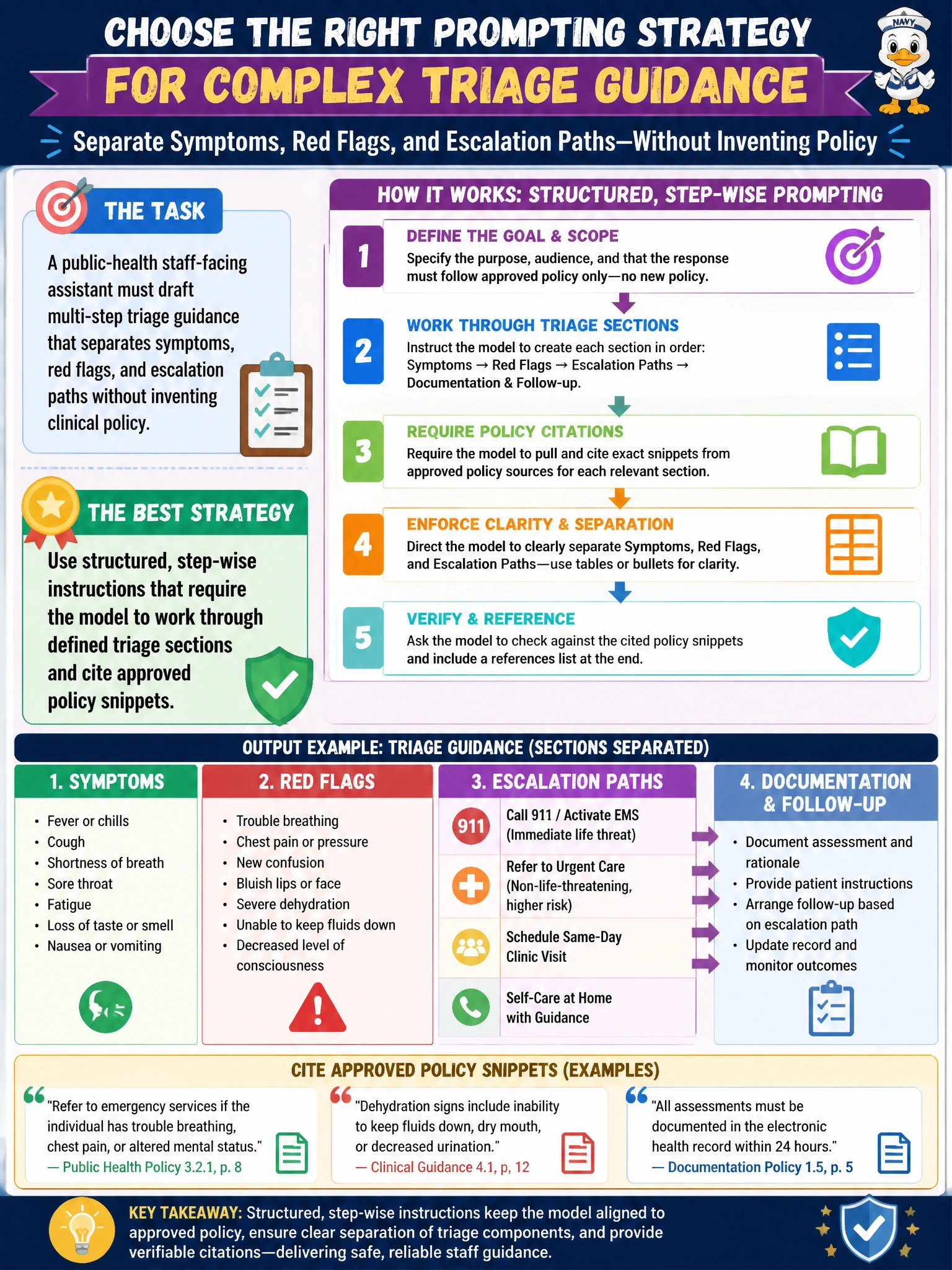
A public-health staff-facing assistant must draft multi-step triage guidance that separates symptoms, red flags, and escalation paths without inventing clinical policy. Which prompting strategy best supports that complex drafting task?
Select an answer to reveal the explanation.
Short Explanation
A triage nurse uses a checklist—symptoms, red flags, escalate—not a blank napkin. Structured step-wise prompts give the FM that same checklist and force citations from approved policy. Empty prompts or dumping every PDF into one blob is how you get mushy guidance.
Full Explanation
Staff-facing public-health assistants that must draft multi-step triage guidance—symptoms, red flags, escalation paths—without inventing clinical policy need structured, step-wise prompting that forces ordered sections and citations to approved policy snippets. Advanced prompting patterns improve completeness and auditability: the model works through defined headings and grounds each escalation statement in retrieved sanctioned text rather than free improvisation. Sending an empty user message and relying on unprompted invention maximizes hallucination risk and fails policy grounding. Concatenating every historical outbreak PDF into one unstructured mega-prompt without sectioning overwhelms context, muddies which edition is authoritative, and still lacks an ordered triage skeleton. Replacing prompting with unsupervised training of a new clinical foundation model each morning is operationally absurd, medically unsafe, and unrelated to controlled drafting from approved policy. Exam caveat: complex multi-section civic drafts point to structured step-wise grounded prompts, not empty prompts, PDF dumps, or daily model training. Operational check: encode triage section headings in the template, require citation IDs from the approved policy index, block send without citations on escalation language, and have clinical policy owners review template changes before staff-facing release.