
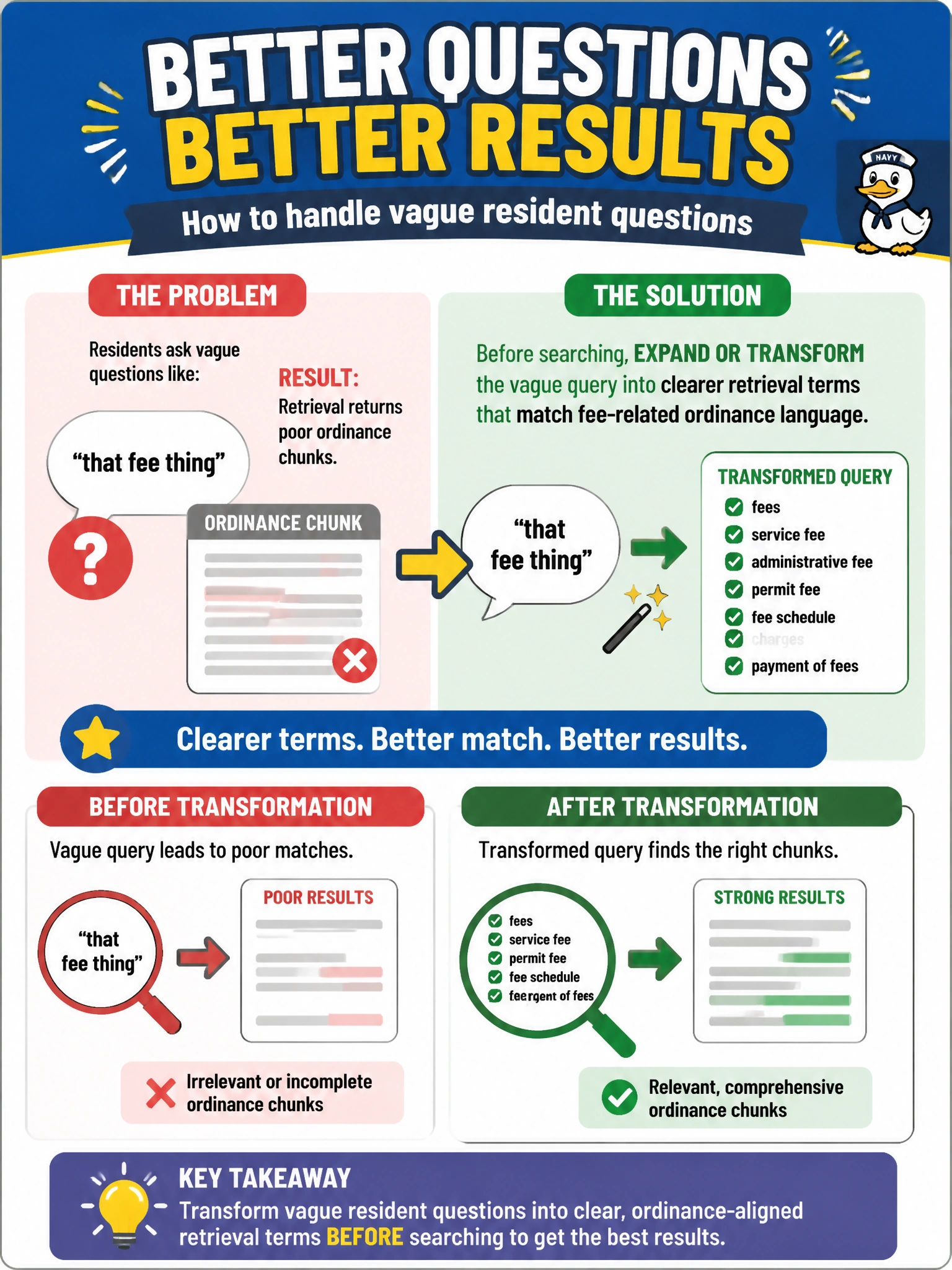
Residents often ask a clerk bot vague questions such as “that fee thing,” which retrieve poor ordinance chunks. Which retrieval technique should the team apply before searching?
Select an answer to reveal the explanation.
Short Explanation
‘That fee thing’ is a shrug in text form. Expand it into clearer search language — filing fee, recording fee, hearing fee — so retrieval can actually find the right ordinance shelf.
Full Explanation
Vague resident questions such as “that fee thing” rarely match ordinance language well. Before searching, the team should expand or transform the vague query into clearer retrieval terms aligned with fee-related ordinance wording—filing fees, recording fees, hearing fees, remittance schedules, and related clerk terminology. Query expansion or rewriting improves recall for clerk-bot RAG without forcing residents to speak in statute citations, and it keeps the vector store focused on precise municipal fee rules.
Rejecting every short question and forcing scanned deed uploads fails accessibility and still does not teach the retriever better terms for legitimate fee inquiries. Sending the vague phrase unchanged while only lowering the similarity threshold fails conceptually: a lower threshold admits more noise without clarifying intent, so unrelated property or tax chunks can flood the prompt. Disabling the vector store and answering from an ungrounded FM guess fails municipal accuracy and audit needs whenever fee amounts or conditions are at stake.
Exam caveat: Query transformation/expansion is a legitimate pre-retrieval technique for short, ambiguous civic questions and is preferred over threshold hacking or abandoning grounding.
Operational check: log vague queries and their expansions, measure ordinance hit-rate before/after rewriting, maintain a controlled synonym list for fee types reviewed by the clerk’s office, block expansions that drift into unrelated tax topics, and require periodic human review of rewritten queries that retrieve low-confidence chunks.