
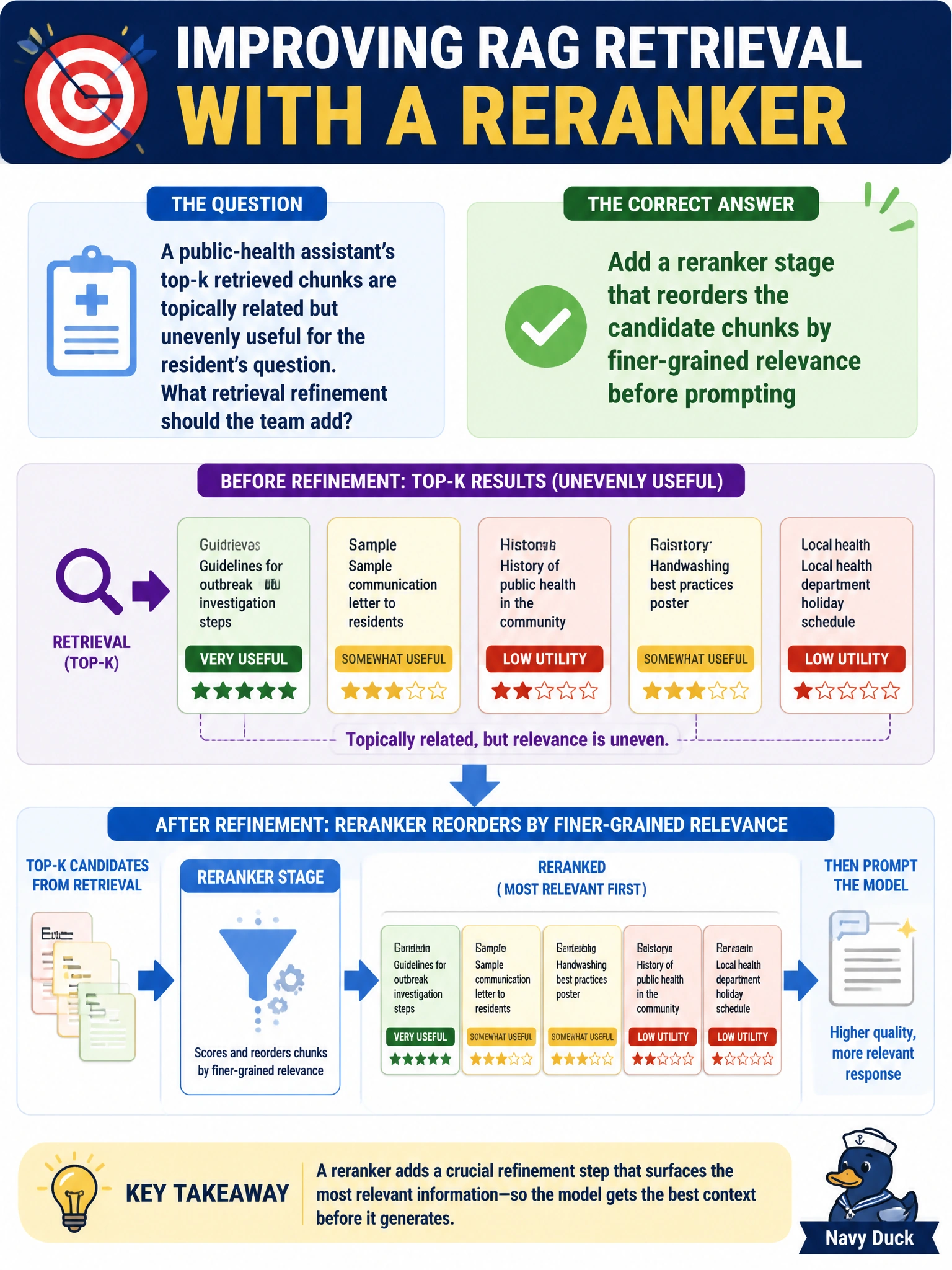
A public-health assistant’s top-k retrieved chunks are topically related but unevenly useful for the resident’s question. What retrieval refinement should the team add?
Select an answer to reveal the explanation.
Short Explanation
First-pass retrieval is a wide net; the reranker is the sorter on the dock. It promotes the chunks that actually answer the health question so the FM isn’t distracted by near-miss neighbors.
Full Explanation
When a public-health assistant’s top-k chunks are topically related but unevenly useful, a reranker stage should reorder candidates by finer-grained relevance before prompting. Bi-encoder retrieval casts a wide net across guidance documents; a cross-encoder or comparable reranker promotes the chunks that best answer the resident’s specific question so the FM is not distracted by near-miss neighbors from adjacent programs or outdated flyers. That refinement improves answer faithfulness for health guidance without abandoning retrieval or inventing clinical policy.
Increasing FM temperature so weaker chunks influence answers more randomly worsens reliability and can amplify marginal guidance. Dropping retrieval to answer only from pretrained knowledge removes grounding in department-issued materials residents expect. Randomly shuffling top-k for perceived “fairness” actively harms relevance ordering and is inappropriate for public-health accuracy where the best evidence must surface first.
Exam caveat: Reranking is a standard retrieval refinement between first-stage recall and generation—distinct from temperature tuning, and commonly tested as the fix when top-k is noisy but not empty.
Operational check: A/B evaluate with/without reranker on a held-out health question set, cap how many reranked chunks enter the prompt, monitor added latency against the chat SLA, calibrate score thresholds per program, and alert if reranker scores diverge sharply from first-stage scores (possible index skew or stale embeddings).