
A housing RAG assistant receives multi-part resident questions that mix eligibility, waitlist status, and document requirements. What retrieval pattern best handles that complexity?
Select an answer to reveal the explanation.
Short Explanation
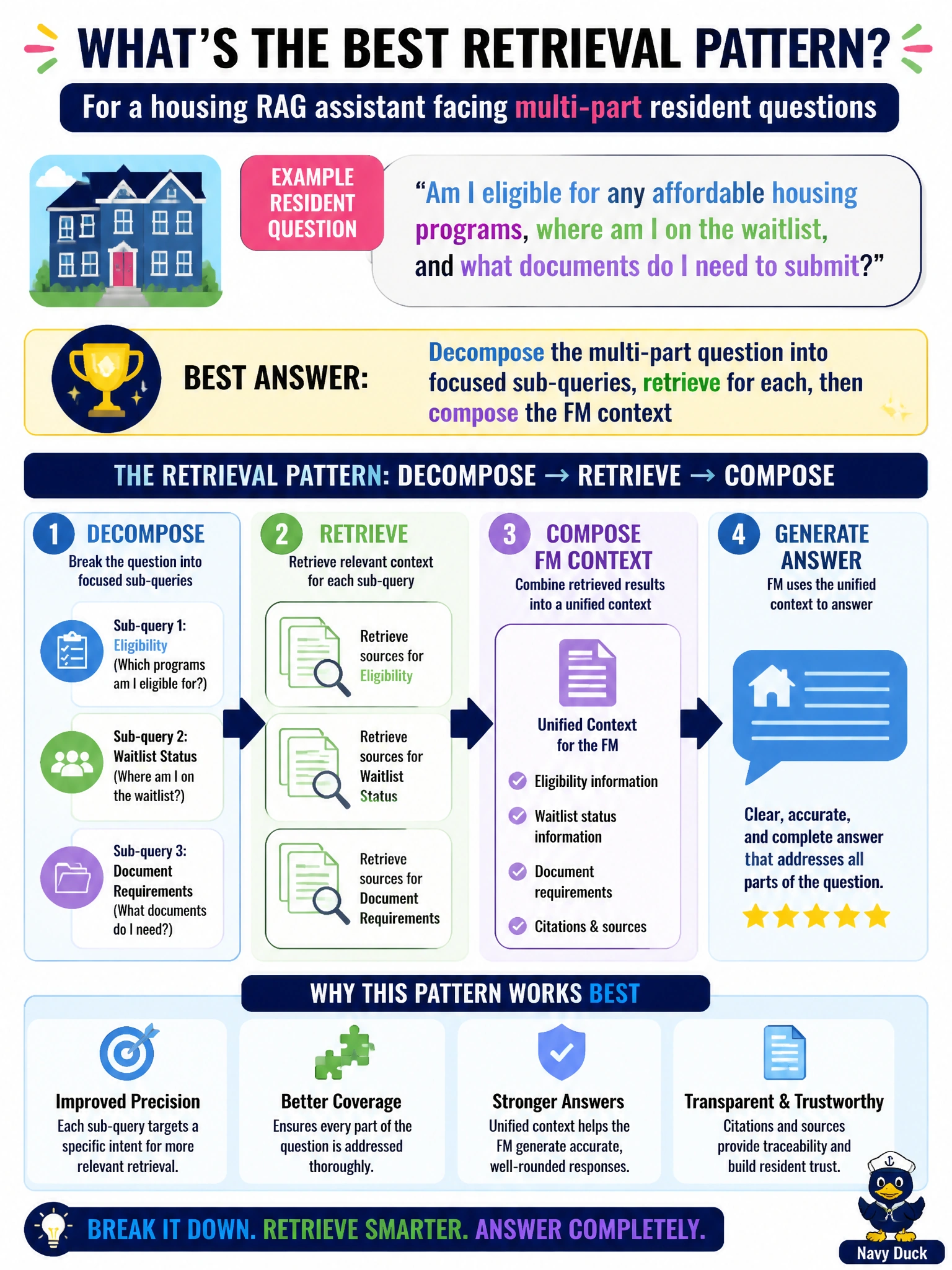
When a resident asks about eligibility, waitlist status, and documents, you have three needs to cover. Use decomposition: retrieve evidence for focused sub-queries, then compose one coherent reply.
Full Explanation
Multi-part housing questions that mix eligibility, waitlist status, and document requirements should not be treated as one opaque retrieval unit. Decompose the question into focused sub-queries, retrieve evidence for each intent, and compose the FM context from the combined results. This covers each resident concern—who qualifies, where they stand in the waitlist process, and which documents are required—instead of relying on one passage that may answer only one part. Embedding the full resident question as one query and retrieving a single top-ranked passage can dilute similarity across mixed intents and leave later clauses under-served. Answering only the first clause and silently ignoring the rest fails to address the resident’s full request and can prompt avoidable repeat contacts. Collapsing all housing policies into one FAQ blurb oversimplifies program rules and loses distinctions among eligibility, waitlist, and documentation policies. Exam caveat: Multi-intent decomposition is a retrieval-planning pattern; it does not mean skipping RAG or compressing policy into one static blurb. Practical check: Detect multi-intent questions with lightweight classification or rules, retrieve for each detected intent, and check coverage of every part before release. Track partial-answer complaints and verify that the composed context stays within token limits without dropping evidence for a required intent.