
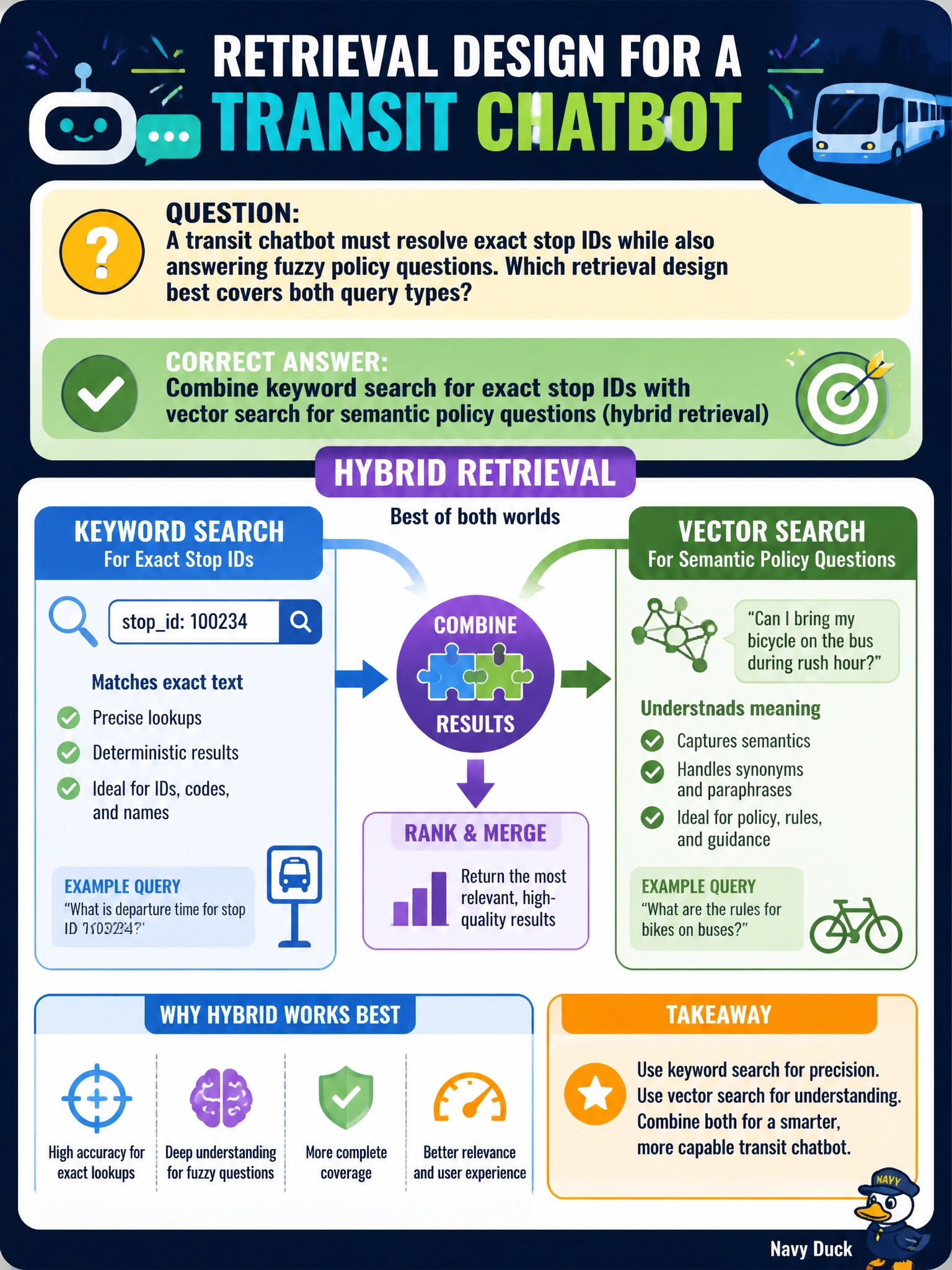
A transit chatbot must resolve exact stop IDs while also answering fuzzy policy questions. Which retrieval design best covers both query types?
Select an answer to reveal the explanation.
Short Explanation
Stop ID 4521 is a license plate — you want exact match. ‘What’s the pet policy on the ferry?’ is a vibe question — you want vectors. Hybrid search gives you both tools in one toolkit.
Full Explanation
A transit chatbot that must resolve exact stop IDs and also answer fuzzy policy questions needs both lexical precision and semantic recall. Hybrid retrieval—keyword (or exact-match) search for stop identifiers plus vector search for policy language—covers both query types in one design. Stop IDs behave like structured keys; pet policies and fare rules behave like natural-language questions. Hybrid is the pattern that serves both without forcing one tool to do the other’s job.
Using vector search only and forbidding exact-match lookup fails when IDs are brittle under embedding noise. Using keyword search only and discarding semantic retrieval fails on paraphrased policy questions. Ignoring retrieval and hard-coding every stop ID and policy paragraph into the system prompt fails to scale and to stay current as stops and policies change.
Exam caveat: Hybrid retrieval is the standard answer when workloads mix exact identifiers and semantic civic questions.
Operational check: route ID-like queries to keyword/exact lookup, route policy phrasing to vectors (or fuse scores), measure stop-ID exact accuracy separately from policy RAG scores, and refresh both indexes when GTFS stops or policy pages change.