
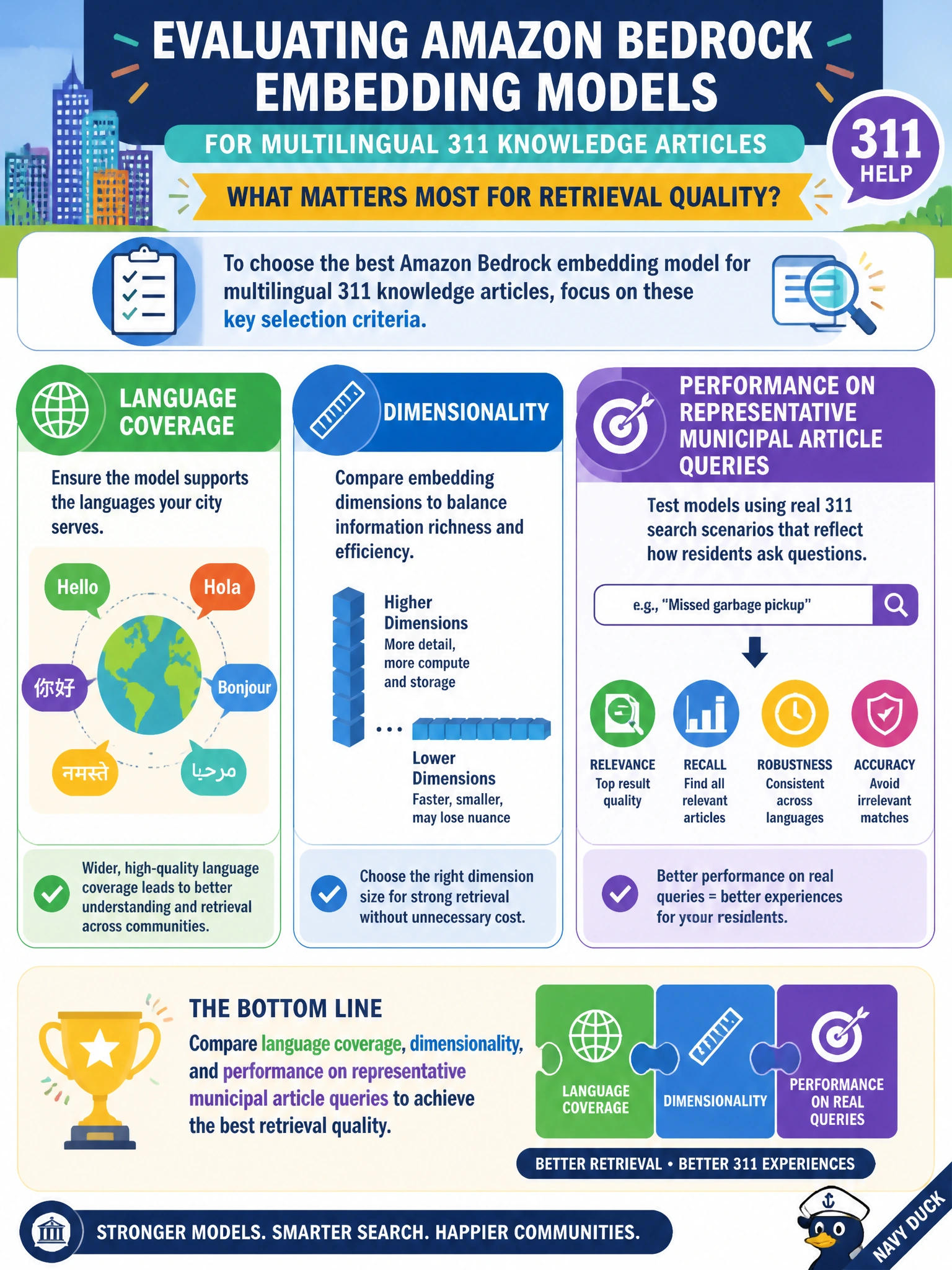
A city evaluates Amazon Bedrock embedding models for multilingual 311 knowledge articles. Which selection criteria matter most for retrieval quality?
Select an answer to reveal the explanation.
Short Explanation
Multilingual 311 articles need an embedding model that actually speaks those languages — not just the cheapest sticker. Test coverage, dimensions, and real city queries before you lock the choice.
Full Explanation
Selecting Amazon Bedrock embedding models for multilingual 311 articles should be driven by retrieval quality factors: language coverage, embedding dimensionality/tradeoffs, and measured performance on representative municipal queries in the languages residents actually use. Comparative evaluation on civic article sets beats marketing, English-only legal pretraining assumptions, or price-only selection when the corpus is multilingual.
Choosing the embedding model with the flashiest marketing name regardless of language coverage fails as an evaluation method. Preferring embeddings trained only on English legal opinions for every 311 language fails multilingual retrieval for non-English articles and queries. Selecting solely by lowest price without testing civic query languages fails to validate that cheap embeddings actually retrieve the right municipal articles.
Exam caveat: Embedding model choice is an empirical retrieval decision under language and domain constraints, not a brand or cost-only shortcut.
Operational check: build a multilingual 311 judgment set, compare recall@k and MRR across candidate Bedrock embedding models, include dimensionality/latency/cost as secondary factors, and lock the model only after language-coverage gaps are acceptable.