
A permitting RAG system retrieves poor answers from long zoning ordinances when chunks ignore section boundaries. Which segmentation approach should the team adopt?
Select an answer to reveal the explanation.
Short Explanation
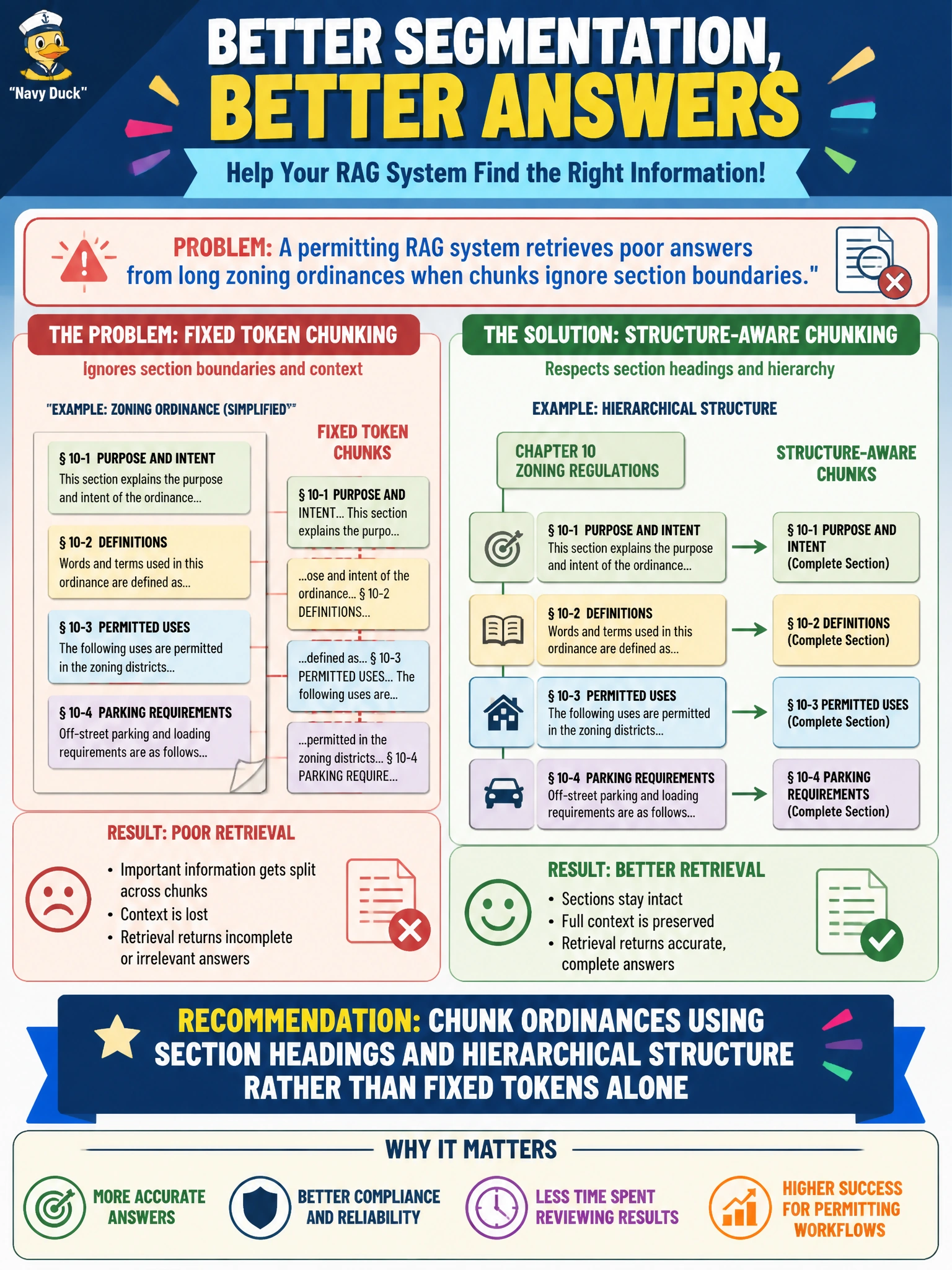
Zoning text has natural chapter breaks — cut on the headings, not with a blind ruler. Structure-aware chunks keep a complete rule together so retrieval doesn’t hand the FM half a sentence from two different sections.
Full Explanation
Long zoning ordinances retrieve poorly when chunking ignores section boundaries and splits rules mid-thought. The team should chunk using section headings and hierarchical structure rather than fixed token lengths alone, so each vector tends to represent a coherent regulatory unit the FM can apply. Structure-aware segmentation improves permitting RAG precision for municipal zoning questions.
Using only random 50-character slices ignores ordinance structure and yields incoherent fragments. Embedding each entire multi-hundred-page ordinance as a single vector fails because similarity becomes too coarse and the FM cannot isolate the governing section. Replacing chunking with classical k-means on parcel tax amounts fails conceptually—tax clustering is unrelated to textual segmentation of zoning law.
Exam caveat: Chunking strategy is a first-class retrieval-quality decision; structure-aware chunks beat naive fixed windows for legal/regulatory corpora.
Operational check: evaluate answer accuracy on section-specific zoning questions before/after structure-aware chunking, inspect chunk boundaries at heading breaks, avoid oversized mega-chunks, and re-chunk when the ordinance outline is reorganized.