
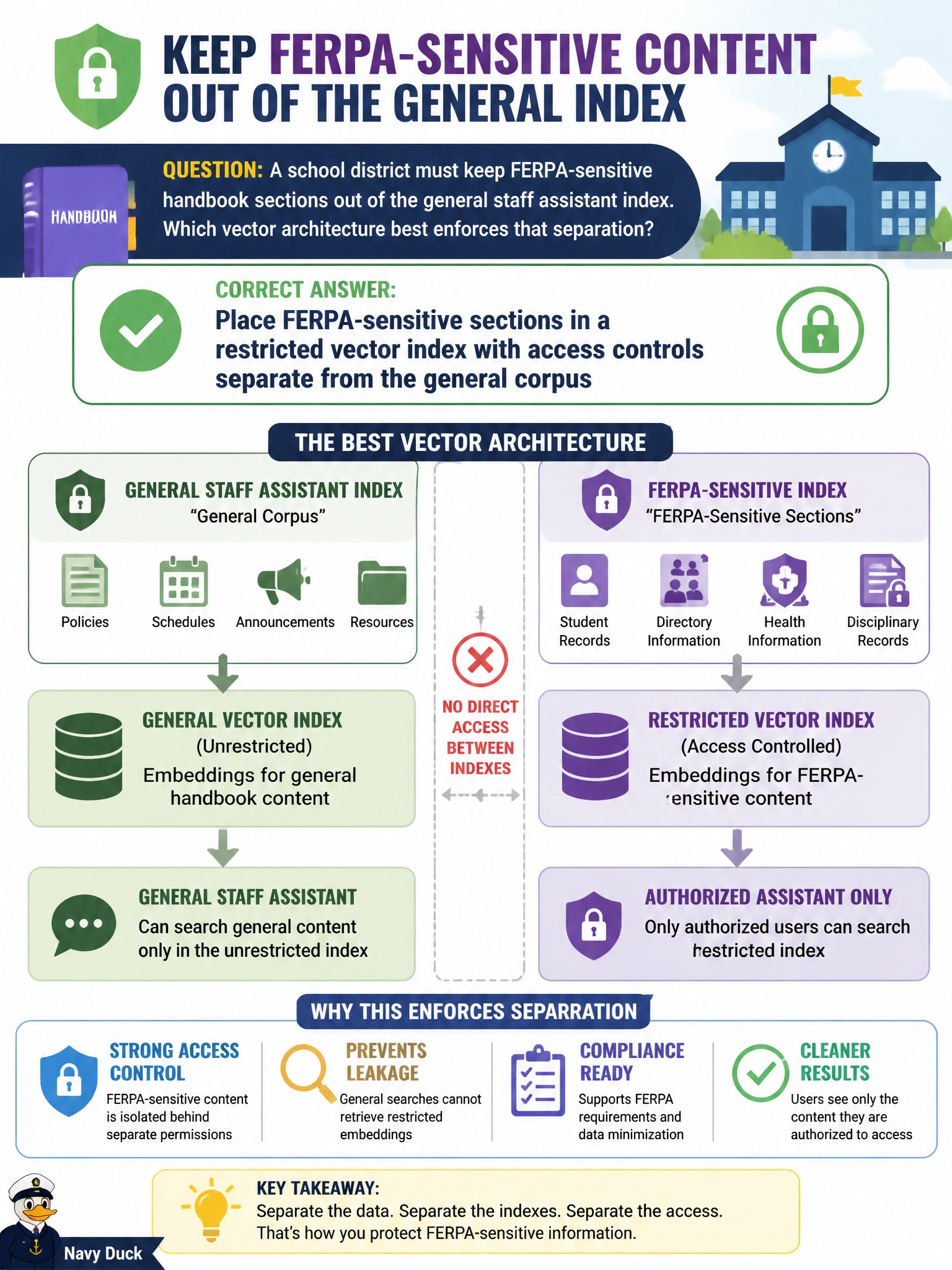
A school district must keep FERPA-sensitive handbook sections out of the general staff assistant index. Which vector architecture best enforces that separation?
Select an answer to reveal the explanation.
Short Explanation
Sensitive handbook bits get their own locked drawer, not the open staff bookshelf. A restricted vector index with real access controls beats hoping a polite prompt keeps FERPA data out.
Full Explanation
A school district must keep FERPA-sensitive handbook sections out of the general staff assistant index. The enforceable architecture is a restricted vector index (or equivalently isolated collection) with access controls separate from the general corpus. Separation at the store and IAM/application authorization layer prevents ordinary staff queries from retrieving protected student-privacy content, whereas prompt etiquette alone cannot.
Mixing sensitive and public sections in one index and relying on prompt wording alone fails because retrieval can still surface FERPA chunks regardless of polite instructions. Publishing all handbook sections to an anonymous public knowledge base fails confidentiality completely. Disabling retrieval and answering student-privacy questions from pretraining alone fails accuracy and still risks inappropriate generalizations without district policy grounding—or worse, invented policy.
Exam caveat: Sensitive civic/education data needs index isolation and access control, not prompt-only “safety theater.”
Operational check: penetration-test that general-role credentials cannot query the restricted index, log access to sensitive retrieval, classify handbook sections at ingest, and review quarterly that new FERPA sections land only in the restricted store.