
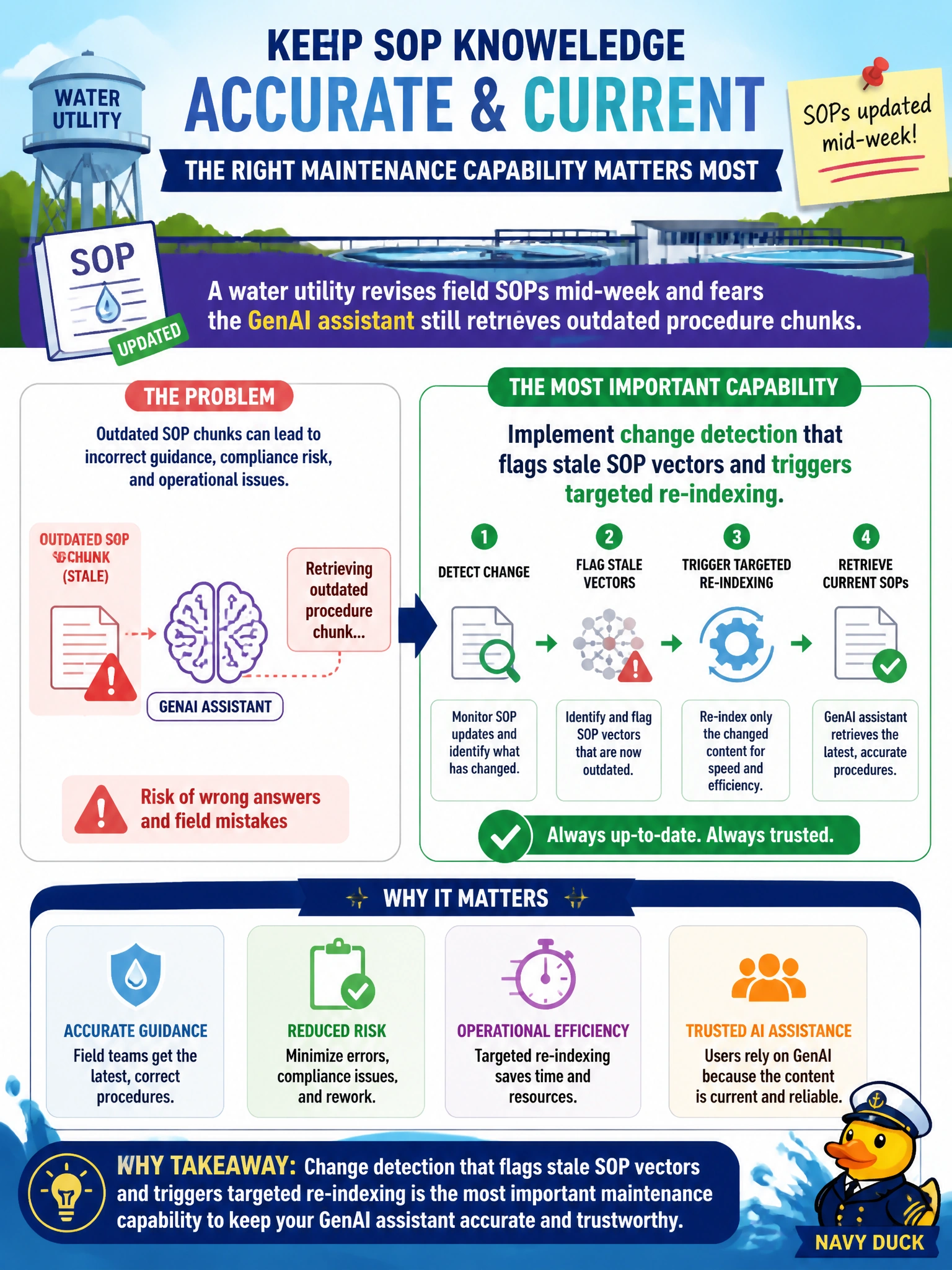
A water utility revises field SOPs mid-week and fears the GenAI assistant still retrieves outdated procedure chunks. What maintenance capability is most important?
Select an answer to reveal the explanation.
Short Explanation
If the field crew rewrote the hydrant steps on Wednesday, Tuesday’s vectors are leftovers in the fridge. Change detection spots stale SOP chunks and kicks a targeted re-index before someone follows the old playbook.
Full Explanation
When a water utility revises field SOPs mid-week, the GenAI assistant will keep retrieving outdated procedure chunks unless the vector store can detect staleness and re-index targeted content. Change detection that flags stale SOP vectors and triggers targeted re-indexing is the maintenance capability that protects field crews from obsolete hydrant, valve, or safety steps. Version-aware freshness beats hoping the model “just knows” the new procedure.
Increasing FM max tokens so longer outdated SOP text is always included fails—it increases the chance of citing obsolete content rather than fixing freshness. Removing all SOP version identifiers simplifies the schema but destroys the ability to reason about currency. Switching exclusively to on-demand fine-tuning after every field edit without updating vectors fails conceptually: fine-tuning is the wrong, slow lever for SOP text updates compared with re-embedding changed chunks.
Exam caveat: Vector freshness and change detection are core RAG operations topics; model fine-tuning is not a substitute for index maintenance.
Operational check: compare SOP document etags/versions to indexed chunk versions, auto-requeue changed SOP IDs, block answers that cite superseded versions when a newer vector exists, and audit weekly for any live answer referencing retired procedure IDs.