
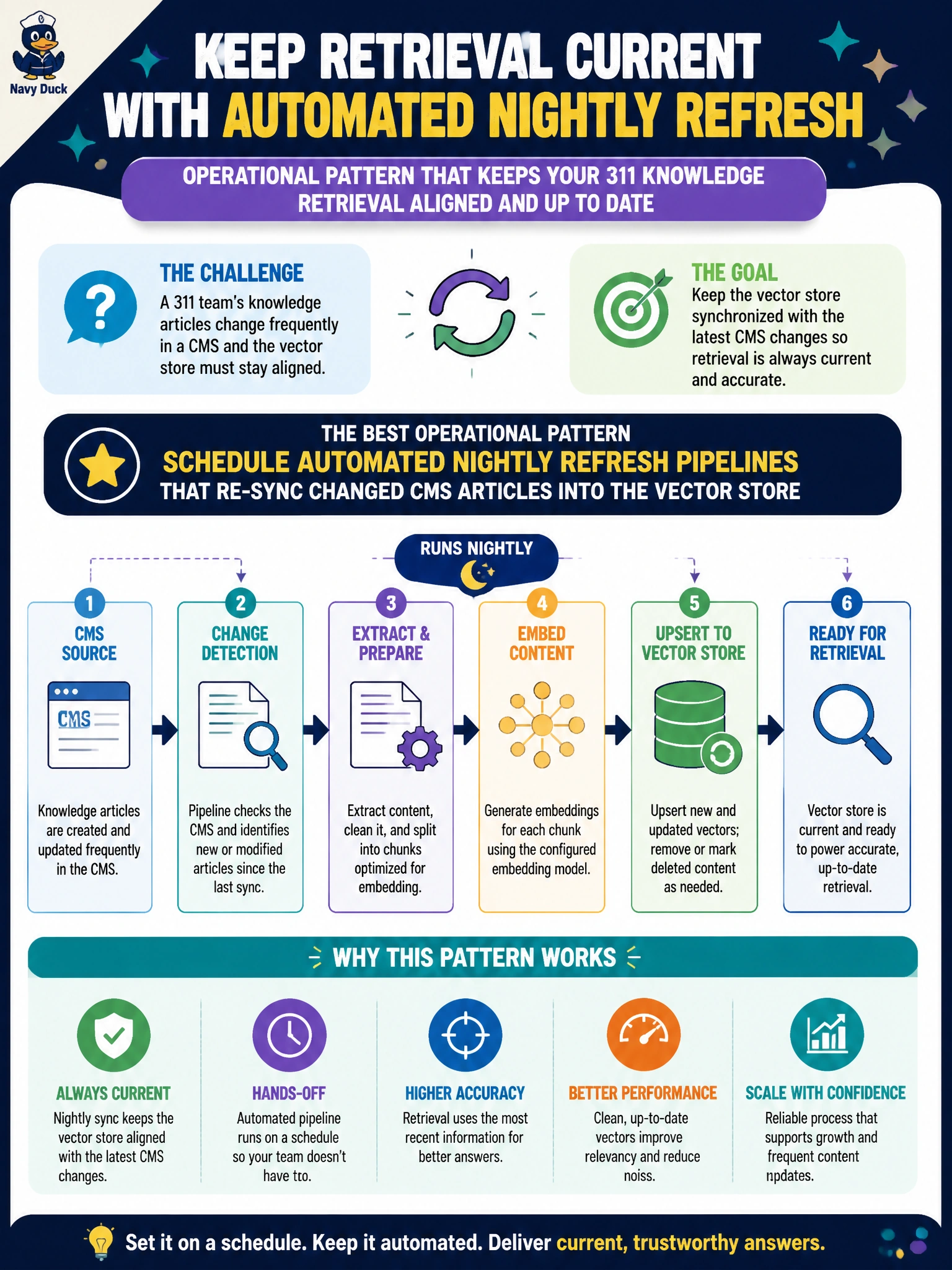
A 311 team’s knowledge articles change frequently in a CMS and the vector store must stay aligned. Which operational pattern best keeps retrieval current?
Select an answer to reveal the explanation.
Short Explanation
The CMS is the living bulletin board — the vector store is the copy downstairs. A nightly sync job reprints what changed so the bot doesn’t keep quoting yesterday’s closed holiday hours.
Full Explanation
A 311 knowledge base that changes frequently in a CMS stays useful for GenAI only if the vector store is refreshed on a cadence that matches edit velocity. Scheduled automated nightly pipelines that detect and re-sync changed CMS articles into the vector store keep retrieval aligned with what residents are told on the website—holiday hours, diversion programs, fee updates—without waiting for an annual manual rebuild. Automation is the operational pattern that fits continuous civic content change.
Rebuilding embeddings manually once per fiscal year fails because 311 content churns far faster than yearly cycles, leaving stale answers most of the year. Disabling vector refresh and telling the FM to invent answers when articles are missing fails on grounding and public trust. Moving all 311 knowledge into hard-coded prompt text and abandoning the vector store fails to scale and makes every edit a prompt redeploy.
Exam caveat: Dynamic municipal knowledge favors scheduled sync pipelines over static prompts or annual rebuild rituals.
Operational check: track CMS change events vs re-indexed article counts nightly, fail the job on partial sync, sample answers against the live CMS the next morning, and page on-call when refresh freshness exceeds the published SLA.