
A parks department designs civic RAG storage with source documents, searchable vectors, and queryable document attributes. Which combination best fits that architecture?
Select an answer to reveal the explanation.
Short Explanation
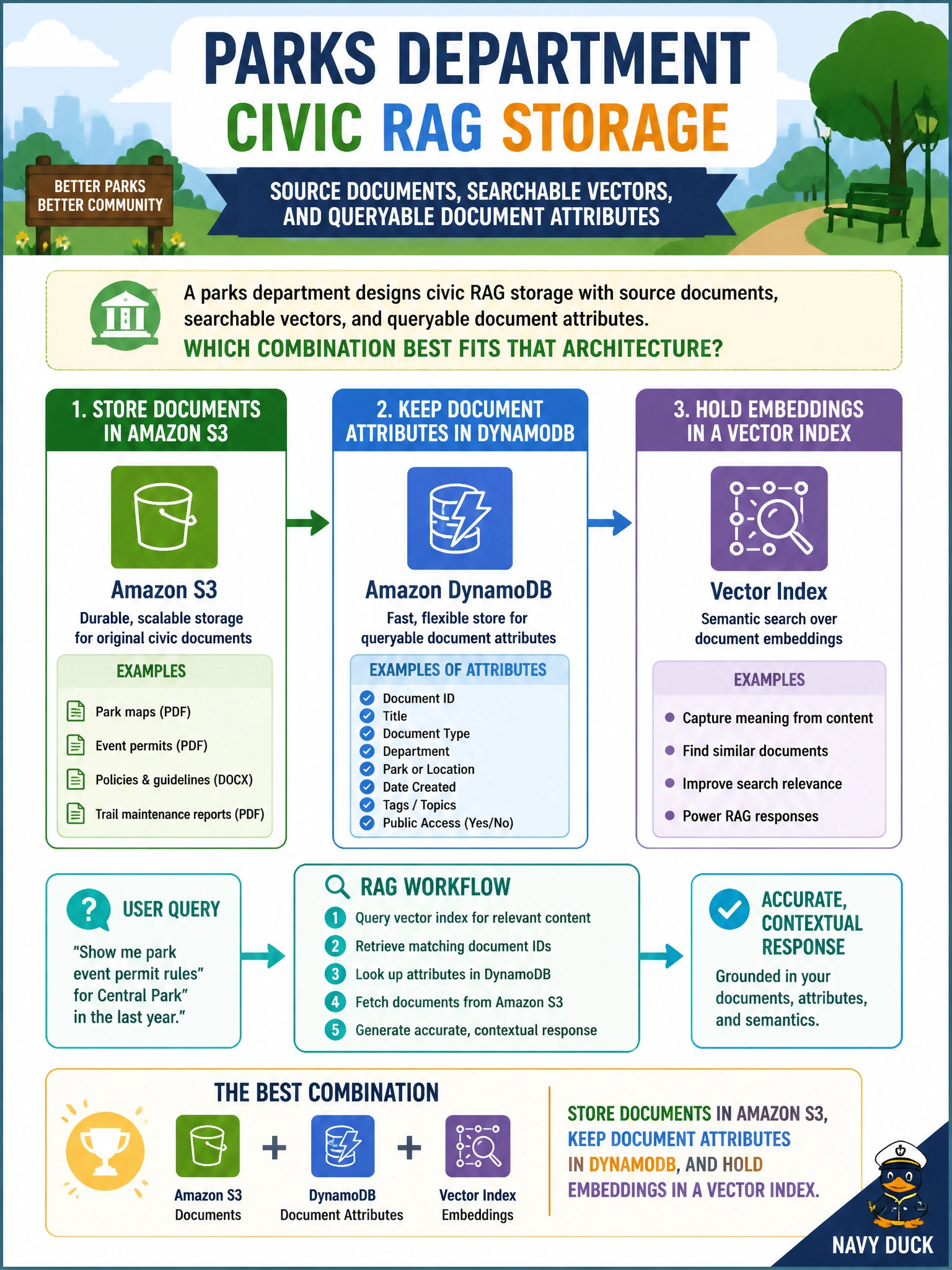
S3 holds the PDFs, DynamoDB holds the labels, and the vector index holds the ‘find me similar’ magic. That three-part setup is the usual civic RAG pantry layout.
Full Explanation
Civic RAG storage for a parks department typically separates three concerns: durable source documents, queryable attributes, and semantic vectors. Storing documents in Amazon S3, keeping document attributes in DynamoDB, and holding embeddings in a vector index fits that architecture—S3 for handbook PDFs and assets, DynamoDB for metadata and pointers, and a vector index for similarity search used by the assistant. Clear separation simplifies updates, access control, and troubleshooting.
Keeping documents only in email attachments without durable object storage fails on durability, searchability, and governance. Encoding the entire parks handbook as a single IAM policy document fails conceptually—IAM is for access policy, not knowledge corpora. Persisting embeddings exclusively inside CloudWatch Logs Insights queries fails because logs are for observability, not as a maintainable vector store for RAG.
Exam caveat: Map storage technologies to RAG roles (object store, metadata store, vector index); do not overload IAM or logs as knowledge bases.
Operational check: verify S3 object keys link from DynamoDB attributes to vector IDs, test attribute filters (park, topic, language), backup all three stores, and alert when orphan embeddings lack a source object.