
A clerk’s office manages a large OpenSearch-backed corpus and wants specialized retrieval per court division. Which indexing strategy best supports that goal?
Select an answer to reveal the explanation.
Short Explanation
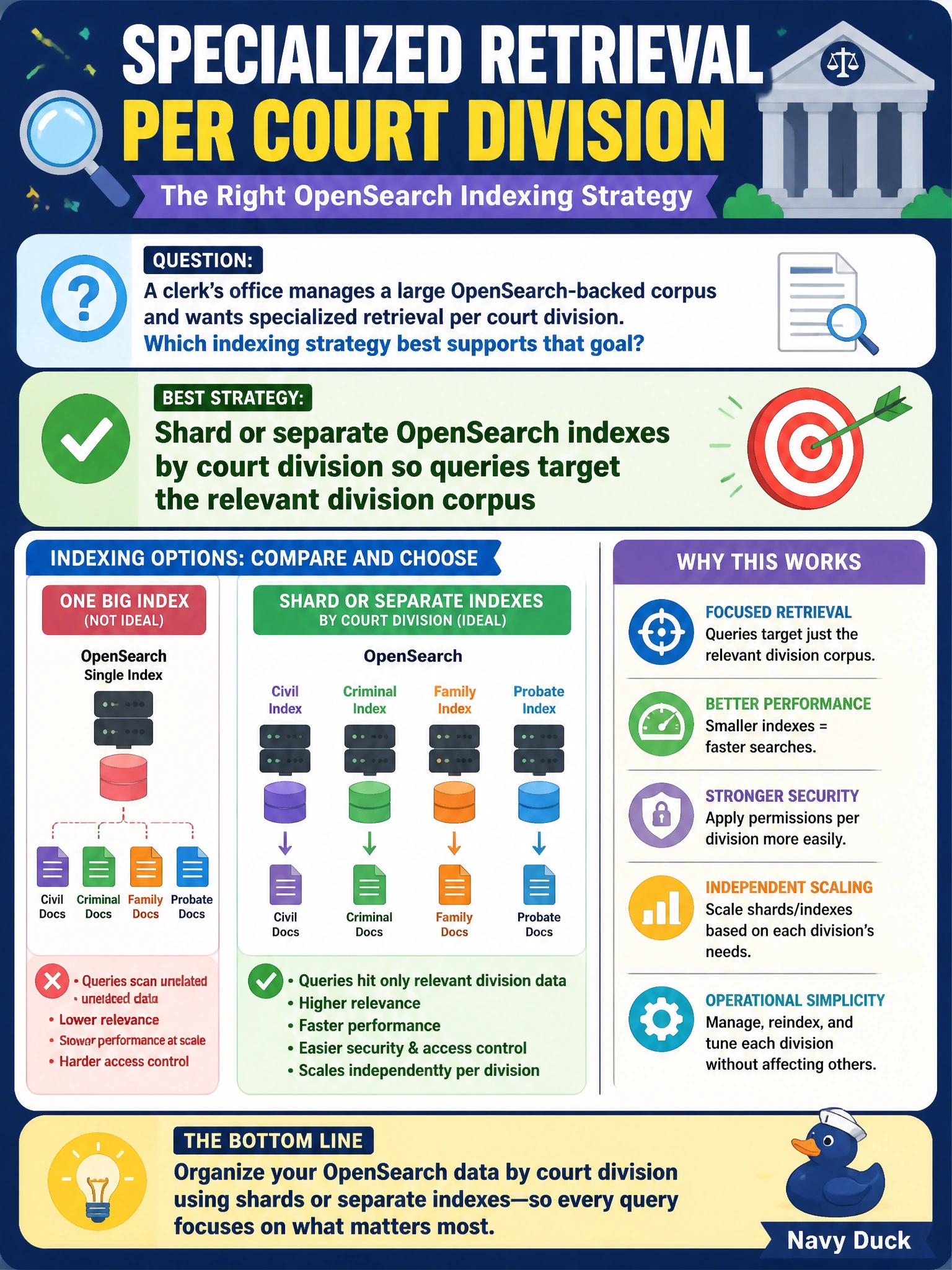
Traffic court and family court don’t share the same filing cabinets. Separate or shard indexes by division so retrieval stays in the right room instead of mixing every docket together.
Full Explanation
A clerk’s office with a large OpenSearch-backed corpus and specialized needs per court division should shard or separate indexes by division so queries target the relevant corpus. Division-scoped indexes improve precision (traffic vs family vs probate), clarify access boundaries, and keep retrieval from mixing unrelated dockets. That indexing strategy matches specialized municipal retrieval without abandoning OpenSearch.
Placing every division’s documents into one unordered index with no division identifiers fails because queries cannot reliably stay in-division and noise rises. Routing all division queries to a general web search API fails conceptually—the authoritative corpus is municipal court content, not the open web. Collapsing all divisions into a single summary paragraph before indexing destroys source detail clerks need for accurate GenAI assistance.
Exam caveat: Index partitioning by business domain is a valid vector/search architecture choice when specialization and precision matter more than a single flat corpus.
Operational check: map each query path to a division index, deny cross-division reads where policy requires, monitor per-index size and error rates, and test that a traffic-division question does not surface family-court chunks.