
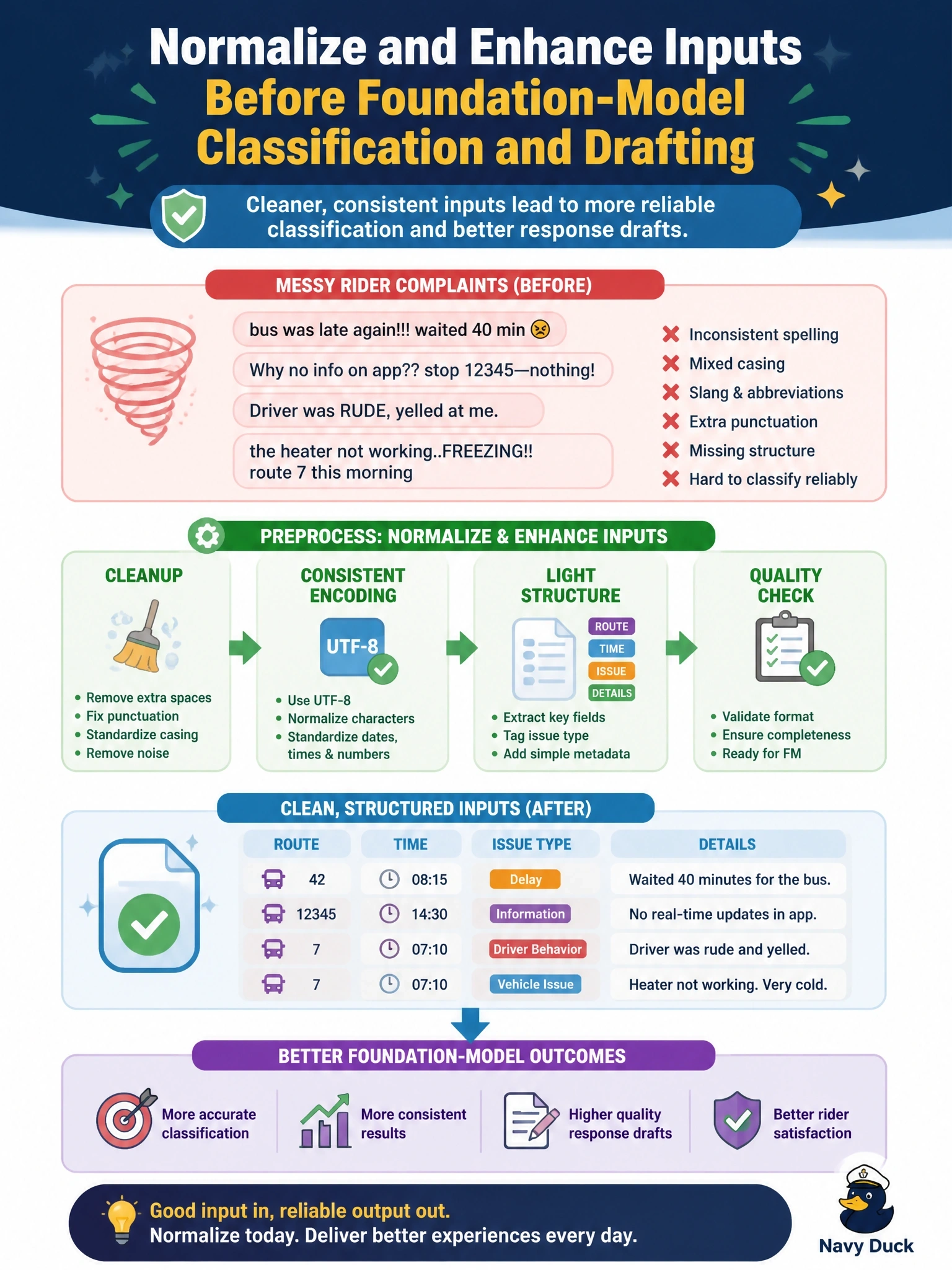
A transit authority receives messy free-text rider complaints before classification and response drafting. Which preprocessing step most improves foundation-model consistency?
Select an answer to reveal the explanation.
Short Explanation
Rider complaints arrive like crumpled notes in a cup holder. You smooth them out first—normalize the text, strip junk, add light structure—so the foundation model sees a cleaner signal for classification and drafting.
Full Explanation
A transit authority receiving messy free-text rider complaints should normalize and enhance inputs—cleanup, consistent encoding, light structure—before foundation-model classification and response drafting. Preprocessing strips duplicated signatures and device junk, unifies Unicode/encoding, and may add light fields (route, stop, time) so the foundation model sees a cleaner, more consistent signal. Consistency upstream reduces variance in labels and drafted replies without pretending the model thrives on noise.
Feeding every raw complaint unchanged, including duplicated signatures and device junk text, maximizes irrelevant tokens and confuses classification boundaries. Translating complaints into hexadecimal so the model sees only opaque tokens destroys natural-language meaning the foundation model was pretrained to use. Discarding all free text and classifying using only the ticket ID number removes the complaint content entirely and cannot support response drafting.
Exam caveat: input normalization/enhancement is a standard data-pipeline stage before foundation models consume them—especially for messy civic free text.
Operational check: measure classification agreement on a cleaned vs raw sample set, keep a reversible cleanup log for audit, and confirm drafting quality improves without stripping safety-relevant wording from rider complaints.