
A water utility transcribes call-center audio and then needs foundation-model help rewriting work orders. Which pipeline awareness is most important?
Select an answer to reveal the explanation.
Short Explanation
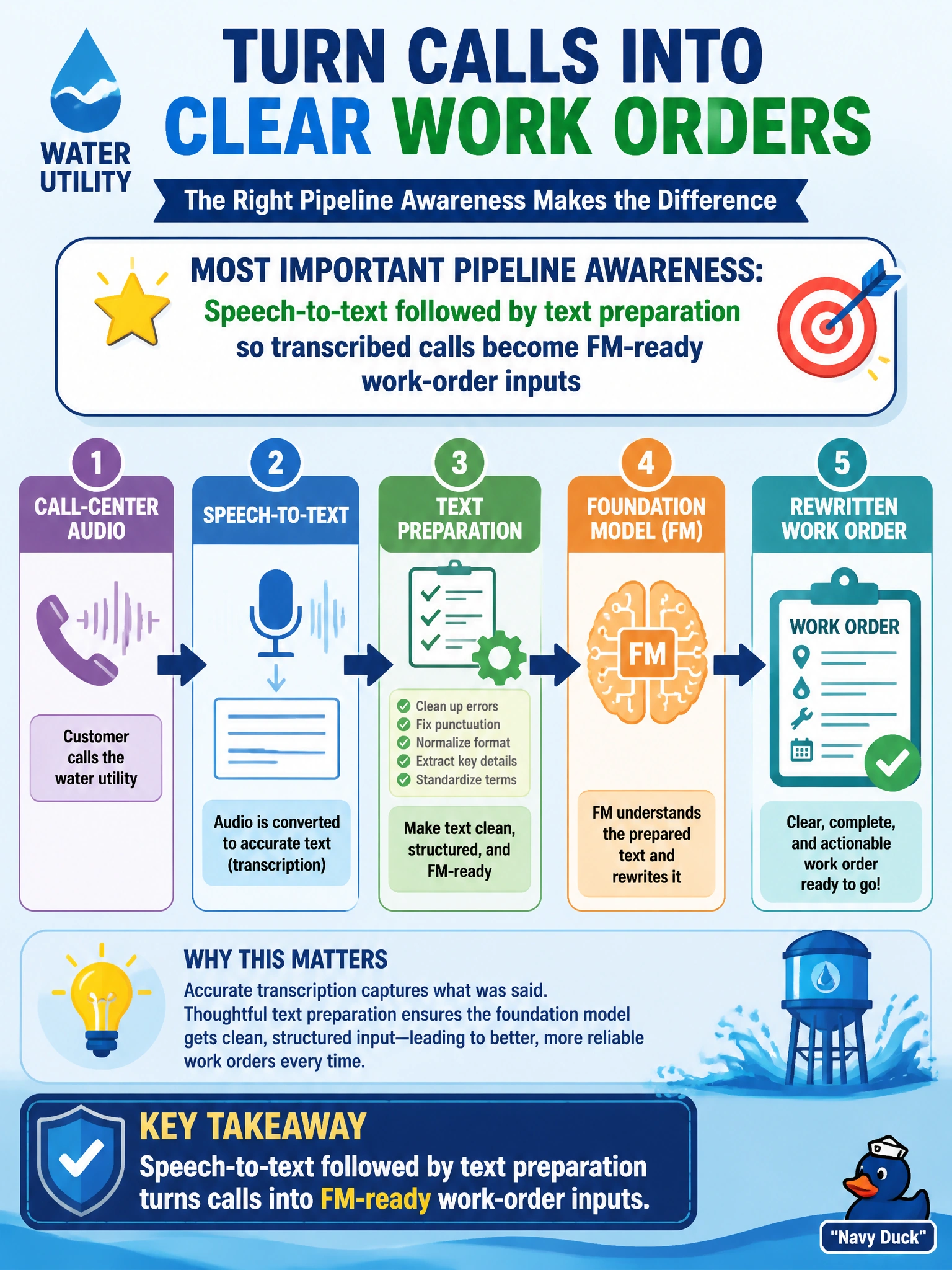
The model can't "hear" the call-center tape by magic. Transcribe the audio first, tidy the text, then let the FM rewrite the work order—speech-to-text plus FM prep is the municipal ops pipeline.
Full Explanation
A water utility that transcribes call-center audio and then needs foundation-model help rewriting work orders must treat speech-to-text followed by text preparation as the required pipeline awareness: audio becomes text, text is normalized for FM input, then the FM rewrites work-order fields. Most text FMs do not natively consume raw call recordings end-to-end in this architecture; the municipal ops path is STT → cleanup/structure → FM rewrite → human or system commit to the work-order system.
Assuming foundation models natively consume raw audio files with no speech-to-text stage skips a mandatory modality conversion for text-centric FM rewrite workflows. Skipping transcription and asking staff to retype every call from memory into the work-order system reintroduces manual labor and error while abandoning the automation goal. Storing audio only on removable drives with no path into the GenAI workflow isolates evidence from the pipeline entirely.
Exam caveat: distinguish multimodal models that accept audio from pipelines that still standardize on STT plus text FMs; read the stem’s processing stages carefully.
Operational check: verify call audio lands in STT, transcripts pass validation, FM rewrite prompts receive prepared text, and spot-check that work orders match the call before crews are dispatched.