
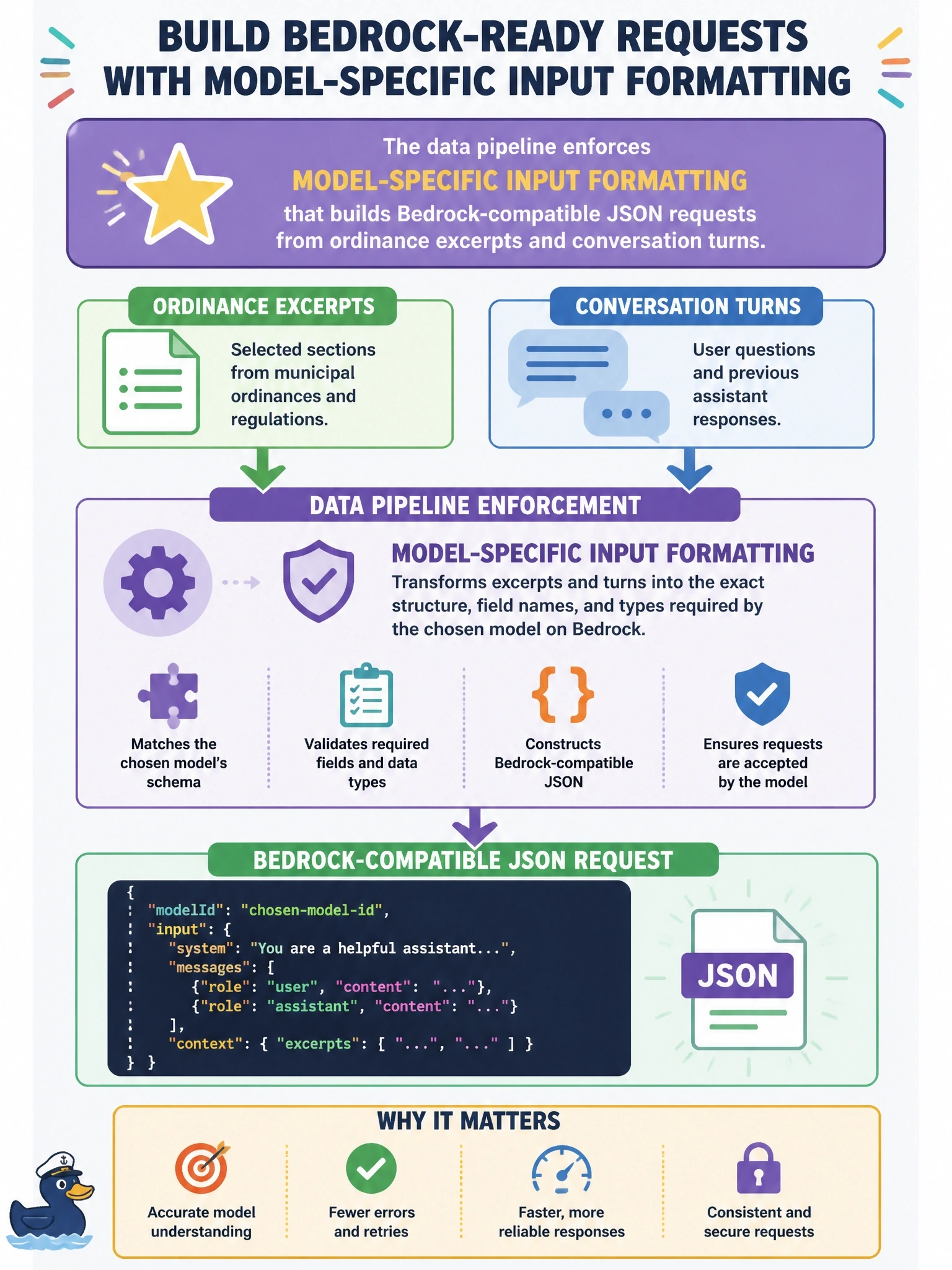
A permitting office must send ordinance excerpts and conversation turns to Amazon Bedrock in the shape the chosen model expects. What should the data pipeline enforce?
Select an answer to reveal the explanation.
Short Explanation
Each model wants its lunch packed a certain way. Format ordinance excerpts and chat turns into the Bedrock-compatible JSON that model expects—don't toss raw blobs over the fence and hope.
Full Explanation
A permitting office that must send ordinance excerpts and conversation turns to Amazon Bedrock in the shape the chosen model expects should enforce model-specific input formatting that builds Bedrock-compatible JSON requests from those excerpts and turns. Different foundation models expect different message schemas, role fields, and content structures; the data pipeline’s job is to transform municipal conversation state and retrieved ordinance text into valid InvokeModel / Converse payloads. Reliable inference integration depends on that formatting contract, not on hoping the model reparses arbitrary blobs.
The approach that pastes unstructured blobs into any field and hopes the foundation model normalizes them produces brittle failures and inconsistent grounding. The approach that sends raw binary PDF bytes as the only message content with no JSON structure skips both the required API envelope and usually the text the model needs. The approach that omits conversation turns entirely because Bedrock never uses dialog context is factually wrong for chat-style APIs and destroys multi-turn permitting assistance.
Exam caveat: know that application code or a formatting layer must adapt inputs to the selected model’s request schema; model choice and payload shape travel together.
Operational check: for the selected model ID, build requests that include ordinance excerpts plus prior turns, validate against API schema in staging, and reject pipeline output that cannot serialize to a successful Bedrock invoke.