
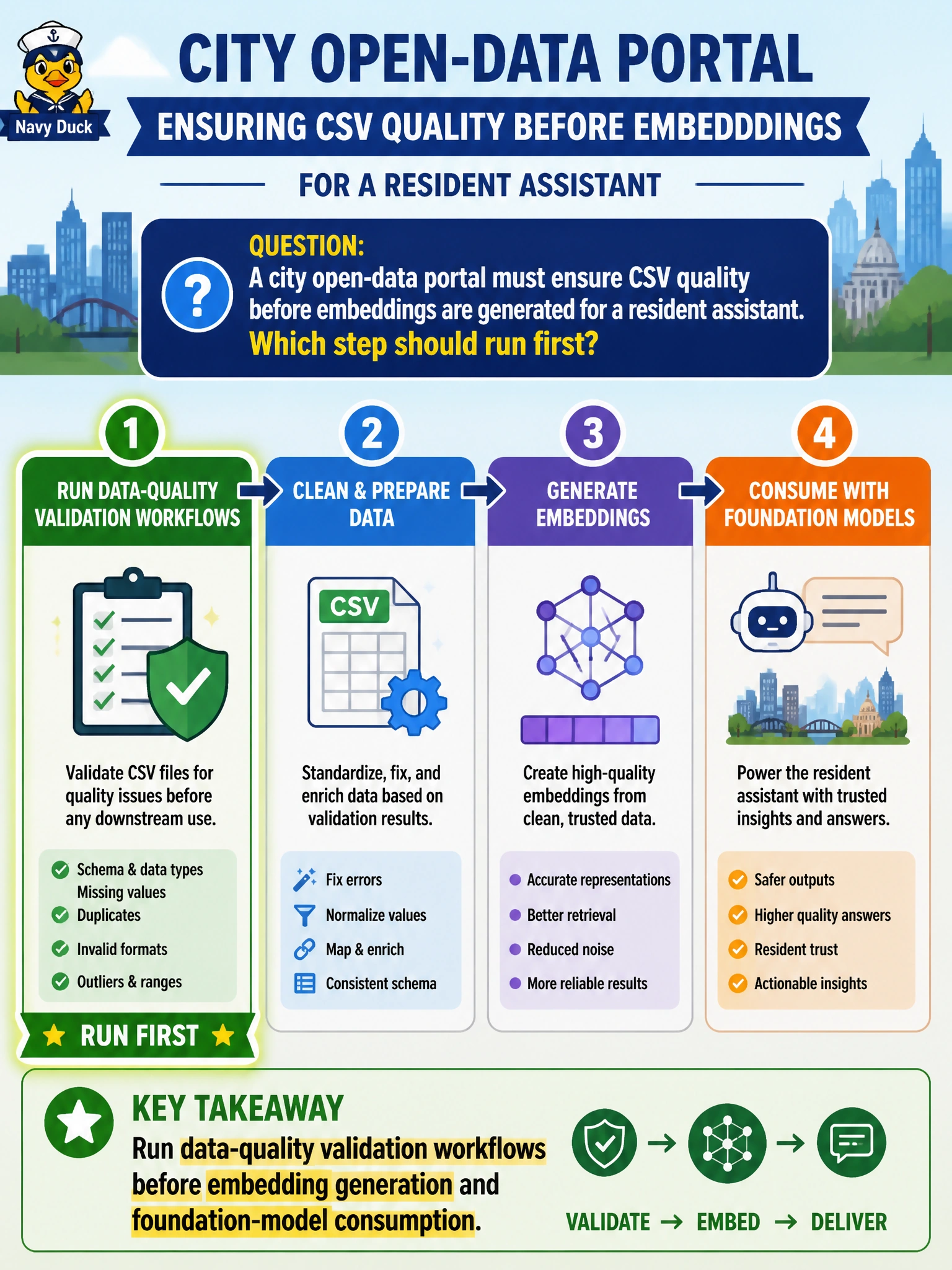
A city open-data portal must ensure CSV quality before embeddings are generated for a resident assistant. Which step should run first?
Select an answer to reveal the explanation.
Short Explanation
Garbage CSVs in, garbage vectors out. Validate the open-data files first—schema, nulls, obvious junk—then embed. Don't ask the resident assistant to paper over bad rows after the fact.
Full Explanation
A city open-data portal that must ensure CSV quality before embeddings are generated for a resident assistant should run data-quality validation workflows before embedding generation and foundation-model consumption. Schema checks, null/range rules, duplicate detection, and encoding normalization gate what enters the vector corpus. Embeddings amplify whatever they are given; malformed civic CSVs become confidently wrong retrieval context that the resident assistant will quote.
Generating embeddings immediately from raw uploads and fixing quality only after residents complain discovers data bugs in production answers. Skipping schema checks because vector search will hide malformed rows misunderstands retrieval: similarity search does not repair invalid fields. Training a new foundation model on the broken CSVs to “learn around” quality issues is an extreme, expensive inversion of pipeline order and still leaves the open-data portal serving bad source files.
Exam caveat: data preparation order matters—validate and clean before chunk/embed/index for RAG-style civic assistants.
Operational check: fail the embed job when validation fails, publish quality metrics on portal datasets, re-embed only after fixes, and spot-check resident-assistant answers against cleaned source CSVs.