
A county wants runtime switching between a cheaper foundation model for FAQ answers and a stronger model for complex permitting edge cases. Which approach best supports that goal?
Select an answer to reveal the explanation.
Short Explanation
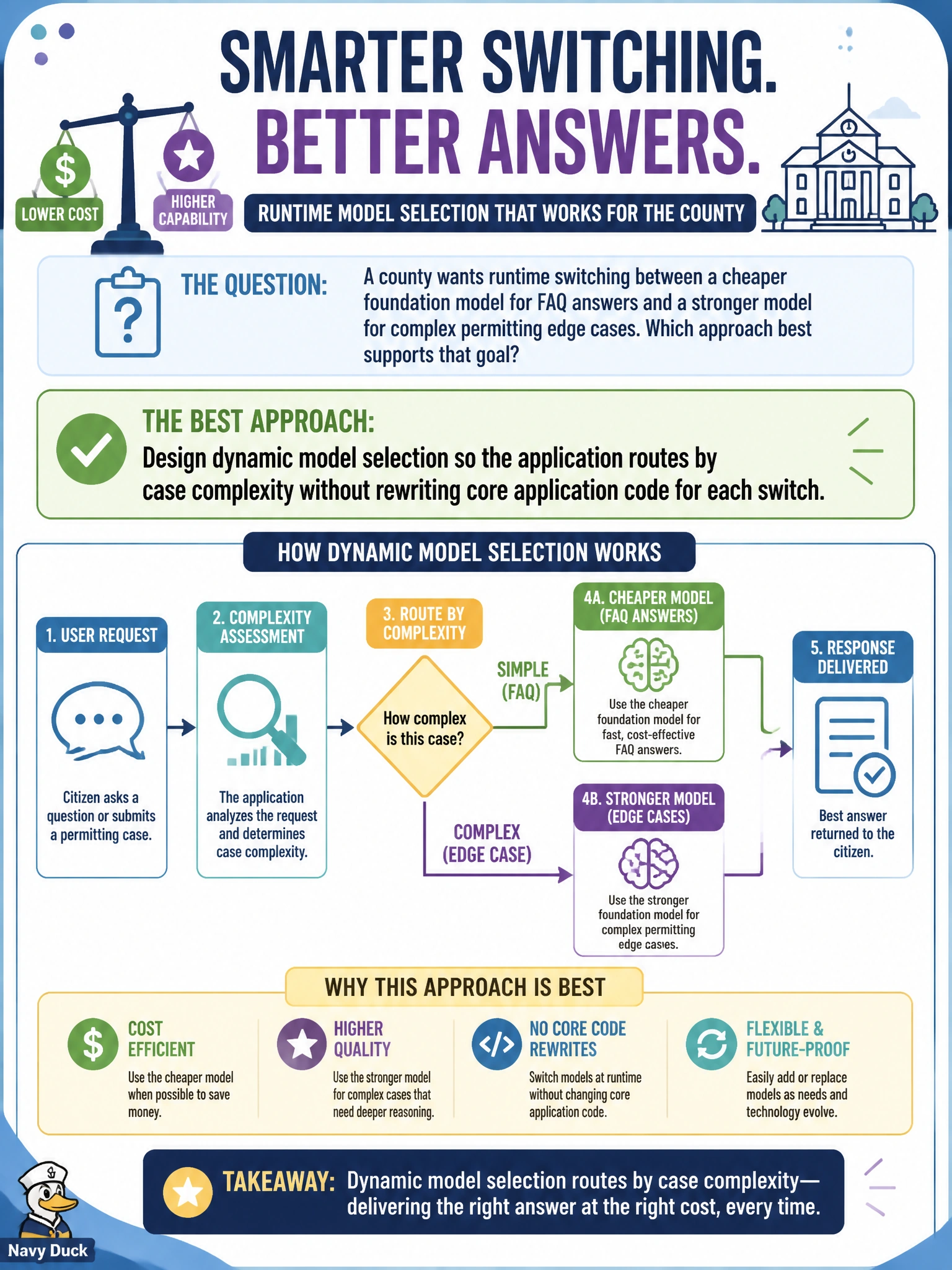
Simple FAQ? Use the thrifty model. Nasty permitting edge case? Call in the heavy hitter. Dynamic routing lets the app flip between them at runtime without rewriting the whole permitting UI every time.
Full Explanation
A county that wants runtime switching between a cheaper foundation model for FAQ answers and a stronger model for complex permitting edge cases should design dynamic model selection so the application routes by case complexity without rewriting core application code for each switch. Routing logic—rules, classifiers, or explicit staff “escalate” flags—selects a model ID at invoke time while the permitting/FAQ service interface stays constant. That yields cost control on common FAQs and quality headroom on hard cases without a release for every model tweak.
Rebuilding and redeploying the entire permitting UI whenever the FAQ model ID changes confuses presentation releases with model-routing configuration and slows iteration. Training two classical regressors and abandoning foundation models for both FAQ and edge cases abandons the GenAI capability the county is trying to operationalize. Hard-wiring a single expensive model for every FAQ burns budget where a lighter FM would suffice.
Exam caveat: dynamic model selection / routing is the pattern when stems describe multiple tiers of difficulty or cost for related GenAI tasks on AWS.
Operational check: externalize route rules (FAQ → cheaper model, complex permit → stronger model), log which model served each request, A/B quality on edge cases, and confirm UI code has no baked-in model IDs.