
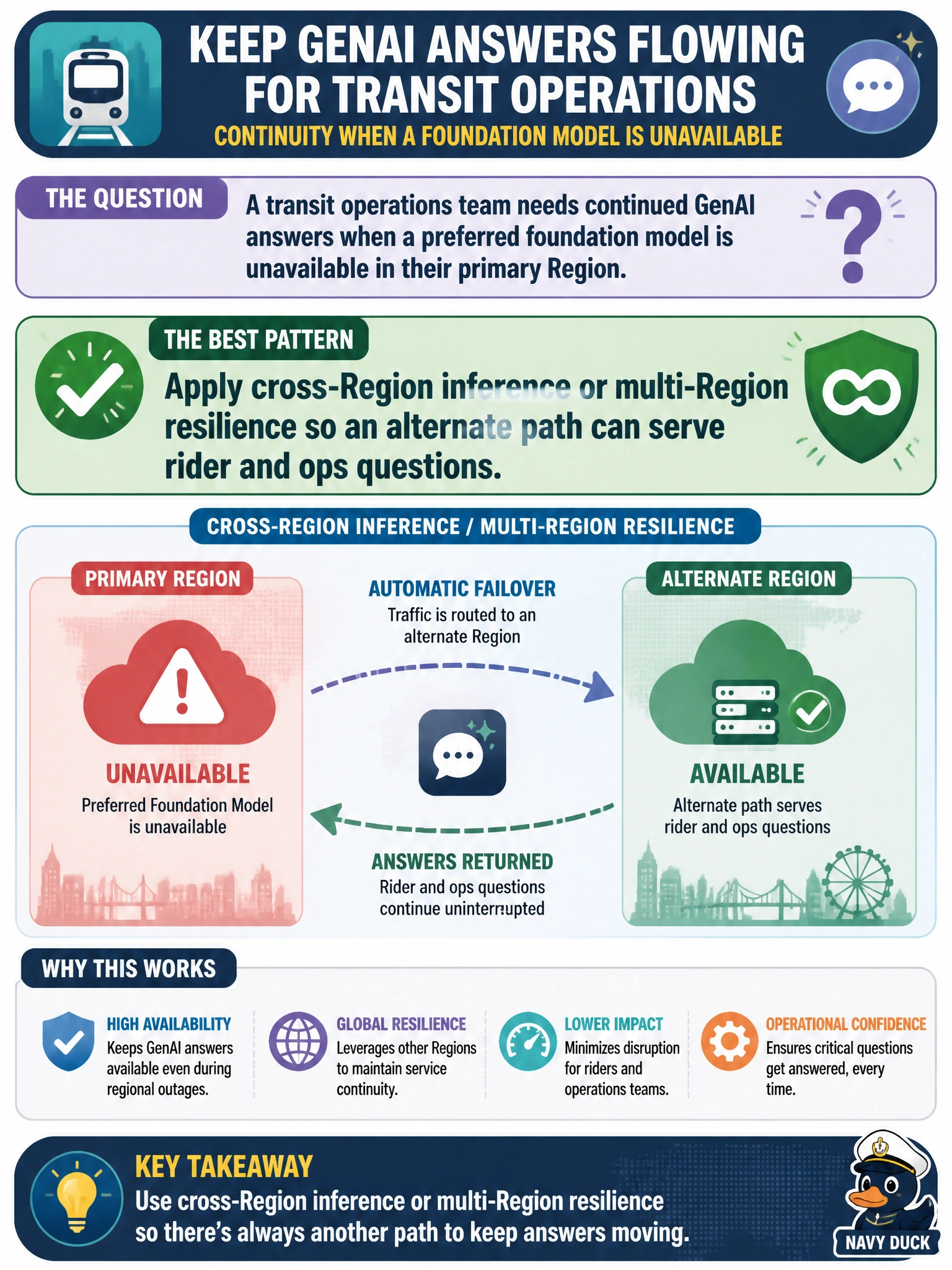
A transit operations team needs continued GenAI answers when a preferred foundation model is unavailable in their primary Region. Which pattern best addresses continuity?
Select an answer to reveal the explanation.
Short Explanation
Trains keep moving even if one station closes—route around it. Same idea for FMs: cross-Region inference or multi-Region resilience gives transit ops another path when the preferred model is dark in the primary Region.
Full Explanation
Transit operations that must keep answering rider and ops questions when the preferred foundation model is unavailable in the primary Region should apply cross-Region inference or multi-Region resilience so an alternate path can serve traffic. Continuity design assumes Regional impairment: credentials, networking, and runbooks exist to invoke the same or equivalent model elsewhere (or a documented fallback model) without waiting for the primary path to recover. For transit, GenAI assist is subordinate to keeping dispatch and rider communications moving.
Failing permanently until the preferred model returns in the primary Region turns a Regional capacity or service issue into a full capability outage. Instructing dispatchers to stop answering riders until capacity is restored is an operational surrender incompatible with transit continuity. Deleting secondary Region credentials so failover cannot run deliberately disables the resilience path.
Exam caveat: AWS GenAI resilience topics include multi-Region strategies and cross-Region inference options—know when the stem is about availability, not about training.
Operational check: document primary and secondary invoke paths, periodically test failover with synthetic rider/ops questions, monitor error budgets, and ensure IAM/network allow the secondary path before an incident, not during one.