
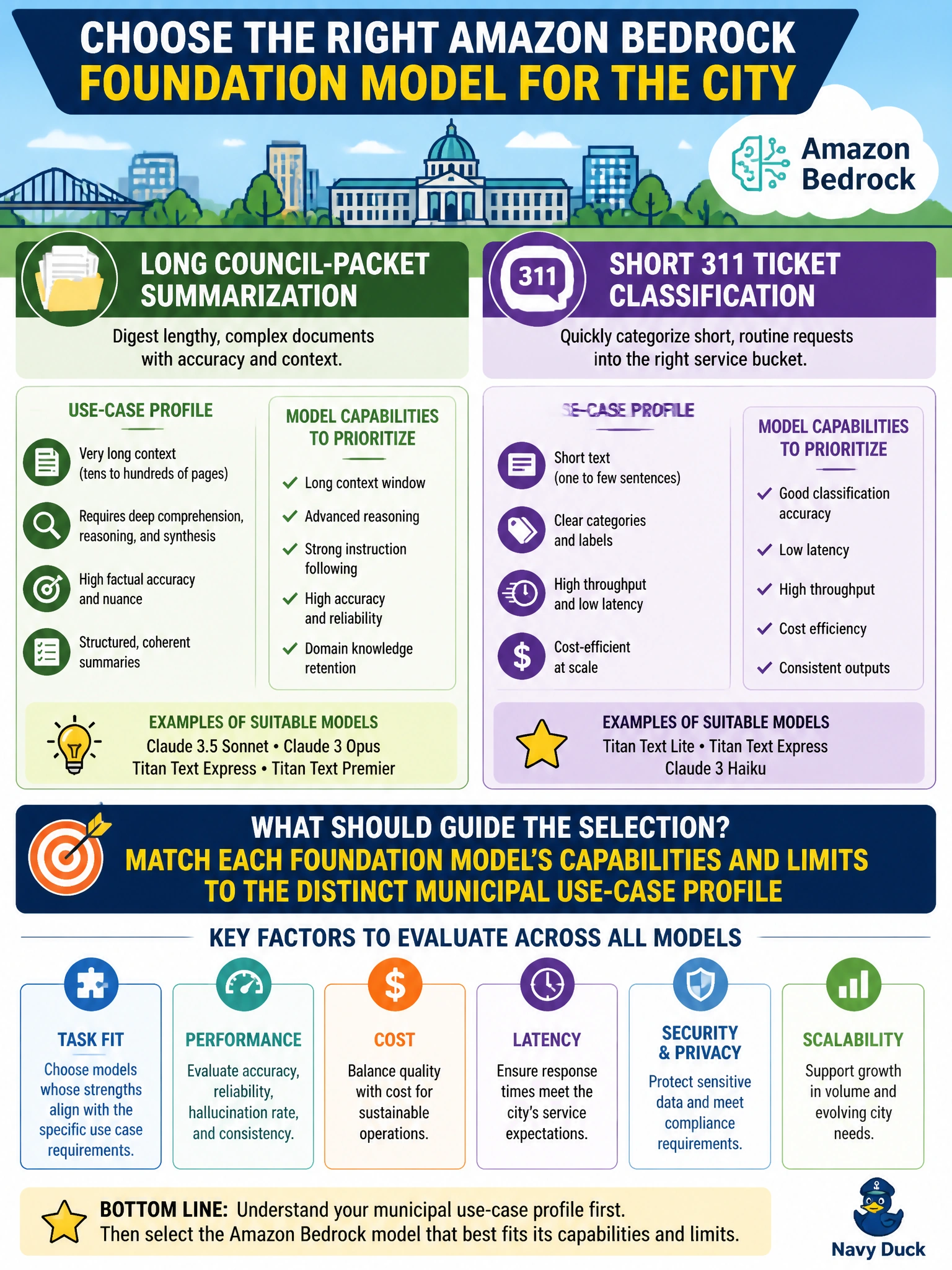
A city must choose among Amazon Bedrock foundation models for long council-packet summarization versus short 311 ticket classification. What should guide the selection?
Select an answer to reveal the explanation.
Short Explanation
Long council packets and short 311 tickets are different animals. You’ll get a better fit by matching each model’s capabilities and limits to the job, rather than forcing one model onto every city workload.
Full Explanation
Choose by matching each Amazon Bedrock foundation model’s capabilities and limits to the distinct municipal use-case profile. Long council packets stress context-window capacity, long-document summarization quality, and cost per large prompt; short 311 ticket classification stresses low latency, smaller inputs, and affordable high-volume invokes. This is a fit problem involving task shape, context limits, accuracy needs, and budget—not a single universal ranking. Always picking the single largest model for every municipal workload can waste money and add latency on simple classification without guaranteeing better short-ticket accuracy. Using the same tiny classification model for multi-hundred-page council packets can truncate or ignore content and produce weak summaries. Ignoring context-window and task fit to select only by alphabetical model name is arbitrary and fails any serious evaluation. Exam caveat: Bedrock selection questions expect you to distinguish workloads by context length, modality, cost, and quality, rather than defaulting to “biggest” or “cheapest” globally. Practical check: benchmark a long council packet and a batch of 311 tickets on candidate models, record quality, latency, and cost, then assign model IDs per use case or use a router instead of one citywide default.