
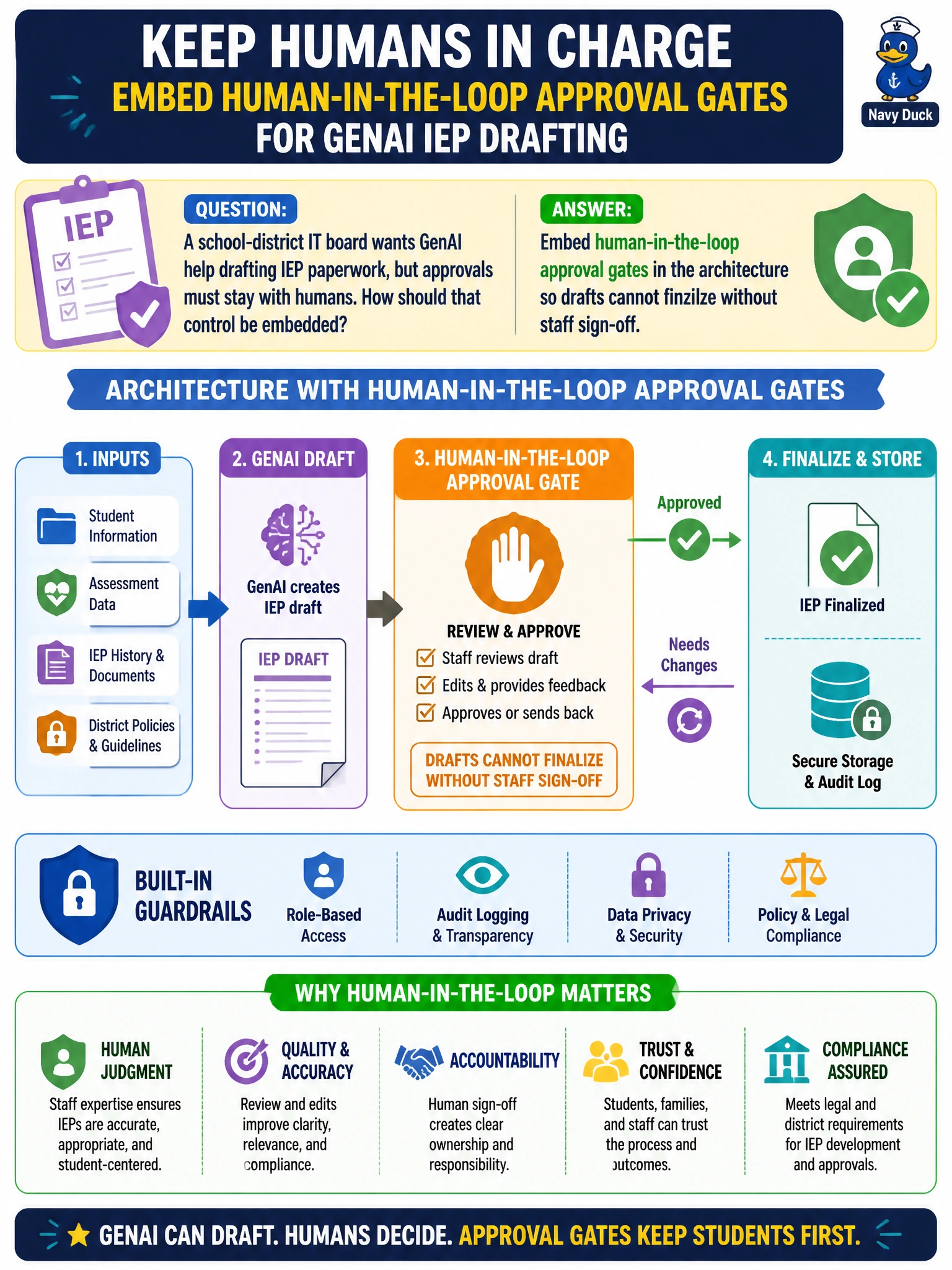
A school-district IT board wants GenAI help drafting IEP paperwork, but approvals must stay with humans. How should that control be embedded?
Select an answer to reveal the explanation.
Short Explanation
IEP paperwork is too important for "the model said it was fine." Put a real human approval gate in the workflow architecture—draft yes, finalize only after a staffer signs off—not just a polite sentence in the prompt.
Full Explanation
School-district GenAI help drafting IEP paperwork must keep approvals with humans by embedding human-in-the-loop approval gates in the architecture so drafts cannot finalize without staff sign-off. The control belongs in workflow state transitions—draft → staff review → approve/reject → submit—not merely in aspirational prompt wording. Architecture-level gates enforce that the FM never becomes the final authority on legally sensitive education documents.
Adding only a prompt line that says “be careful” while auto-submitting drafts to the state portal is soft guidance without enforcement and fails when the model is wrong. Letting the foundation model digitally sign completed IEPs without staff review transfers accountability to a system that cannot hold professional licensure. Publishing every draft immediately to parent portals to speed turnaround skips review and risks releasing incomplete or incorrect education plans.
Exam caveat: human-in-the-loop is a recurring responsible-AI / solution-design control for high-stakes outputs; prompts alone are not a substitute for workflow enforcement.
Operational check: implement an explicit approval step in the IEP drafting service, deny API paths that submit without an authenticated staffer action, and audit-log who approved each finalized packet before any state-portal transmission.