
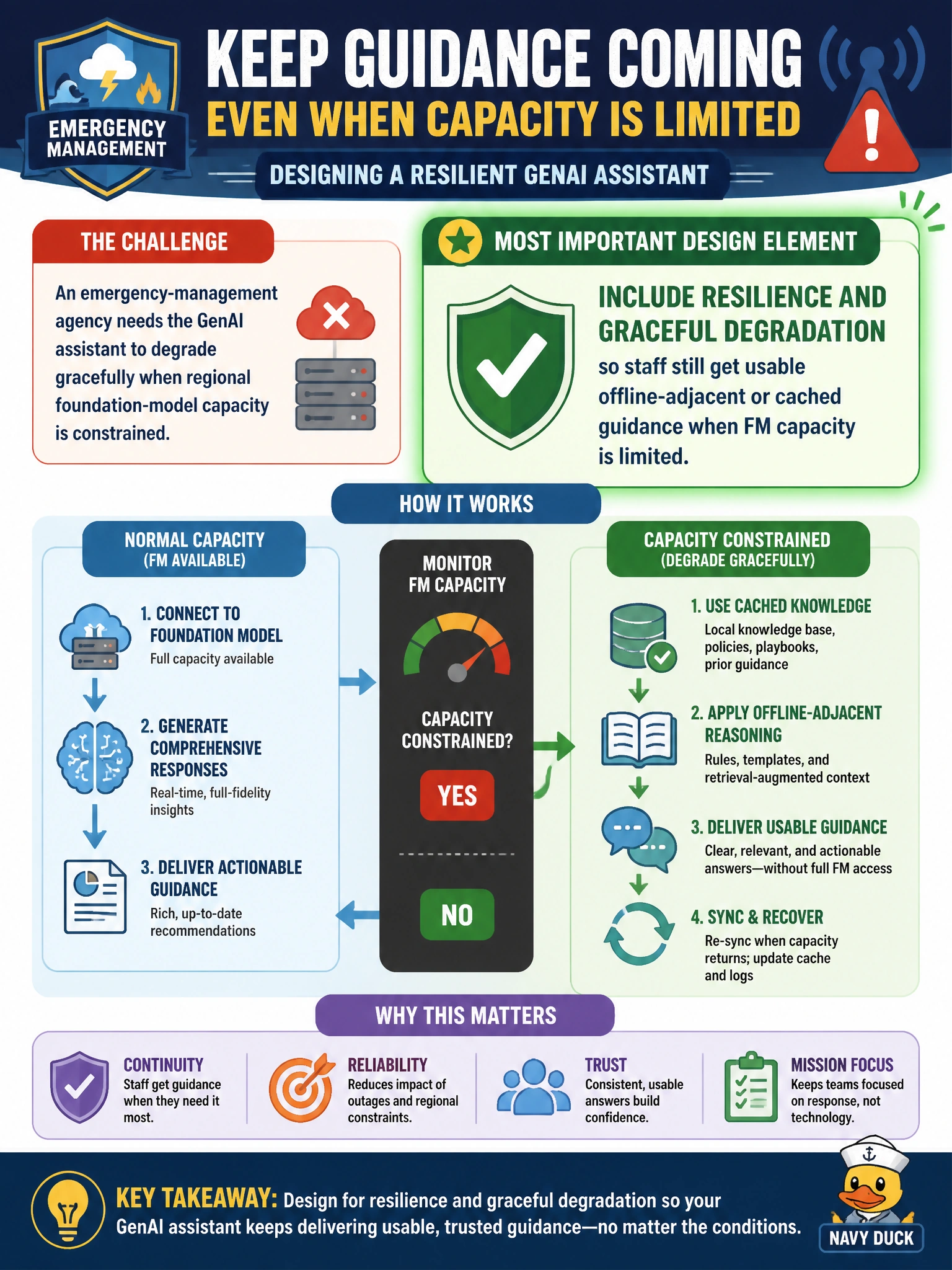
An emergency-management agency needs the GenAI assistant to degrade gracefully when regional foundation-model capacity is constrained. Which design element is most important?
Select an answer to reveal the explanation.
Short Explanation
Emergencies don't pause for a model throttle. Bake in a soft landing—cached SOPs, simpler fallbacks, degraded but usable answers—so the desk keeps moving when regional FM capacity gets tight.
Full Explanation
An emergency-management agency needs the GenAI assistant to degrade gracefully when regional foundation-model capacity is constrained, so resilience and graceful degradation are the critical design element. Soft-fail paths—cached SOP excerpts, static playbook cards, queued requests with clear “degraded mode” banners, or simpler non-FM lookups—keep staff productive when throttling or Regional limits hit. Emergency desks cannot treat an FM 429 as a full stop; usable offline-adjacent or cached guidance is part of the architecture, not an afterthought.
Assuming unlimited regional capacity and omitting any fallback path is wishful capacity planning and fails under the exact stress the agency cares about. Crashing the entire emergency portal on any FM throttle error amplifies a model-layer incident into a mission-system outage. Deleting local SOP copies so staff must wait for the primary Region to recover removes the very content that graceful degradation should serve.
Exam caveat: reliability for GenAI includes timeouts, retries with jitter, circuit breakers, and purposeful degraded modes—not only happy-path Bedrock invokes.
Operational check: simulate FM throttling in staging, verify the assistant returns cached SOP guidance with an explicit degraded indicator, measure that the portal remains usable, and document when full FM answers resume after capacity recovers.