
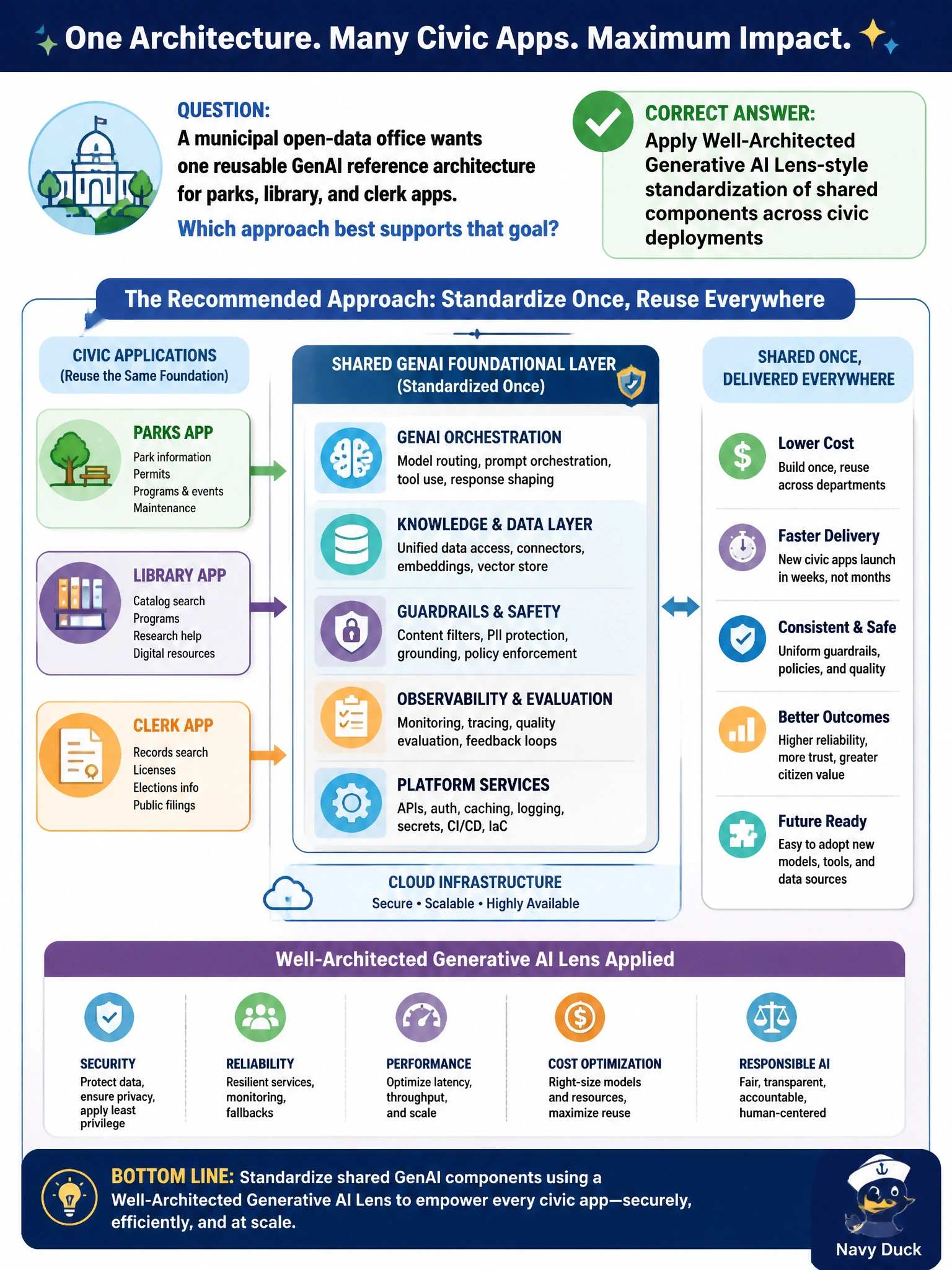
A municipal open-data office wants one reusable GenAI reference architecture for parks, library, and clerk apps. Which approach best supports that goal?
Select an answer to reveal the explanation.
Short Explanation
Parks, library, and clerk shouldn't each reinvent the plumbing. A shared GenAI reference architecture—think city standard water pipes—keeps retrieval, prompts, and model access consistent while each app still has its own faucet. That is Well-Architected / Generative AI Lens thinking for municipalities.
Full Explanation
A municipal open-data office that wants one reusable GenAI reference architecture for parks, library, and clerk apps should standardize shared components in a Well-Architected Generative AI Lens style: common FM access patterns, retrieval/vector stores, prompt stores, logging, identity, and guardrails—while allowing each department app to own its UX and domain prompts. Shared plumbing reduces duplicate security reviews, lowers per-app cost, and keeps civic deployments consistent enough that platform teams can operate them as a product rather than a pile of one-offs.
Letting each department invent its own FM client, vector store, and prompt store with no shared patterns guarantees drift: different auth models, incompatible observability, and repeated mistakes under the same city policies. Standardizing only the UI theme while leaving retrieval, prompts, and model access ad hoc fails the architecture goal; the hard parts are the GenAI control plane, not CSS. Requiring every app to fine-tune a separate foundation model on department-specific GPUs forces expensive customization where shared base models plus retrieval or light adapters would usually suffice, and it blocks reuse.
Exam caveat: the Generative AI Lens and Well-Architected guidance emphasize reusable patterns, least privilege, and operational excellence across FM workloads—not mandatory per-app fine-tunes or UI-only standards.
Operational check: publish a reference architecture diagram and approved building blocks (gateway, Bedrock access, vector store, prompt registry), require new parks/library/clerk apps to consume them, and track exceptions with architecture review so the open-data office retains one coherent platform.