
A transit authority must support rider alerts that mix text policy answers with speech and image context. Which design choice best aligns the foundation-model stack to that requirement?
Select an answer to reveal the explanation.
Short Explanation
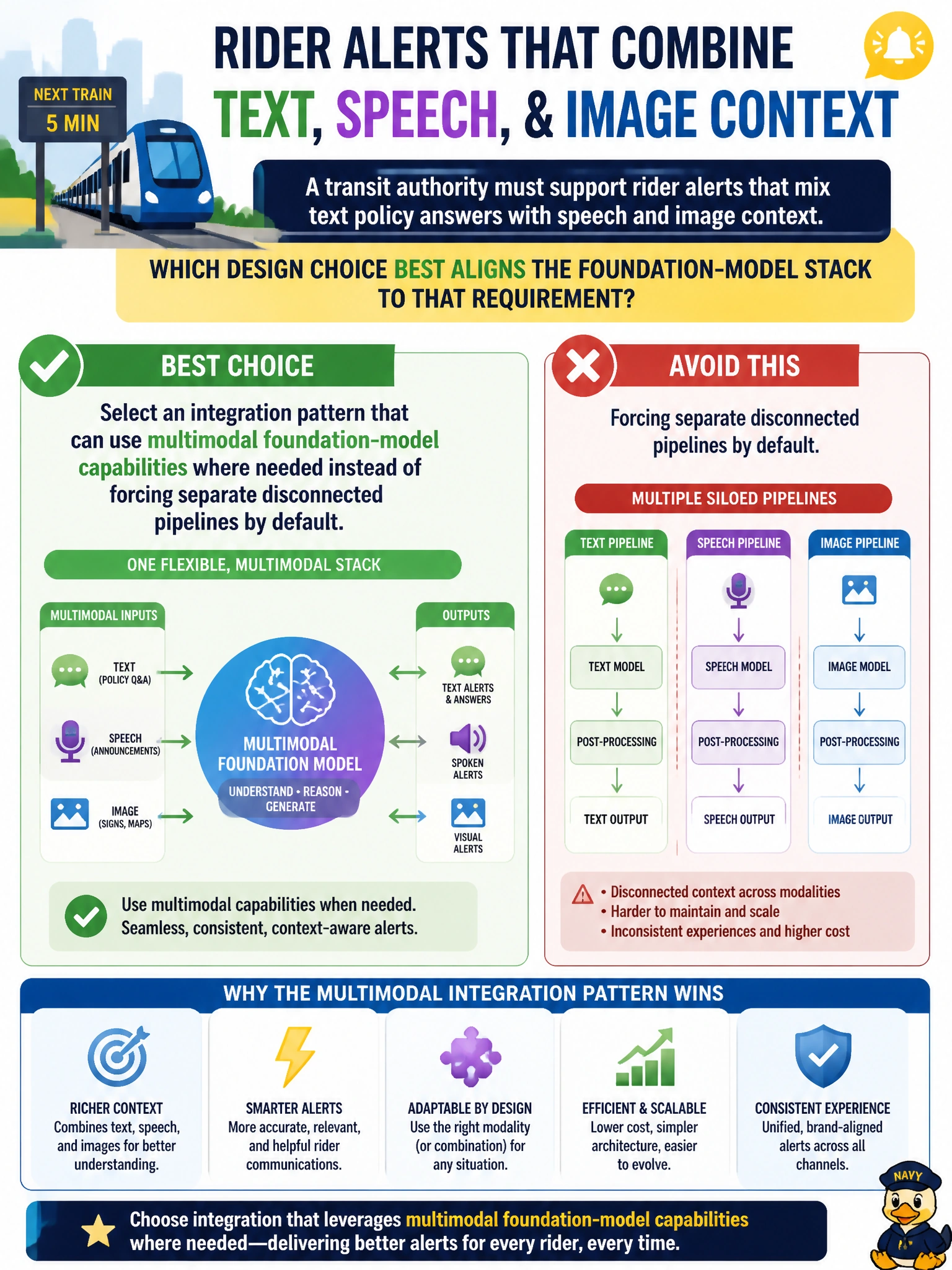
Riders don't experience text, voice, and pictures as three different IT projects—they just want the alert. Align the FM stack to multimodal needs so you aren't juggling disconnected speech and text pipelines unless ops truly forces it.
Full Explanation
A transit authority that must support rider alerts mixing text policy answers with speech and image context should select an integration pattern that can use multimodal foundation-model capabilities where needed, rather than forcing permanently disconnected pipelines by default. Requirement analysis drives FM stack choice: if field apps and rider channels present mixed modalities, the architecture should invoke multimodal-capable models or tightly coordinated multimodal pipelines so policy text, speech, and images stay in one coherent alert workflow. That alignment reduces handoff loss between “text team,” “speech team,” and “image team” when the rider experience is a single alert.
Mandating text-only models forever and banning speech or image inputs from field apps contradicts the stated multimodal requirement and pushes work into brittle side channels. Training a classical audio classifier offline and never calling a foundation model for rider communications may handle narrow audio labels but does not produce the integrated policy-aware communications GenAI is being asked to support. Storing voice clips in email attachments for overnight manual rewrite is an operational workaround, not an FM integration pattern, and it fails latency and consistency expectations for transit alerts.
Exam caveat: multimodal capability is a selection and design criterion when use cases span modalities; do not assume every FM is text-only, and do not invent multimodal complexity when the workload is purely textual.
Operational check: inventory alert inputs (text policy, ASR transcripts, images), confirm the chosen Bedrock/FM path accepts those modalities or define an explicit prep stage, and test end-to-end alert generation with mixed samples before locking the transit stack.