
A county public-health team wants to prove value before funding a full resident FAQ chatbot. Which next step best validates feasibility on AWS?
Select an answer to reveal the explanation.
Short Explanation
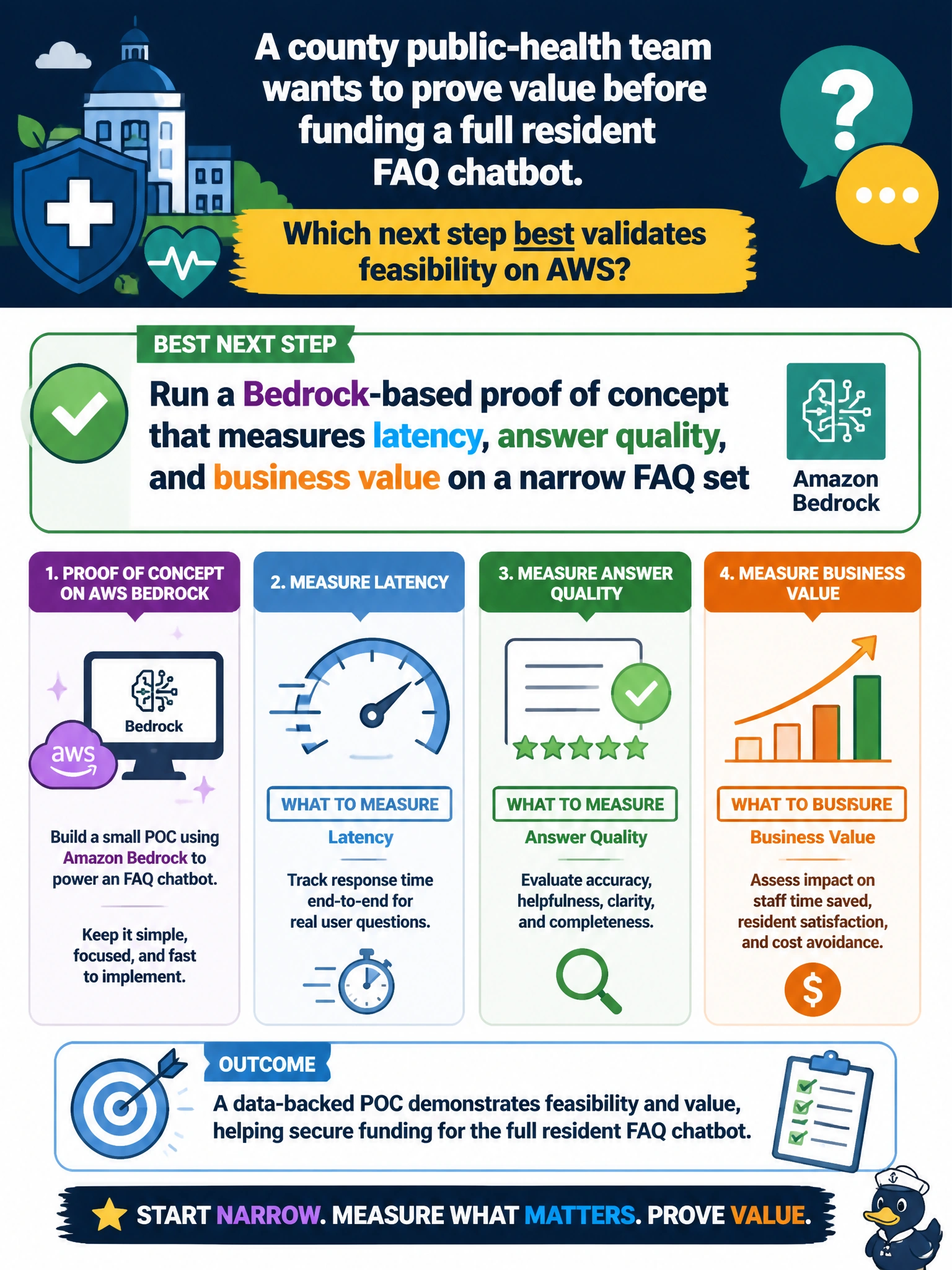
Before the county writes a big check, try a small kitchen-table demo. A Bedrock PoC on a tight FAQ set tells you if latency and answer quality are good enough—and whether the business case is real—before anyone funds the full chatbot.
Full Explanation
Before a county public-health team funds a full resident FAQ chatbot, the highest-leverage next step is a constrained Amazon Bedrock proof of concept that measures latency, answer quality, and business value on a narrow FAQ set. That PoC exercises the real integration path—model invocation, prompts, retrieval if used, and evaluation against health-department acceptance criteria—without locking budget into permanent capacity. Feasibility on AWS is demonstrated by evidence: p95 latency under SLA, grounded answers on the pilot FAQ corpus, and a clear value signal for leadership, not by purchasing the largest possible footprint first.
Purchasing provisioned throughput for the largest available foundation model across all Regions immediately inverts the sequence: capacity decisions should follow measured demand and quality, not precede them. Skipping Bedrock to train a medical foundation model on local GPUs before any user testing maximizes risk and cost while delaying the only question that matters early—whether residents and staff get useful answers. Publishing the chatbot citywide with no evaluation metrics replaces design discipline with anecdotal incident reports and makes rollback or remediation harder once trust is damaged.
Exam caveat: AIP-C01 solution analysis expects PoCs and success metrics before scale-out. Bedrock is the managed FM path for most AWS GenAI workloads; custom training is not the default first step for an FAQ chatbot feasibility test.
Operational check: define a small FAQ gold set, instrument latency and quality scores (including hallucination or citation checks), document go/no-go thresholds, and only then size throughput or expand topics for the county rollout.