
A city CIO wants a permitting assistant that drafts staff summaries from ordinance PDFs without training a new model from scratch. Which architecture best fits that need?
Select an answer to reveal the explanation.
Short Explanation
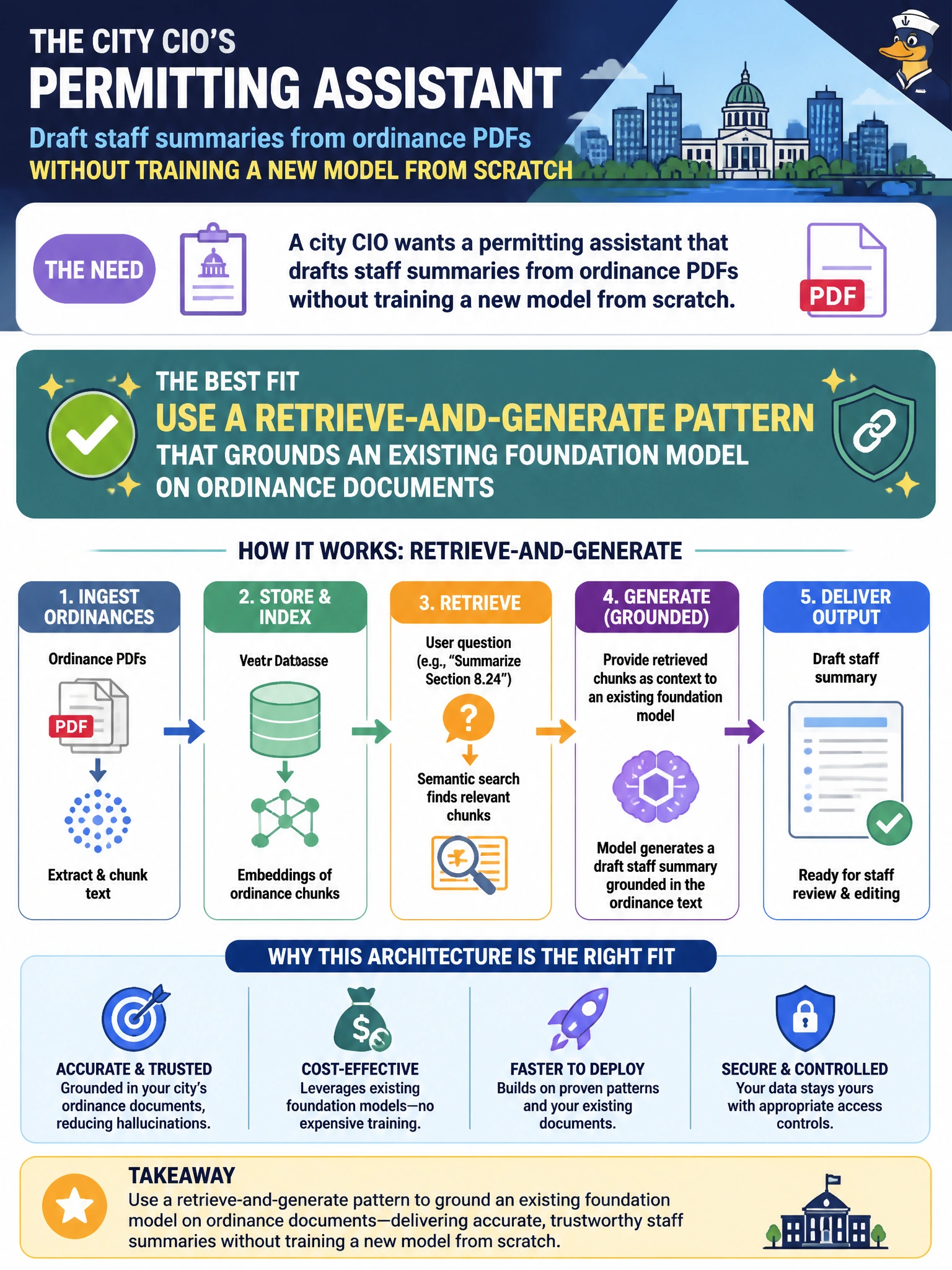
Think of the ordinances like a city library—you don't reprint every book to answer a question, you look them up and then write the memo. Retrieve-and-generate does the same: pull the right PDF chunks, then let an existing foundation model draft the summary. Training a brand-new model from scratch is the long way around for this job.
Full Explanation
Municipal permitting assistants that draft staff summaries from ordinance PDFs are a grounding problem, not a from-scratch training problem. A retrieve-and-generate architecture keeps an existing foundation model in place and, at inference time, retrieves relevant ordinance chunks—typically via embeddings and a vector index over the municipal corpus—then conditions generation on those excerpts. That pattern matches the city CIO’s constraint: professional summaries without standing up a supervised training pipeline on custom GPUs until a municipal-only foundation model converges. Grounding also improves citation fidelity to the ordinances staff actually enforce, which matters when planners and inspectors rely on the draft for casework.
Full supervised training of a municipal-only foundation model fails the stated need conceptually: it maximizes time, cost, and MLOps burden when the knowledge already exists as documents and an off-the-shelf FM can summarize when properly grounded. Classical NLP classifiers trained only on permit fee codes address narrow labeled categories; they do not draft free-form staff summaries across heterogeneous ordinance language. Exporting ordinances into spreadsheets with keyword macros abandons generative drafting entirely and does not scale as policy PDFs change.
Exam caveat: retrieve-and-generate (RAG-style) is the default AWS GenAI pattern when the requirement is “use existing FMs with enterprise knowledge” rather than “train a new foundation model.” Do not confuse retrieval grounding with fine-tuning; both customize behavior, but only retrieval satisfies “no new model from scratch” while keeping source documents first-class.
Operational check: confirm ordinance PDFs are chunked and indexed, retrieval returns the sections staff would cite, prompts instruct the FM to stick to retrieved text, and sample summaries are reviewed against the source PDFs before the permitting assistant goes live.