
A financial services firm is establishing an AI COE to support scaling. Select the two characteristics that best describe an effective cross-functional collaboration mechanism for this purpose. (Select 2.) (Select TWO.)
Select all correct answers, then click Submit.
Short Explanation
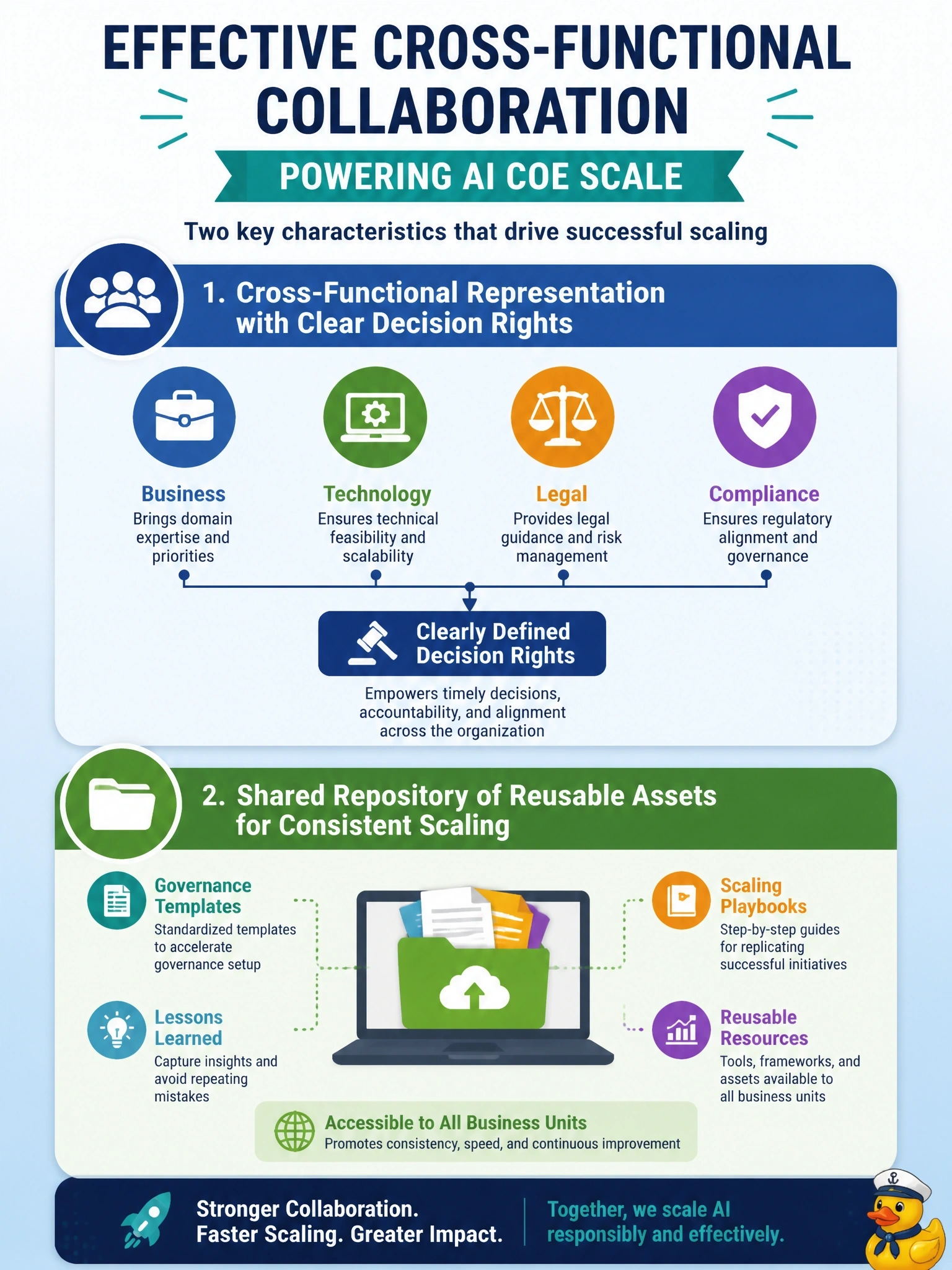
Your COE earns its keep when the right functions, business, technology, legal, compliance, sit at the table with real decision rights, and when it hands other teams a shared repository of templates and playbooks instead of hoarding control. It doesn't need to write every line of code or own every unit's budget to do that job well.
Full Explanation
Representation from business, technology, legal, and compliance functions, with clearly defined decision rights, ensures the right perspectives are at the table when the COE weighs in on scaling decisions, and a shared repository of reusable governance templates, lessons learned, and scaling playbooks is exactly the kind of asset that helps other business units scale faster without duplicating work. Giving the COE sole authority to write and approve the final code for every AI system before deployment is out of scope for a business-facing governance body — writing and approving code is a hands-on technical activity that belongs to implementation teams, not a coordination and governance function. Requiring all business units to suspend their own AI budgets in favor of COE-controlled funding goes too far by centralizing all funding decisions, which removes business unit ownership and isn't a defining trait of effective collaboration — coordination doesn't require control over every budget. Mandating that the COE's founding members remain unchanged for the entire life of the program is an arbitrary staffing constraint; nothing about effective cross-functional collaboration requires frozen membership, and fixed membership can actually work against maintaining broad representation as the organization's needs evolve. The operational check: effective COE mechanisms combine clear representation and decision rights with reusable shared assets, not operational control over code or financial control over every business unit's budget.