
An infrastructure construction firm is introducing an AI tool that predicts likely equipment maintenance needs based on sensor data. Leadership is planning how to shift technician roles toward oversight and collaboration with the tool. Select the TWO decisions that best balance human strengths with the tool's capabilities. (Select TWO.)
Select all correct answers, then click Submit.
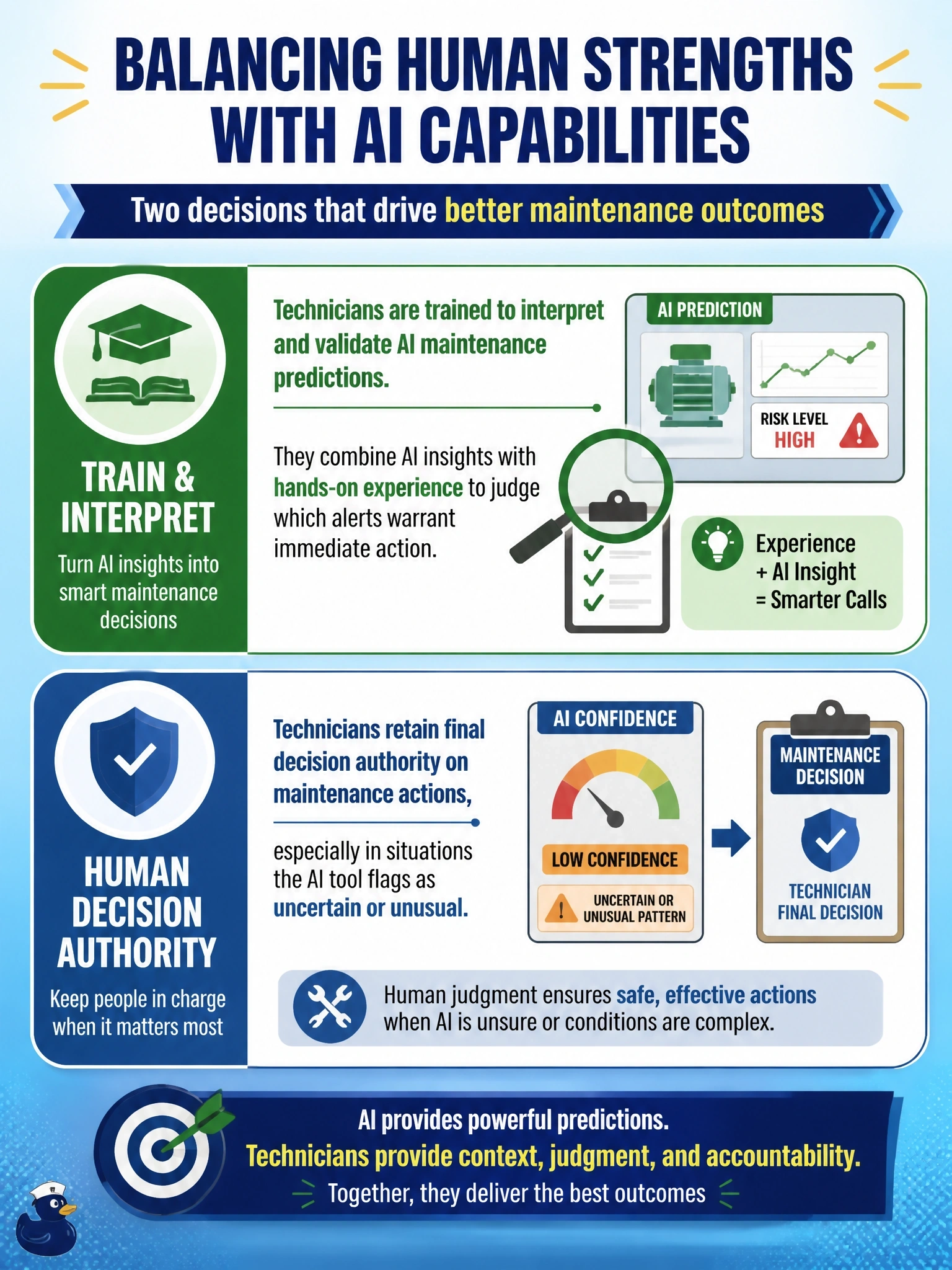
Short Explanation
The tool flags what to look at; the technician still decides what to do about it. Especially when the AI itself says a case looks unusual — that's exactly when you want a person with hands-on experience making the call, not the algorithm running unsupervised.
Full Explanation
Training technicians to interpret and validate AI maintenance predictions puts their hands-on experience to work judging which alerts warrant immediate action, and preserving their final decision authority on maintenance actions, especially in situations the tool flags as uncertain or unusual, keeps human judgment exactly where the tool is least reliable. Directing technicians to perform every maintenance action the AI tool recommends without independent review abandons oversight entirely and risks acting on false positives or missing context the tool has no way to detect. Removing technicians from maintenance decisions altogether, with the AI tool given full authority over scheduling and execution, eliminates the collaboration and judgment this kind of role shift is specifically meant to preserve. Asking technicians to double-check the AI tool's math using manual statistical calculations before trusting any prediction is a technical, mathematical task well outside the scope of a business-focused oversight role, and it isn't a realistic or valuable use of a technician's time or expertise. The operational check: balancing human strengths with AI capability means keeping people in the interpretation and decision loop, not asking them to either blindly execute AI output or replicate its technical calculations by hand.