
An agribusiness has separate crop and livestock divisions, each of which collects its own weather and soil-moisture data. Leadership wants to pool this data to power a company-wide AI tool that recommends resource allocation across both divisions. Select the TWO elements a data-sharing framework between the divisions should address. (Select TWO.)
Select all correct answers, then click Submit.
Short Explanation
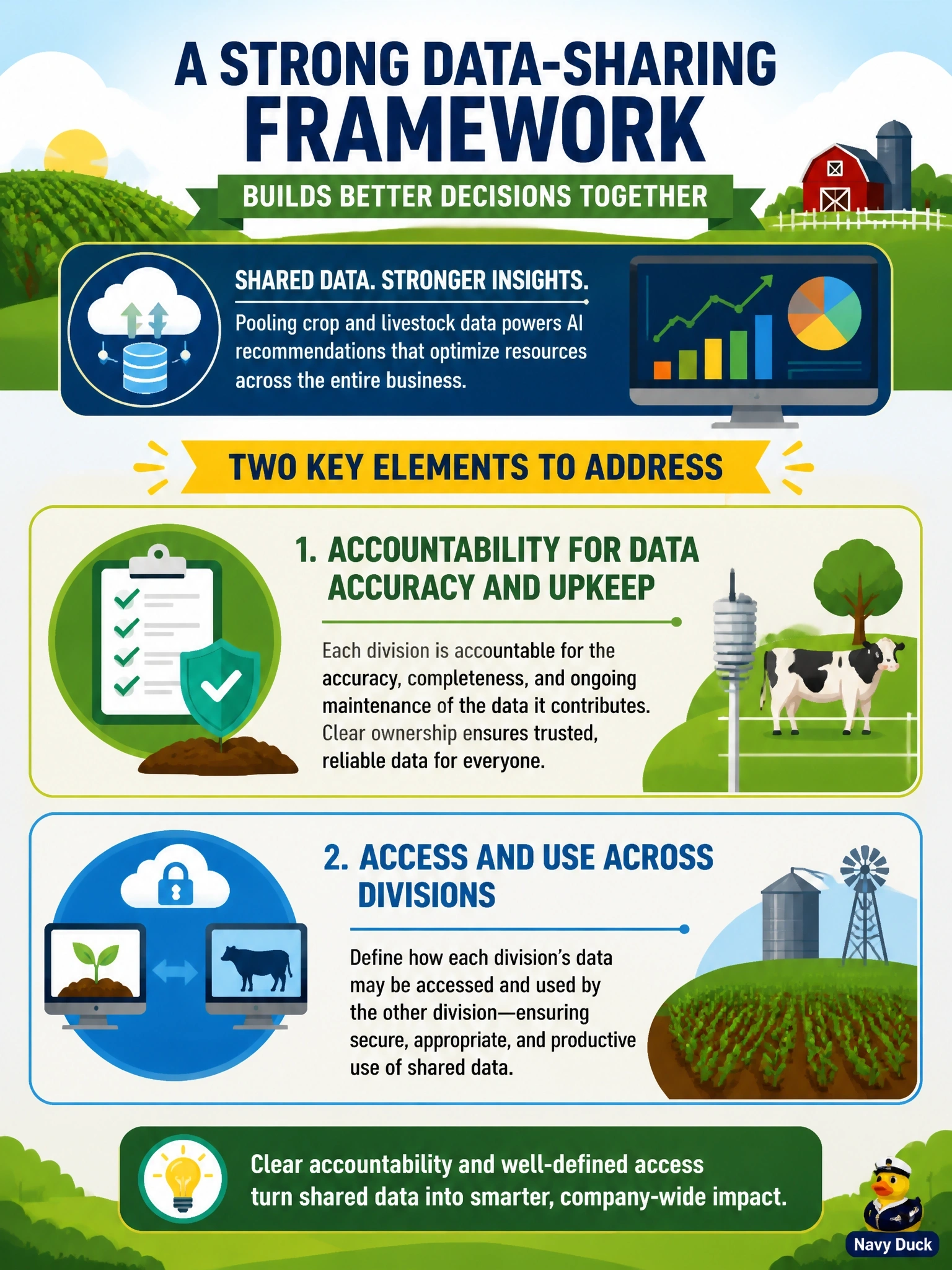
Once you pool two divisions' data, somebody has to own each set's accuracy and somebody has to spell out who's allowed to touch what — that's the whole job of your data-sharing framework. Picking a cloud instance or an algorithm is a technical decision for later, not a governance question you need to settle here.
Full Explanation
A data-sharing framework between the two divisions should assign accountability for the accuracy and upkeep of each division's contributed data, and define how each division's data may be accessed and used by the other — these are exactly the governance questions that arise once two previously separate data sets are pooled into a shared tool. Which cloud compute instance type will run the recommendation model is a technical infrastructure decision that sits outside data-sharing governance and outside what a business leader is expected to decide when standing up this framework. The specific algorithm the model will use to generate recommendations is a modeling and technical choice, not a question of who controls or can use the underlying data. The color scheme used in each division's internal reporting dashboards is a cosmetic detail about presentation, irrelevant to how the pooled data itself is governed or shared between the two sides. The operational check: a data-sharing framework should define who owns each data set's quality and the terms of cross-team access and use, leaving technical implementation choices like compute, algorithms, or presentation to the teams building the tool.