
A disability insurance carrier uses a GenAI assistant to help claims examiners summarize medical records referenced in a benefits determination. The carrier is designing safeguards against the tool fabricating details that never appeared in the source records. Select the TWO safeguards that would most directly address this hallucination risk. (Select TWO.)
Select all correct answers, then click Submit.
Short Explanation
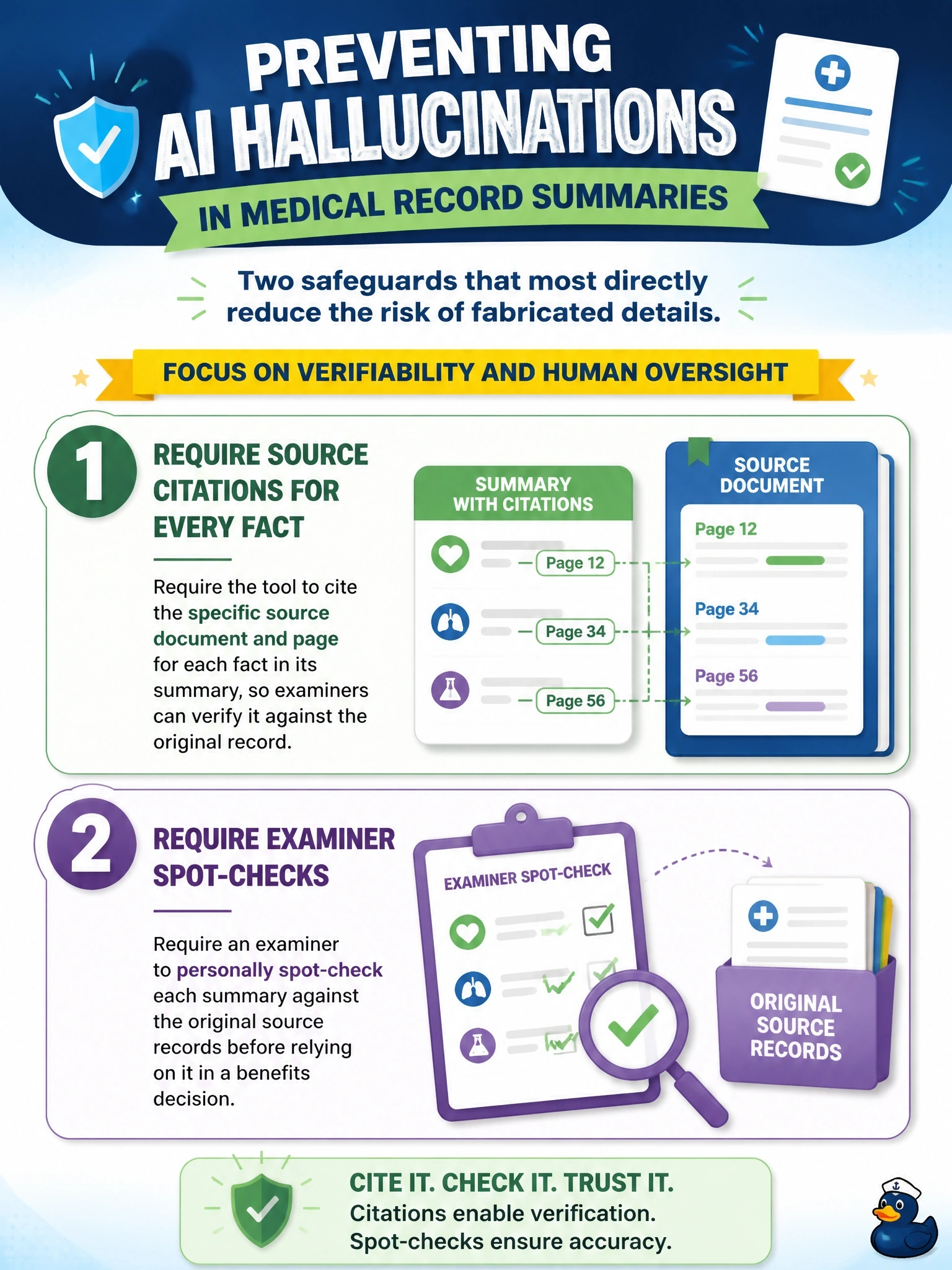
A summary you can't check against the source is just a story someone's asking you to trust. Requiring the tool to cite exactly where each fact came from, and requiring an examiner to actually check it, turns "trust me" into "verify me" — that's what catches a fabricated detail before it drives a benefits decision.
Full Explanation
Requiring the tool to cite the specific source document and page for each fact makes fabricated content detectable, since an examiner can trace any claim straight back to the original record, and requiring an examiner to personally spot-check summaries against those records before relying on them adds the human verification step that catches whatever the citation requirement doesn't. Publishing a general disclaimer that the tool may occasionally produce inaccurate or incomplete information is passive risk acceptance rather than a verification safeguard — it tells examiners a hallucination is possible without giving them any way to identify which specific fact, if any, is fabricated in a given summary. Restricting every summary to a single short paragraph constrains length, but a hallucinated fact can appear just as easily in a short summary as a long one, so shrinking the output does nothing to address the underlying source-fidelity problem. Increasing the speed at which the tool generates summaries targets throughput, which has no bearing on whether the content produced is accurate, and processing claims faster doesn't help catch fabricated details — if anything, it raises the stakes of missing one. The operational check: a real hallucination safeguard makes a claim traceable to its source and puts a human in the loop to confirm it, rather than relying on volume, brevity, or a disclaimer to manage the risk.