
A telecom carrier is standing up an enterprise AI governance committee to oversee its growing portfolio of AI initiatives, including a network-anomaly-summarization tool and a customer-churn-prediction dashboard. Select the TWO characteristics the committee should have to be effective. (Select TWO.)
Select all correct answers, then click Submit.
Short Explanation
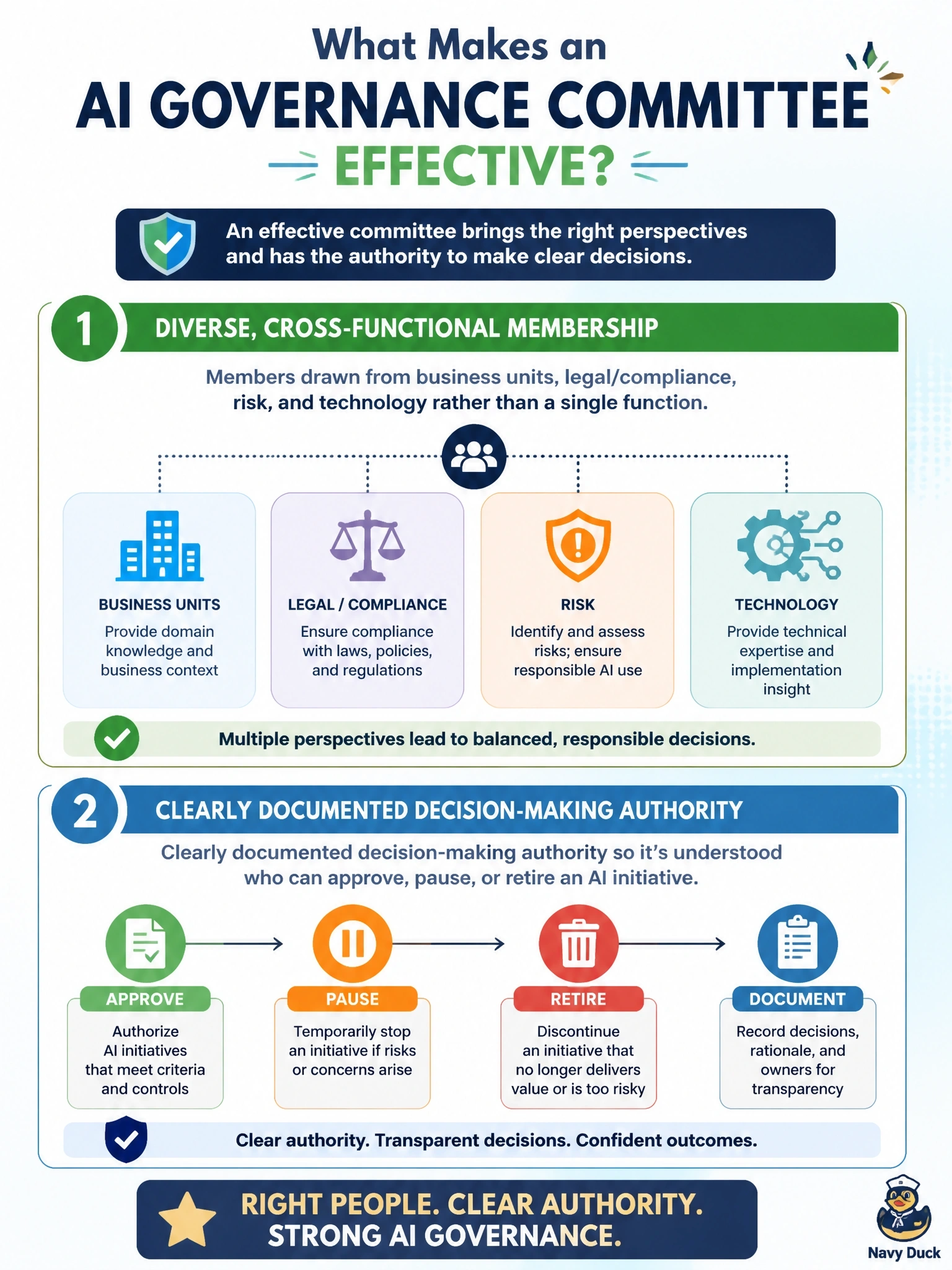
A committee that's all engineers, or that only meets after launch, isn't really governing anything. You need people from legal, risk, and the business in the room, and everyone needs to know who actually has the authority to say yes, pause, or kill a project.
Full Explanation
Cross-functional membership (business, legal/compliance, risk, technology) ensures the committee weighs more than technical feasibility, and documented decision-making authority ensures the committee can actually act rather than just discuss — together these are the two pillars of an effective governance body. Limiting membership to the data scientists and engineers who built the models defeats the purpose of cross-functional oversight; technical builders can't independently judge legal or business risk. Narrowing the mandate to cost savings ignores the risk-oversight function that governance exists to provide — cost is one input, not the whole job. Restricting the committee to reviewing initiatives only after they've launched removes it from governance by design; problems caught post-launch are more expensive and harder to fix than problems caught during planning. The general principle: an effective governance body needs both broad representation and real authority applied early in the lifecycle, not narrow membership or after-the-fact review.