
A telehealth provider wants a GenAI assistant, built on Amazon Bedrock, to independently suggest likely diagnoses to patients in underserved rural areas who currently wait weeks for a physician appointment, arguing this expands access to care. Clinical and legal leadership are concerned that unsupervised AI-suggested diagnoses could lead to missed or incorrect care. Select the TWO approaches that would best resolve this tradeoff between access and safety. (Select TWO.)
Select all correct answers, then click Submit.
Short Explanation
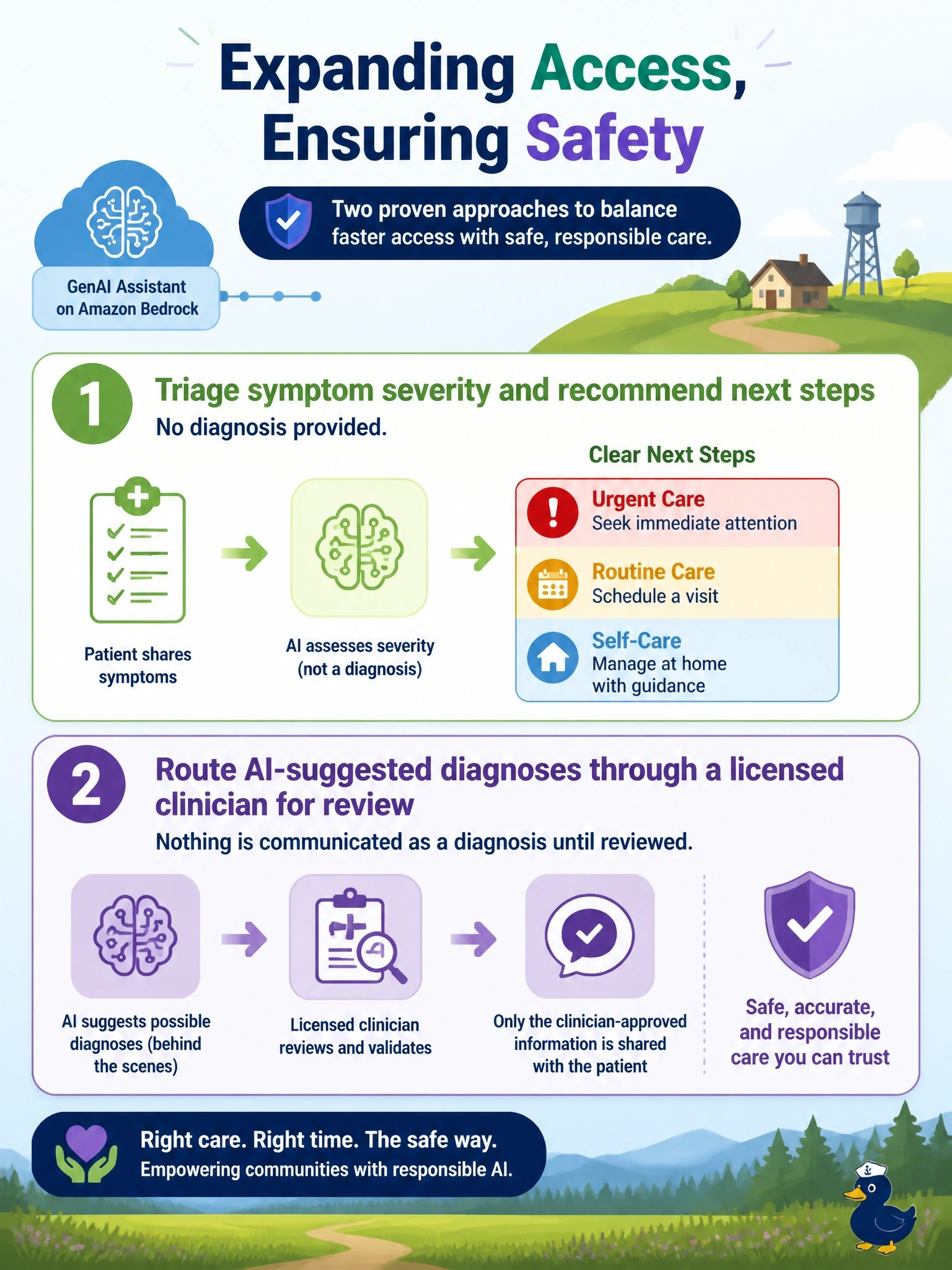
Think of this like a nurse triage line: you don't need a doctor to tell you "go to the ER now" versus "you can wait for your regular appointment" — that's a severity call, not a diagnosis. The AI can handle that layer, but anything that sounds like an actual diagnosis needs a licensed clinician's eyes on it before it reaches the patient.
Full Explanation
Requiring clinician review before any diagnosis reaches a patient, and reframing the tool's unsupervised role as severity triage rather than diagnosis, both let the provider expand access in rural areas without letting an unsupervised model make clinical calls it is not cleared to make. Letting the AI communicate a suggested diagnosis directly, softened by a disclaimer, is tempting as a fast, low-cost way to expand access, but the disclaimer does not substitute for clinical oversight: a warning that a diagnosis "may be wrong" does not reduce the real risk of a patient acting on incorrect information given the potential harm from a missed or wrong diagnosis. Ramping up marketing of the unsupervised tool before clinical review is complete accelerates deployment of the very unsupervised diagnostic capability that concerned clinical and legal leadership, making the risk worse rather than resolving it. Removing the tool entirely is an overcorrection: it eliminates all value from the tool when narrower, safer roles, such as triage, can responsibly expand access without unsupervised diagnosis. The general principle: when a business goal like access conflicts with a safety concern, look for a narrower scope for the AI system, such as triage instead of diagnosis, that preserves the underlying benefit while keeping the highest-risk decision with a qualified human.