
A public housing authority wants to deploy a GenAI eligibility screening tool to cut application processing time in half amid a severe applicant backlog. A fairness review finds that the model, trained on historical approval data, would reproduce past discriminatory denial patterns against families using housing vouchers if deployed as-is. Select the TWO actions that represent an appropriate way to navigate this tradeoff. (Select TWO.)
Select all correct answers, then click Submit.
Short Explanation
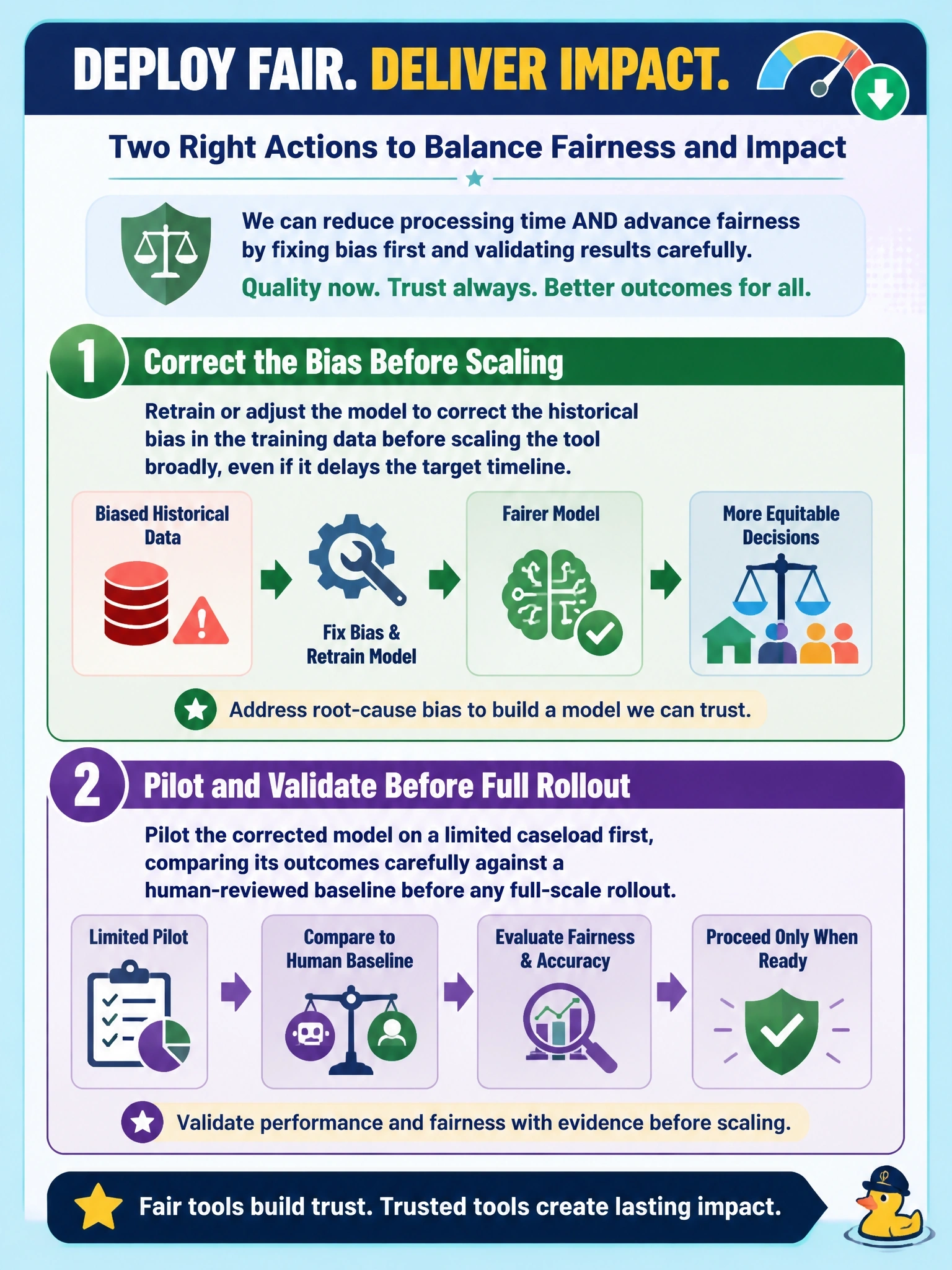
When a fairness review catches real bias before launch, the fix isn't to freeze the project or ship it anyway — it's to correct the root cause and then prove the fix works on a small scale before you trust it at full scale. Think of the pilot as a safety net under the retrain: you check your work against a human baseline before you let the model run the show.
Full Explanation
Correcting the historical bias in the training data before scaling, and then piloting that corrected model on a limited caseload against a human-reviewed baseline, together address the root cause while still moving the project toward its backlog-reduction goal in a controlled, verifiable way. Launching the tool immediately at full scale and addressing bias findings later knowingly deploys a system that would reproduce discriminatory denial patterns against families using housing vouchers — that's unacceptable once the harm is identified and foreseeable, not merely speculative. Suppressing the fairness review's findings so leadership avoids accountability for the resulting delay isn't a legitimate way to navigate a tradeoff at all; it's a governance failure that exists independently of the underlying fairness question, and it leaves the discriminatory pattern completely unaddressed. Continuing the fully manual process indefinitely treats manual review as costless, but it ignores that the backlog itself harms applicants who are waiting on housing decisions, so permanently abandoning the automation effort isn't a genuine resolution of the tradeoff either — it just trades one harm for another. The operational check: a defensible response to a bias finding fixes the identified cause, validates the fix against a real baseline on limited exposure, and only then scales — it never ships known bias to hit a date, and it never buries the finding to dodge a hard conversation.