
A national auto and home insurer's GenAI underwriting assistant, built on Amazon Bedrock, drafts premium adjustment recommendations. An audit finds the tool (1) sometimes fabricates policy clauses that do not exist in the underwriting manual, and (2) occasionally surfaces applicants' driving records to underwriters who are not authorized to view them. Select the TWO responsible AI dimensions most directly implicated. (Select TWO.)
Select all correct answers, then click Submit.
Short Explanation
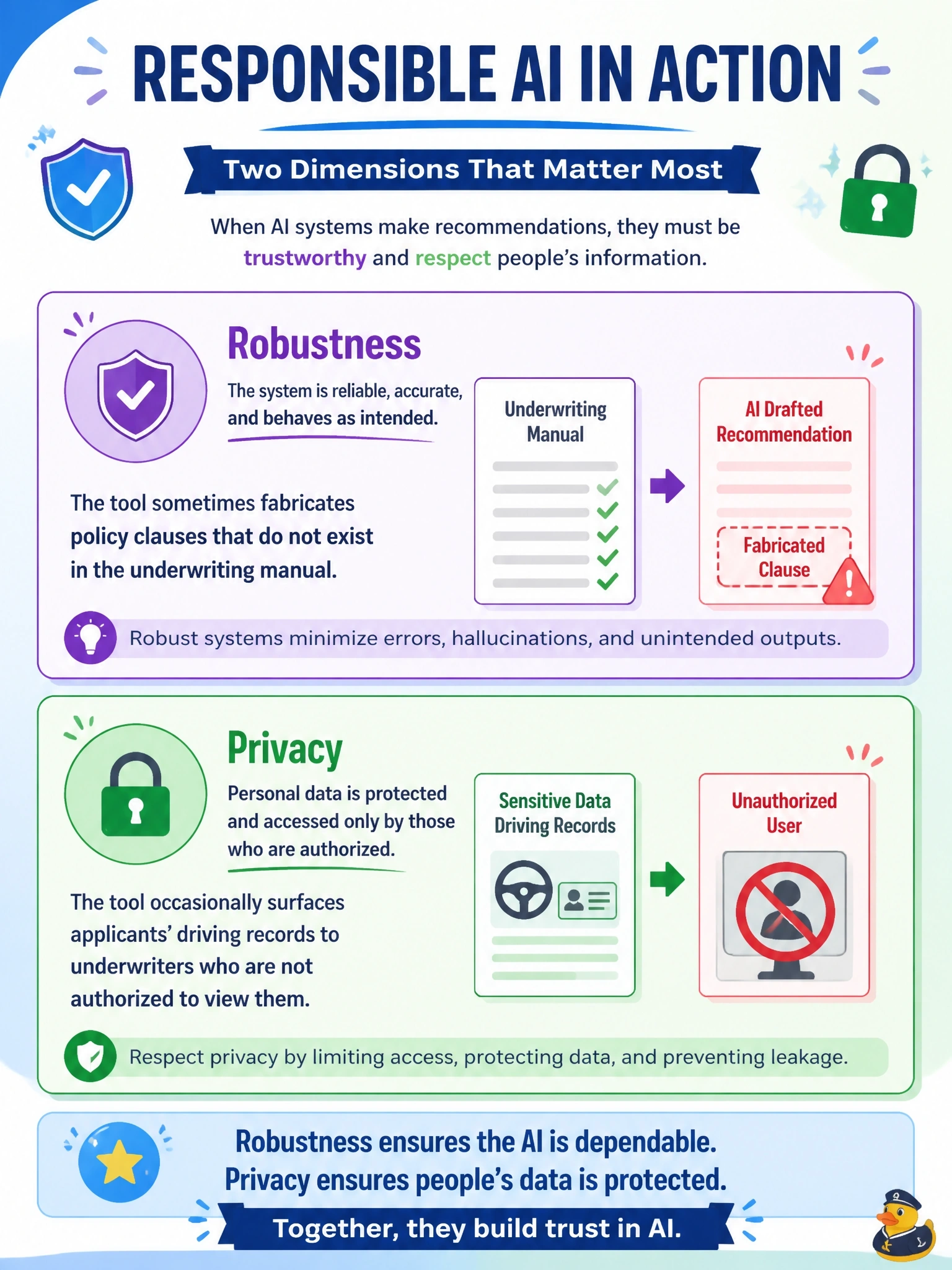
You're looking at two separate failure modes here, so don't lump them together: fabricating policy clauses is a correctness problem that falls under veracity and robustness, while showing driving records to underwriters who aren't authorized to see them is purely an access-control problem under privacy. Fixing one won't fix the other, which is exactly why your audit needs to call out both.
Full Explanation
Fabricating policy clauses that don't exist in the underwriting manual is a hallucination, and AWS places output correctness under its veracity and robustness dimension, defined as achieving correct system outputs, even with unexpected or adversarial inputs; grounding the assistant in the underwriting manual is the fix. Surfacing applicants' driving records to underwriters who aren't authorized to view them is a different failure entirely — it's an access-control breakdown over personal data, which falls squarely under privacy (AWS's privacy and security dimension: appropriately obtaining, using, and protecting data and models). Transparency is about disclosing that AI is involved and how it works, not about whether the content it produces is accurate or who is permitted to see sensitive data, so neither finding maps to it. Explainability concerns whether a decision's reasoning can be understood after the fact; inventing a policy clause is a content-accuracy failure, not a reasoning-transparency failure. Safety, in AWS's framing, is about preventing harmful system output and misuse; an invented clause can lead to a bad premium decision, but the root failure the audit describes is incorrect output, which is the veracity and robustness dimension. The operational check: when an audit turns up multiple findings, map each one to the single dimension it actually violates rather than lumping them together, since the fix for a hallucination (grounding and citation) is very different from the fix for an access leak (role-based permissions).