
An online retailer is comparing two AI initiatives it is deciding whether to prioritize. Select the TWO signs that an initiative is more likely to produce a sustainable advantage rather than one competitors could copy within months. (Select TWO.)
Select all correct answers, then click Submit.
Short Explanation
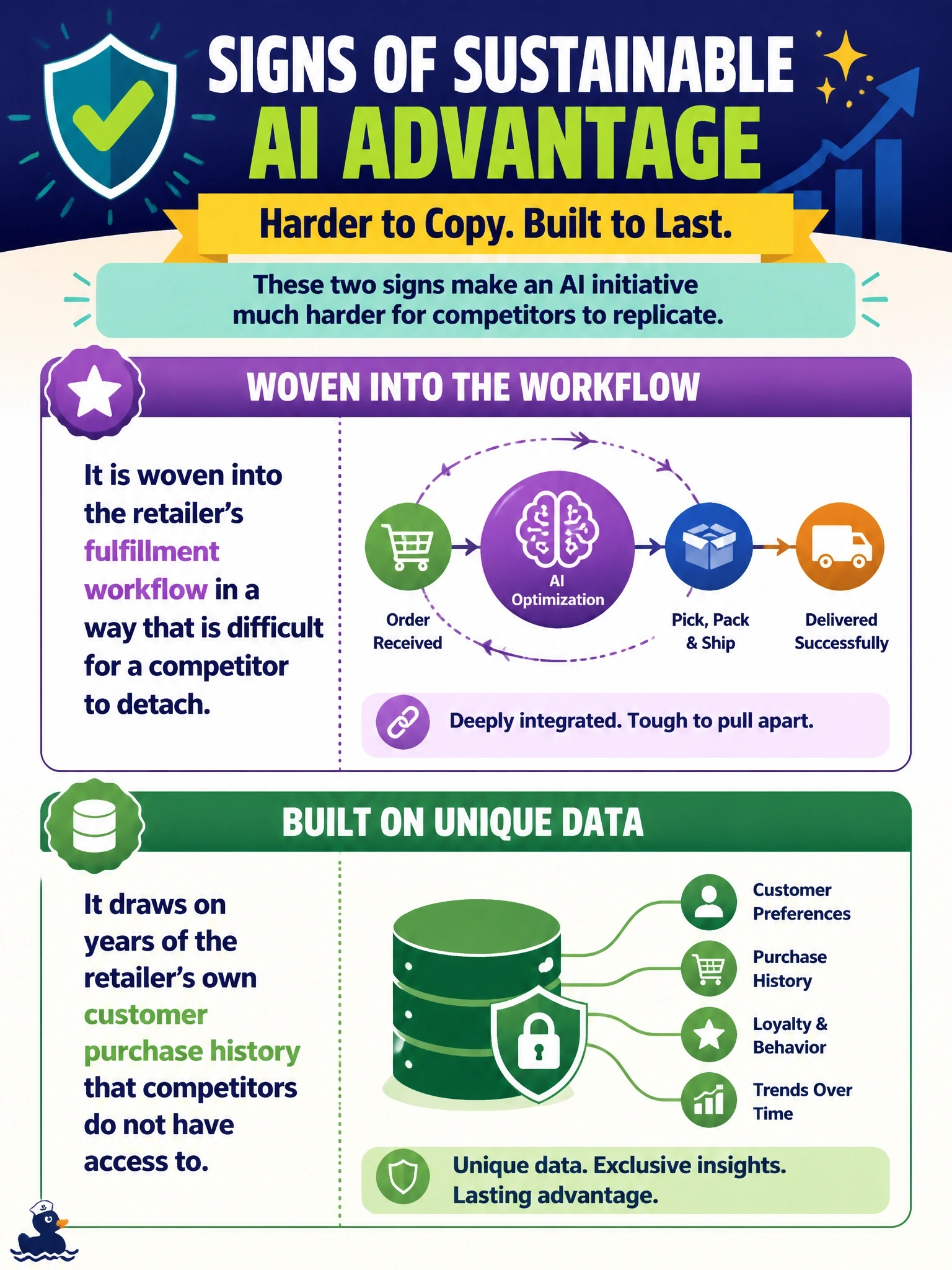
Look for advantages a rival can't just copy over a weekend: years of your own purchase history nobody else has access to, and a capability so deeply stitched into your fulfillment workflow that it can't be lifted out and dropped into someone else's operation. Being first in the trade press, or having a catchy project codename, doesn't stop anyone from copying the underlying idea.
Full Explanation
A durable advantage rests on assets that are hard for competitors to acquire quickly: proprietary historical data, and deep integration into a workflow that can't simply be lifted out and copied. Both raise the cost and time a competitor would need to replicate the result. Using a subscription AI tool that several other retailers have already gone ahead and licensed themselves describes the opposite situation, a tool already licensed by multiple retailers offers no differentiation, since any of them can achieve the same outcome. Being the first such feature that industry trade press outlets happened to cover this year reflects media coverage, which signals attention, not defensibility; being first to be written about doesn't stop a competitor from copying the underlying capability. Having a catchy internal project name that resonates with the marketing team is an internal branding detail with no bearing on whether outsiders can replicate the capability. The principle: judge sustainability by what data or workflow the initiative depends on, not by how it's licensed, publicized, or named internally. A practical test: could a competitor buy the same result off the shelf? If so, it isn't sustainable.