
A retail chain wants to build an AI-driven personalization capability that is difficult for competitors to copy. Select the TWO factors that would most contribute to making the resulting advantage sustainable rather than easily replicated. (Select TWO.)
Select all correct answers, then click Submit.
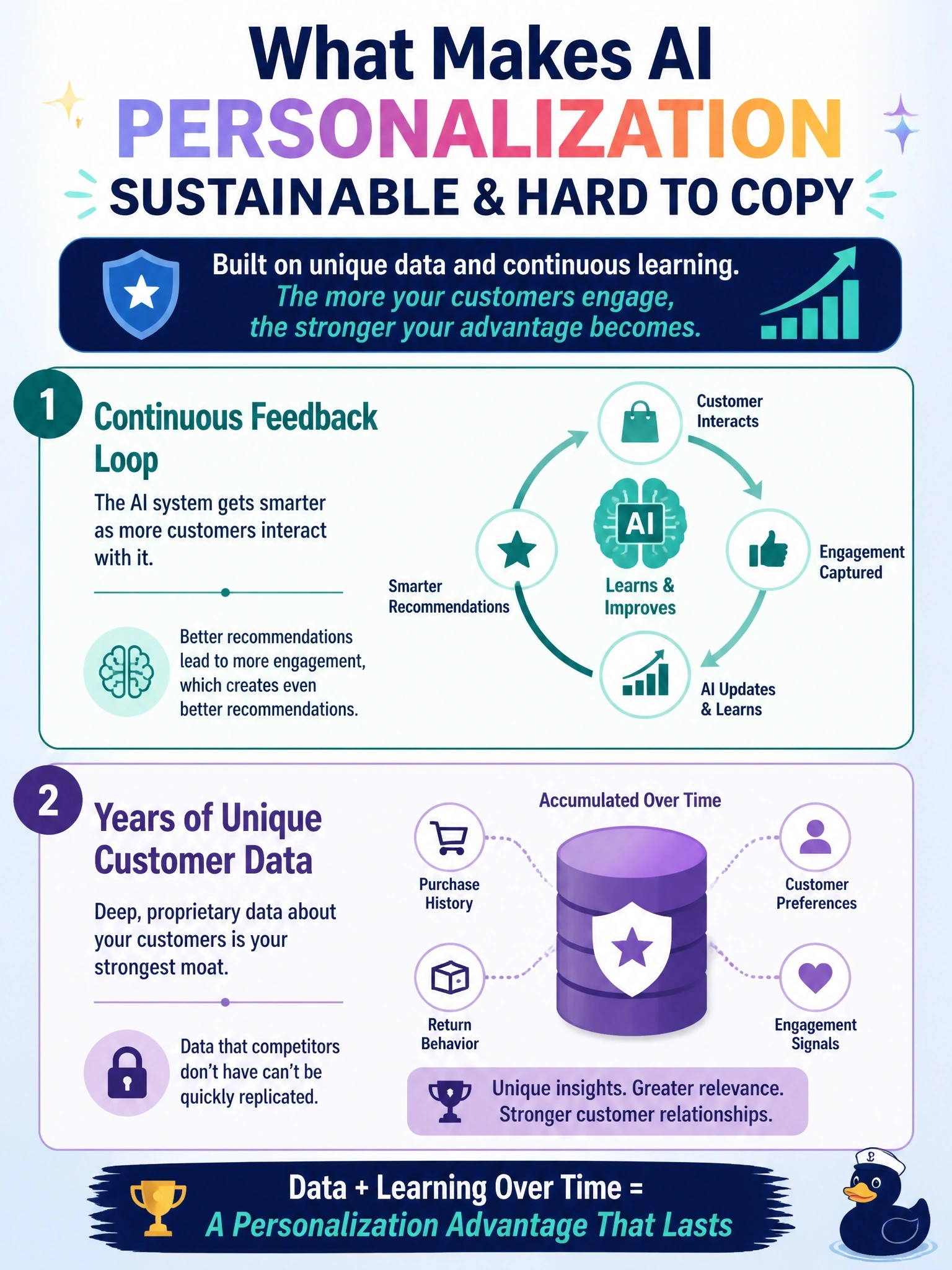
Short Explanation
A moat isn't built from a press release — it's built from things a competitor can't just go buy: years of your own customer data, and a feedback loop where the system keeps getting better the more people use it. Both compound over time. Picking the cheapest tool, or the same tool three other retailers already have, is the opposite of a moat — it's a commodity.
Full Explanation
Sustainable advantage comes from assets a competitor cannot quickly acquire: proprietary data built up over time, and a compounding feedback loop that keeps improving as usage grows. Both make the capability harder to replicate the longer the company operates it. Selecting the same off-the-shelf AI tool that several other retailers have already gone ahead and licensed is the opposite of a durable advantage, a tool multiple competitors already use offers no differentiation, since any of them can use it the same way. Publishing a press release describing the feature as groundbreaking is a marketing action that affects perception, not the underlying defensibility of the capability. Choosing whichever available AI tool carries the lowest per-seat monthly subscription price today is a cost consideration; picking a cheaper tool has no bearing on whether the resulting capability is hard to copy. The generalizable rule: proprietary data and compounding feedback loops create durable advantage, while shared tools, price, and publicity do not. A practical check: ask whether a well-funded competitor could replicate the capability within a year using only money, if yes, it isn't a moat.