
An automotive fleet operator is scaling its predictive-maintenance AI program from one regional fleet to the entire national fleet. Select TWO practices that represent appropriate cost control as the program scales. (Select TWO.)
Select all correct answers, then click Submit.
Short Explanation
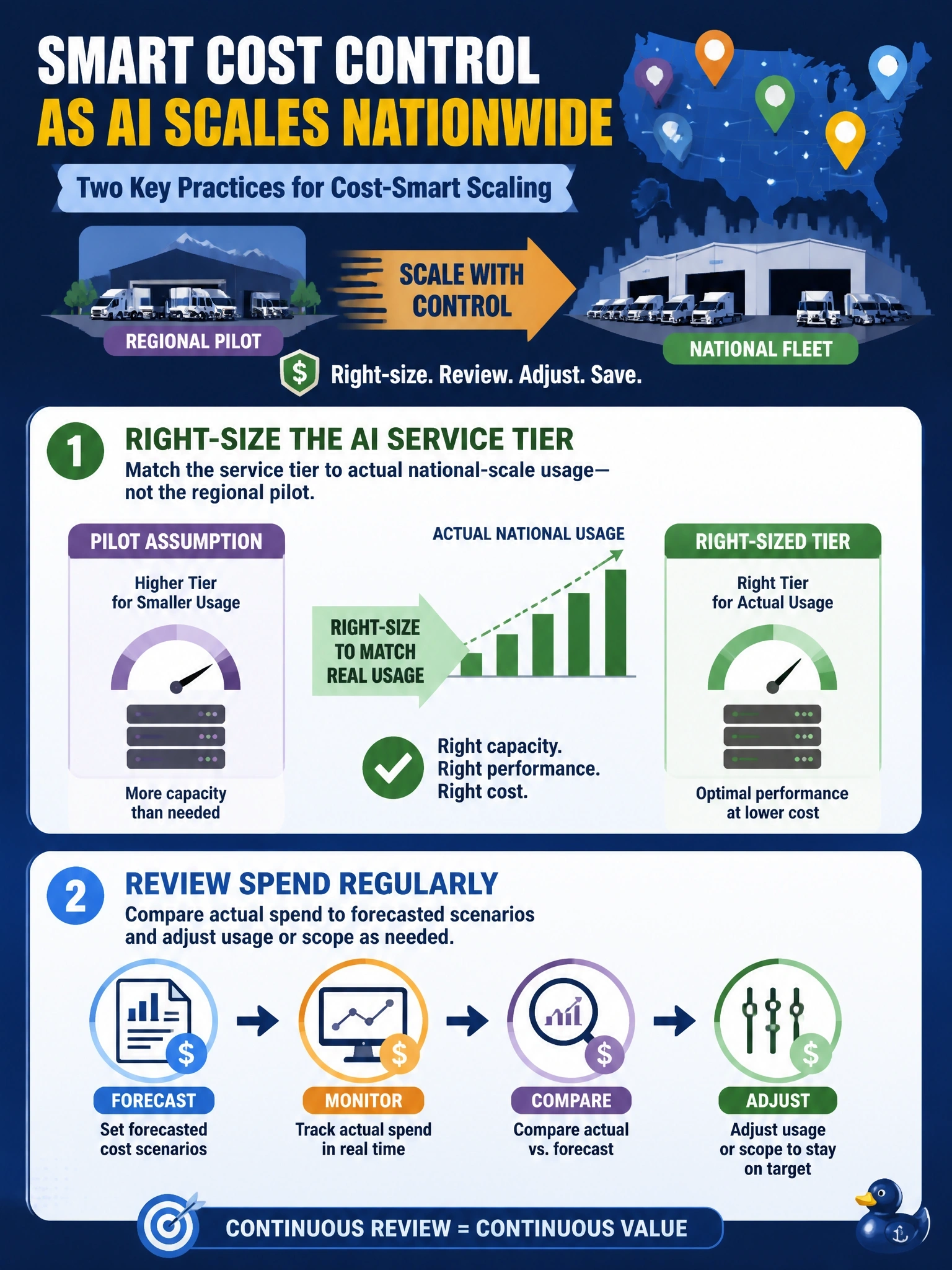
Scaling well means treating the budget as a living thing, not a set-it-and-forget-it number: right-size the service tier to match how the whole fleet actually uses it, and keep checking real spend against what you forecast so you can adjust. Locking in the pilot's exact budget, assuming costs scale in a straight line with vehicle count, or expanding everywhere at once without looking at pilot data — those all skip the checking part.
Full Explanation
Regularly reviewing spend against forecasted scenarios and right-sizing the service tier to match actual national-scale usage are both active, ongoing cost-management practices that keep spending aligned with real usage as the program grows. Locking in the regional pilot's exact budget as the permanent national budget with no further review ignores that costs and usage patterns typically change at larger scale and removes the flexibility needed to manage a bigger program. Expanding to all regions simultaneously without reviewing cost data from the pilot skips the opportunity to apply lessons learned before committing to full-scale spend. Assuming costs will scale in the same fixed proportion as the number of vehicles without validating usage patterns treats a rough assumption as fact, which can lead to significant budget surprises if actual usage doesn't scale linearly. The general principle: cost control during scaling requires ongoing review and right-sizing based on real data, not one-time assumptions, fixed budgets, or skipping validation before expanding. A practical check: revisit the service tier and forecast at each expansion milestone, not just once at the start.