
A freight carrier's leadership is building a monitoring dashboard for its new AI load-matching tool, now three weeks into its pilot. Select TWO metrics that qualify as leading indicators for this pilot. (Select TWO.)
Select all correct answers, then click Submit.
Short Explanation
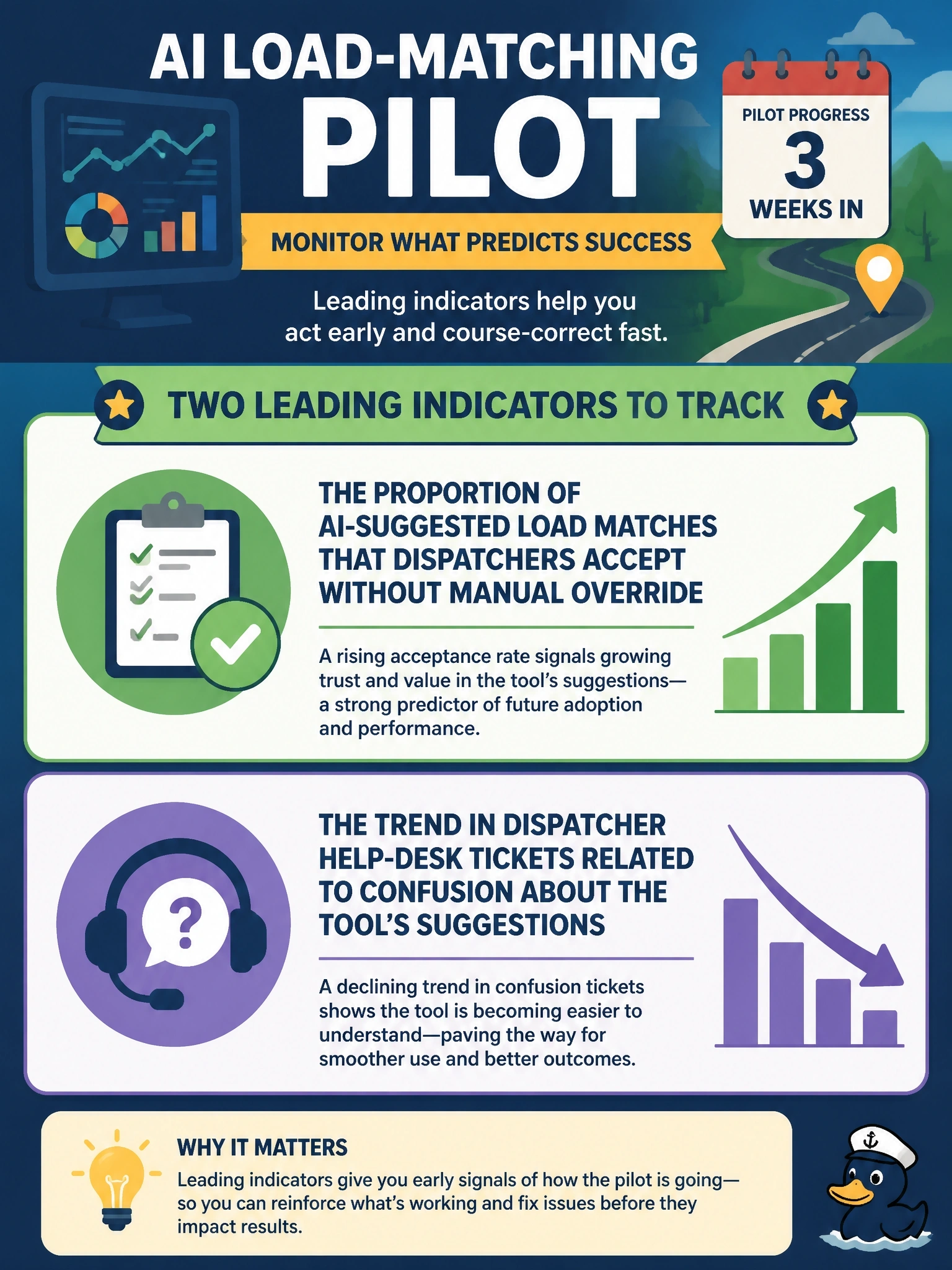
A leading indicator has to do two things: show up early, and actually predict how the pilot will land. Dispatcher acceptance rate and a rising or falling trend in confused-dispatcher help tickets both do that, right now, three weeks in. Year-end revenue or an industry ranking won't tell you anything until it's far too late to act on it.
Full Explanation
Dispatcher acceptance rate and the trend in confusion-related help-desk tickets are both observable early in the pilot and predict whether the tool will be adopted successfully at scale, making them true leading indicators. Annual revenue growth reported at the company's fiscal year-end and the carrier's overall industry ranking published at year-end are both lagging, outcome-level measures that can only be assessed long after the pilot period and don't help guide decisions during it. The total number of trucks the company owns is a static resource count unrelated to how well the AI tool itself is performing or being adopted. The general principle: leading indicators must be both early, observable during the pilot, and predictive, tied to the specific initiative's adoption or performance, which rules out year-end financial results, industry rankings, and fixed resource counts. A practical check: if a metric can only be measured after the pilot ends, it's a lagging indicator, not a leading one, no matter how important it eventually is.