
A logistics warehouse is about to deploy an AI tool that optimizes pick paths for warehouse staff. Select TWO metrics the team should baseline before deployment. (Select TWO.)
Select all correct answers, then click Submit.
Short Explanation
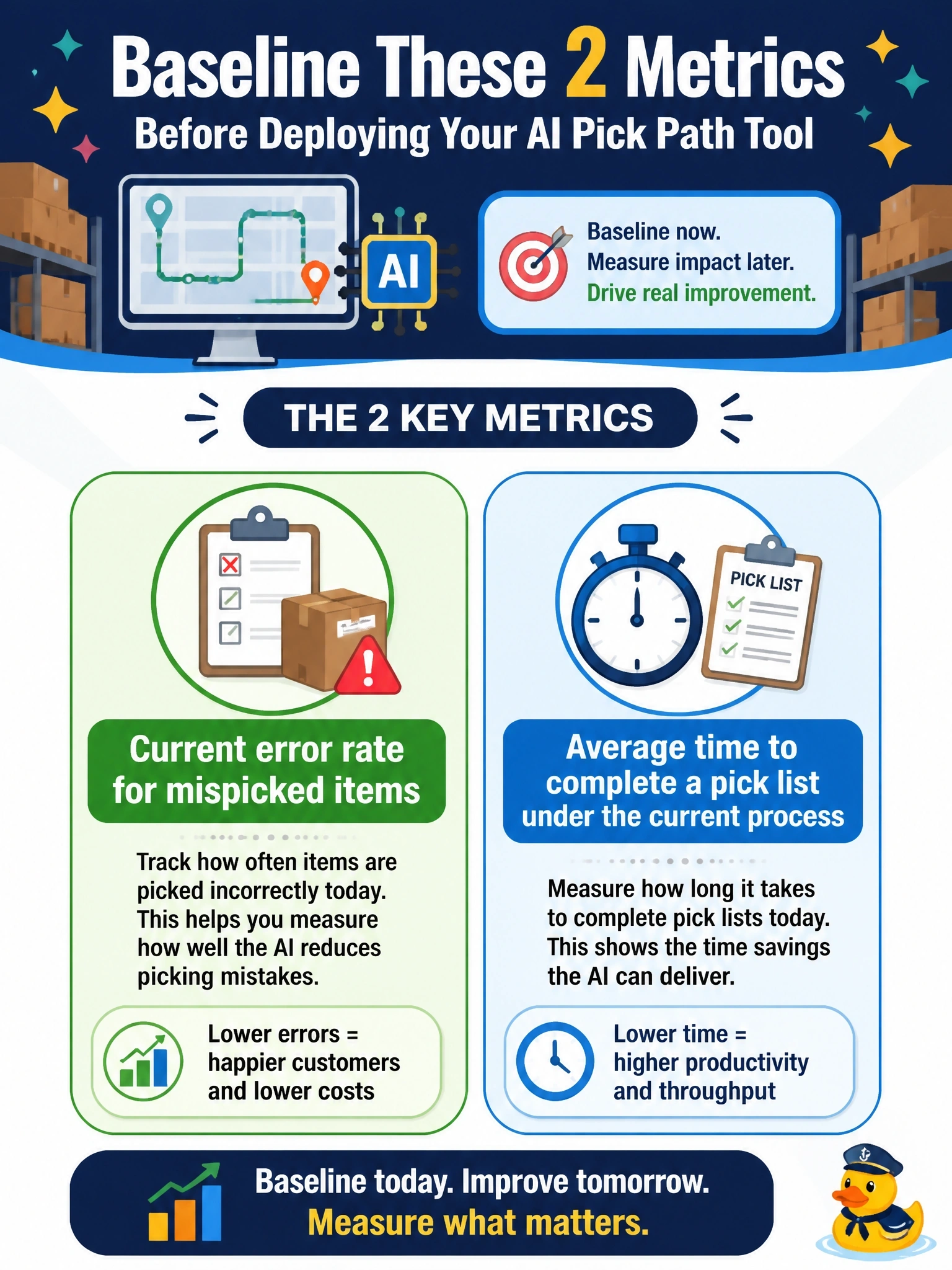
Before flipping the switch on a new tool, you need to know where you're starting from — the current mispick error rate and how long a pick list takes today. Without that baseline, there's no honest before-and-after comparison later. A vendor's marketing numbers, square footage, or how many vendors you shopped don't tell you anything about your own current performance.
Full Explanation
Average pick time and mispick error rate are the operational outcomes the AI tool is meant to improve, so both must be measured under the current process before go-live to allow a valid before-and-after comparison. The warehouse's square footage is a fixed physical attribute that the AI tool doesn't change and isn't relevant as a baseline for its effect. The AI vendor's published accuracy claims describe the vendor's own marketing or lab results, not this warehouse's actual current performance, so they can't substitute for an internal baseline. The number of AI vendors evaluated during procurement is a process detail unrelated to operational performance. The general principle: baseline metrics should reflect the organization's own current performance on the specific outcomes the AI tool targets, not fixed facility attributes or vendor-supplied figures. A practical check: if a metric wouldn't change regardless of whether the AI tool works, it isn't a baseline worth tracking.