
A corporate training company is educating client business leaders on model adaptation techniques. Select the TWO statements below that correctly describe the tradeoffs between Retrieval Augmented Generation (RAG) and fine-tuning. (Select TWO.)
Select all correct answers, then click Submit.
Short Explanation
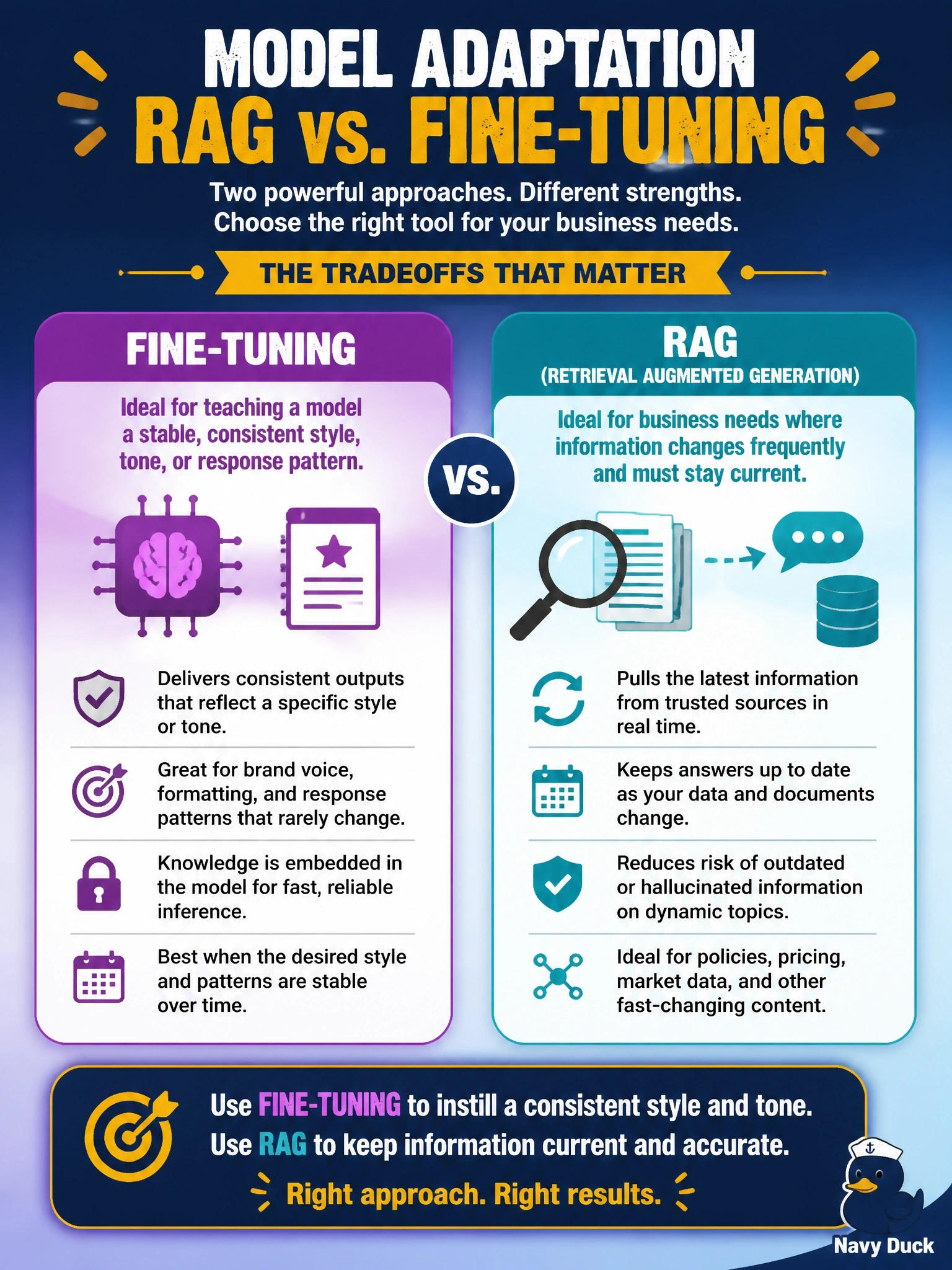
Think of fine-tuning as teaching someone a consistent voice and habits — it sticks around, good for a stable tone or style. Think of RAG as handing someone the latest briefing right before they answer — great when the facts keep changing and need to stay current. Pick based on whether what you need is consistency or freshness.
Full Explanation
RAG's strength is surfacing current, changing information at the time of a response, and fine-tuning's strength is instilling a stable style or behavior pattern, these are the two correct, complementary characterizations of the tradeoff. The claim that RAG and fine-tuning always produce identical results, so the choice never matters, is false and contradicted by how differently the two techniques actually behave: the right technique depends on the type of business need, currency versus consistency. The claim that fine-tuning is the only technique that can ever be used to improve GenAI responses incorrectly narrows the toolkit, ignoring RAG and other approaches entirely, which would mislead client leaders into thinking they have fewer options than they do. The suggestion that RAG requires retraining the underlying model every time new information becomes available misunderstands RAG's core advantage: RAG specifically avoids retraining by retrieving current information at answer time, so describing it as requiring retraining gets the technique backwards. The generalizable principle for training leaders: RAG and fine-tuning solve different kinds of problems, currency of information versus consistency of behavior, and neither replaces the other universally.