
A travel agency's GenAI-powered itinerary assistant handles multi-day trip planning conversations with customers. Select the TWO symptoms below that most strongly suggest the assistant is running into token or context window limits, rather than some other kind of problem. (Select TWO.)
Select all correct answers, then click Submit.
Short Explanation
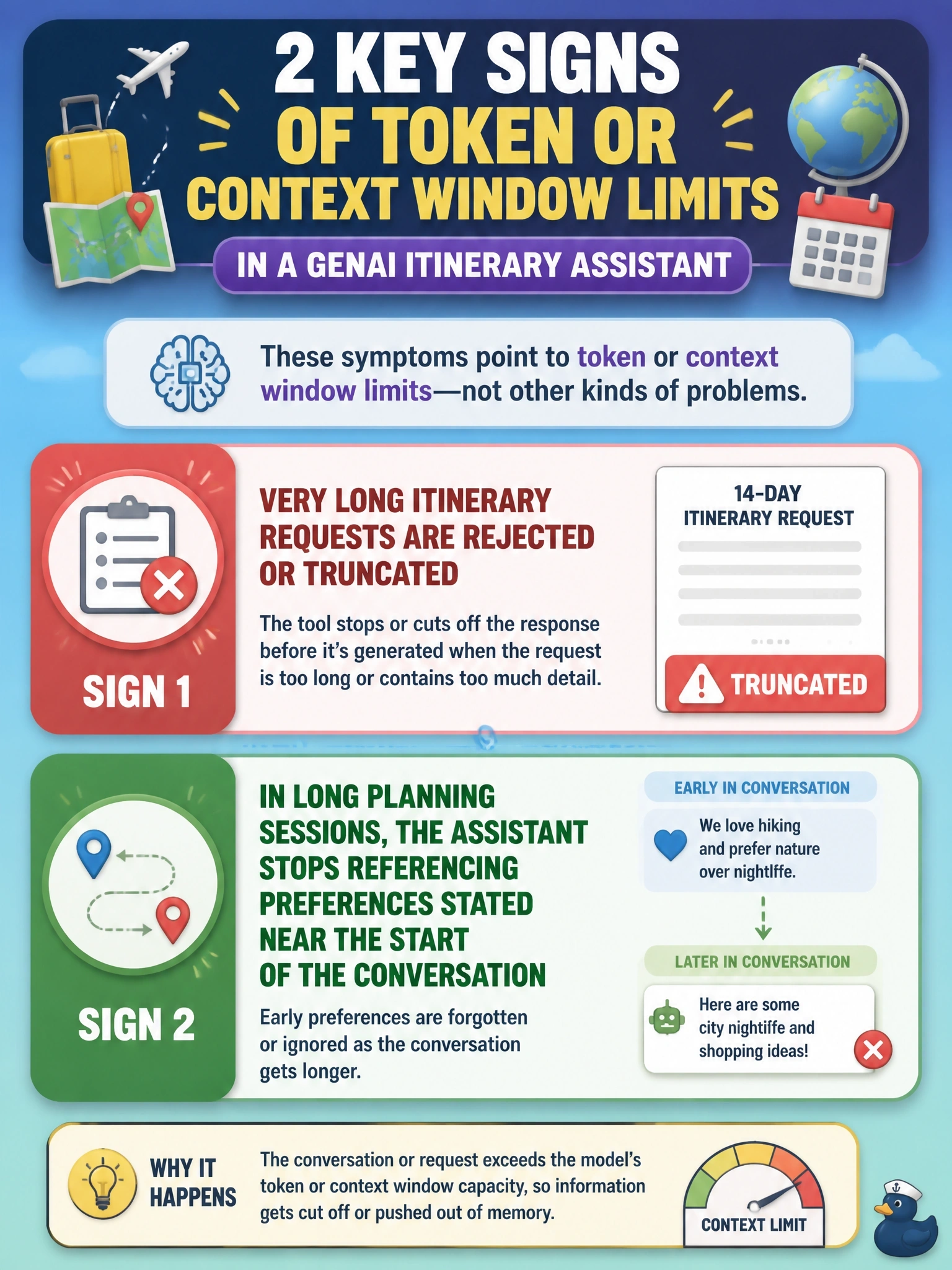
You'll know you're hitting a context window limit when the assistant flat-out rejects or truncates an oversized request, or when it quietly loses track of preferences a customer mentioned way back at the start of a long session. Both symptoms scale with how much text is in play, which is exactly why a short chat's tone shift or a factual slip points somewhere else entirely.
Full Explanation
Losing track of information stated earlier in a long conversation, and outright rejection or truncation of oversized requests, are the two classic signatures of hitting token or context window limits, both tied directly to input length. The assistant occasionally recommending a factually inaccurate destination describes a factual-accuracy problem, closer to a hallucination or data-quality issue, which is a different failure mode not explained by input length. A response style shifting from formal to casual partway through a short conversation points more toward prompting or model behavior variability than a length-driven limit, since context window issues emerge as conversations grow long, not short ones. Customers reporting the assistant unavailable during a scheduled maintenance window describes an availability and operations issue entirely unrelated to token limits. The generalizable skill being tested: distinguishing symptoms that scale with input length, context window issues, from symptoms that don't, so a business owner escalates the right root cause to the right team instead of chasing the wrong fix.