
A construction company's leadership is reviewing a vendor's proposal for an "AI agent" to manage subcontractor onboarding. Select the TWO capabilities that would justify calling this system an AI agent rather than a simpler AI tool. (Select TWO.)
Select all correct answers, then click Submit.
Short Explanation
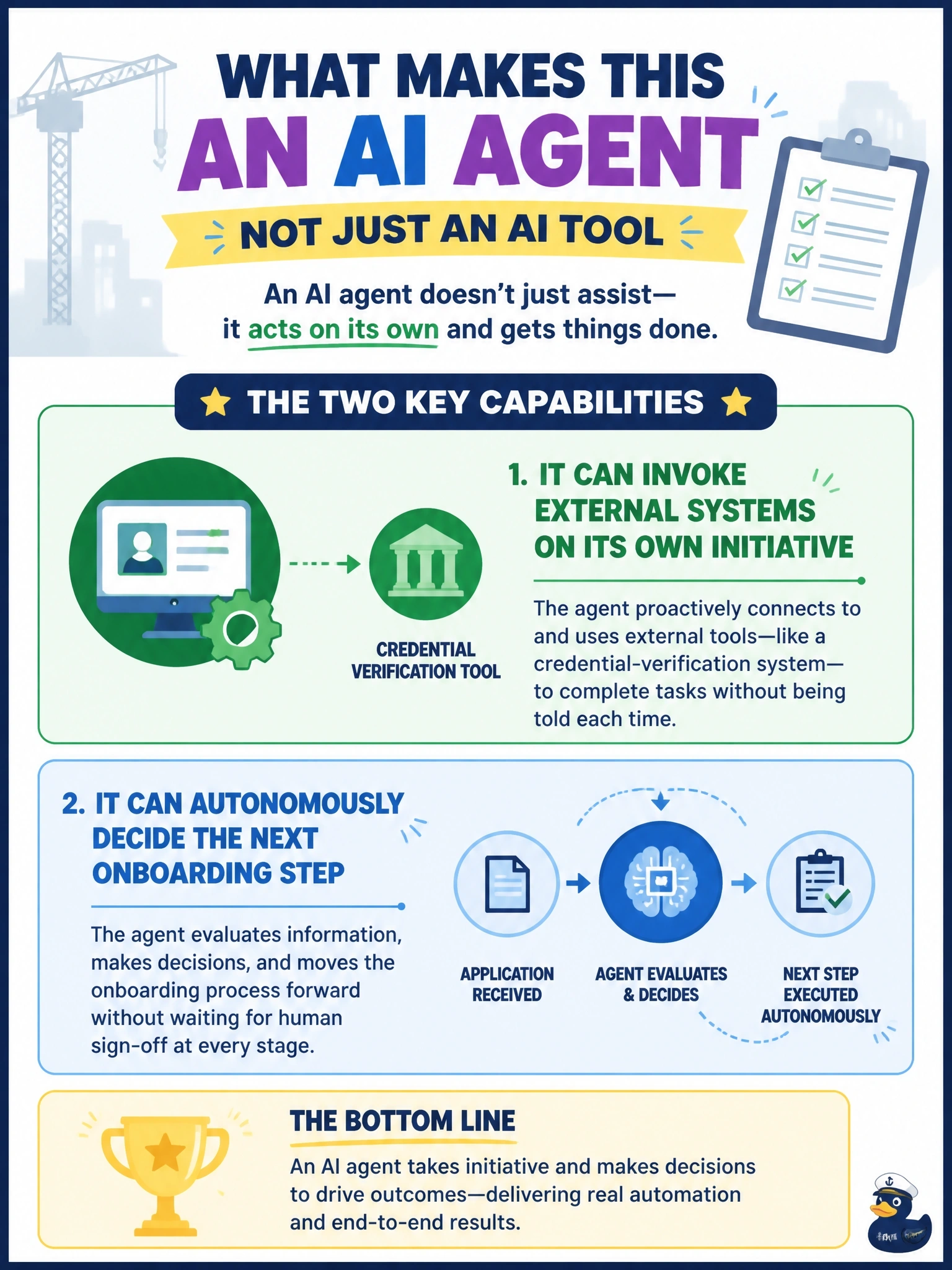
What turns a vendor's tool into a genuine agent for you is whether it can act without waiting on your sign-off — deciding the next onboarding step itself and reaching out to another system, like a credential check, on its own initiative. A tool that just fills in a template or stores records is still doing exactly what it's told, one step at a time.
Full Explanation
Autonomously deciding the next step without human sign-off, and independently invoking an external tool like credential verification, are the defining agentic behaviors: independent decision-making and self-directed tool use toward a goal. Generating onboarding letters from a template is a basic GenAI content task available in many non-agentic tools and involves no independent action; it produces output on request and stops. Storing records in a database describes data infrastructure, a supporting capability many systems have that says nothing about whether the system reasons or acts independently. Following a fixed, unchanging checklist regardless of subcontractor type is the opposite of agentic behavior, since it's rule-based automation with no adaptation or independent decision-making involved. The general principle: what qualifies a system as an AI agent is autonomous decision-making and self-directed use of tools toward a goal, not content generation, data storage, or fixed procedural steps, which are common to many non-agentic systems that leadership might otherwise mistake for agents.