
A construction company is deciding which back-office processes to automate with simple rules versus an AI-based solution. Select the TWO processes that are better suited to rule-based automation. (Select TWO.)
Select all correct answers, then click Submit.
Short Explanation
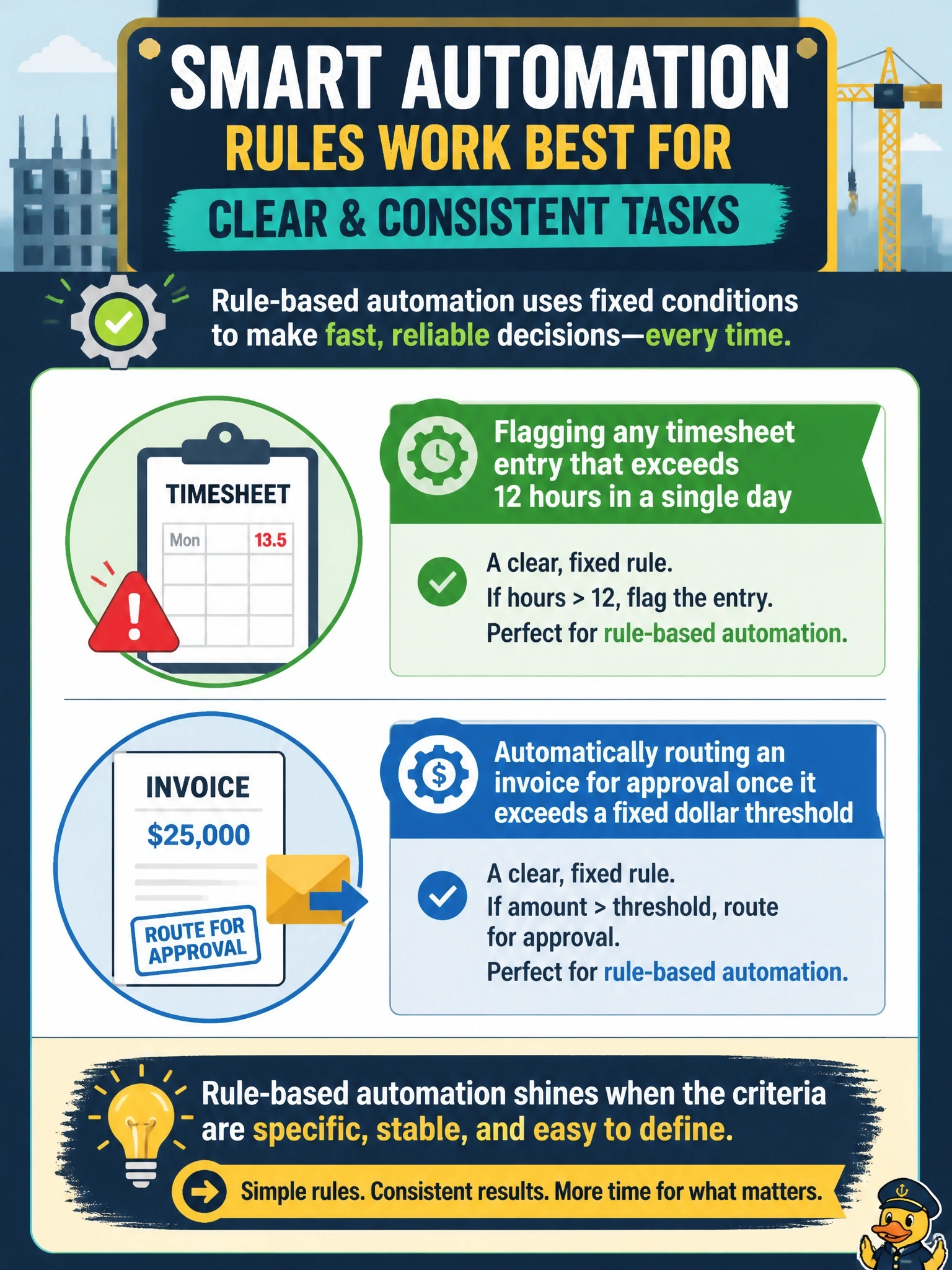
Ask yourself whether the decision rests on one fixed trigger or a pile of shifting signals — flagging a timesheet over 12 hours and routing an invoice past a dollar threshold are both the single-trigger kind, so you can hand them to a simple rule instead of a model. Forecasting risk or predicting behavior needs more than an if-this-then-that check, and that's where you'd reach for AI instead.
Full Explanation
Both correct options are single, fixed-threshold triggers: an invoice amount crossing a set dollar figure, and a timesheet entry crossing a set hour count. Neither requires interpreting interacting factors, so a simple rule handles them accurately and transparently, with no training data or model needed. Estimating a project's completion risk from evolving weather, labor, and supply-chain signals depends on those factors interacting together to produce a risk estimate, which is a pattern-recognition task better suited to AI than a fixed rule. Recommending optimal crew schedules for a live project with shifting resource availability requires balancing shifting availability across a live project, a dynamic optimization problem that static rules handle poorly as conditions change. Predicting which subcontractors are likely to bid competitively based on past behavior is a probabilistic judgment drawn from historical patterns, exactly the kind of inference AI/ML is designed for and rules are not. The general principle: processes with a single deterministic trigger point are rule-based automation candidates, while processes requiring forecasting, optimization, or behavioral prediction from multiple interacting signals call for an AI-based approach.