
A telecom program manager is building the business case for a data-quality initiative ahead of a new AI rollout. Select TWO statements that correctly explain why data quality matters for AI outcomes. (Select TWO.)
Select all correct answers, then click Submit.
Short Explanation
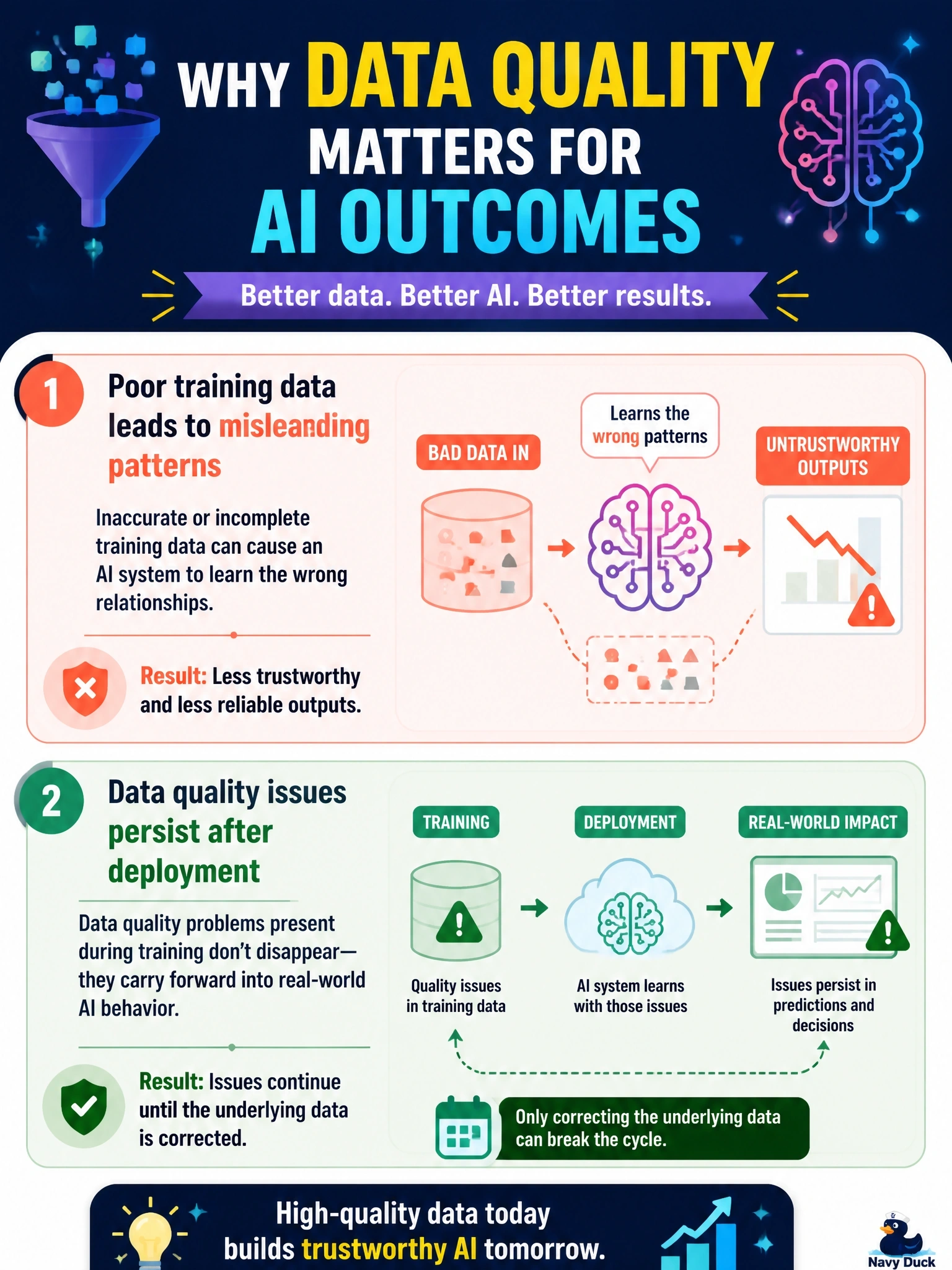
You want to watch for two things when you're building the case for data quality: bad training data teaches a model misleading patterns, and once that happens, those quirks stick around in its behavior long after deployment unless you go back and fix the underlying data. That's exactly why data quality belongs in your business case, not just a technical footnote.
Full Explanation
Poor-quality training data leads a model to learn misleading patterns, and because the model's behavior is shaped by that training, quality issues tend to persist in its outputs even after deployment unless the underlying data is corrected and the model is retrained. The claim that data quality has no measurable effect on business outcomes, only on internal technical metrics, draws a false line: unreliable predictions from a telecom AI tool can directly affect customer experience, operational decisions, and revenue, making data quality a business concern, not just a technical one. The idea that training data quality becomes entirely irrelevant once training wraps up is equally wrong — a model's ongoing behavior continues to reflect whatever patterns, accurate or flawed, it learned during that phase, so old data problems keep showing up in new outputs. The notion that high volume always compensates for low quality is a common misconception too: more data doesn't offset poor quality, and can even amplify the effect of systematic errors by reinforcing them at scale. Together, the two correct points, misleading learned patterns and their persistence post-deployment, build the business case for investing in data quality before an AI rollout rather than after problems surface.