
A hospital's clinical operations committee is reviewing how a readmission-risk model was built. Select TWO accurate statements about training AI models using historical data. (Select TWO.)
Select all correct answers, then click Submit.
Short Explanation
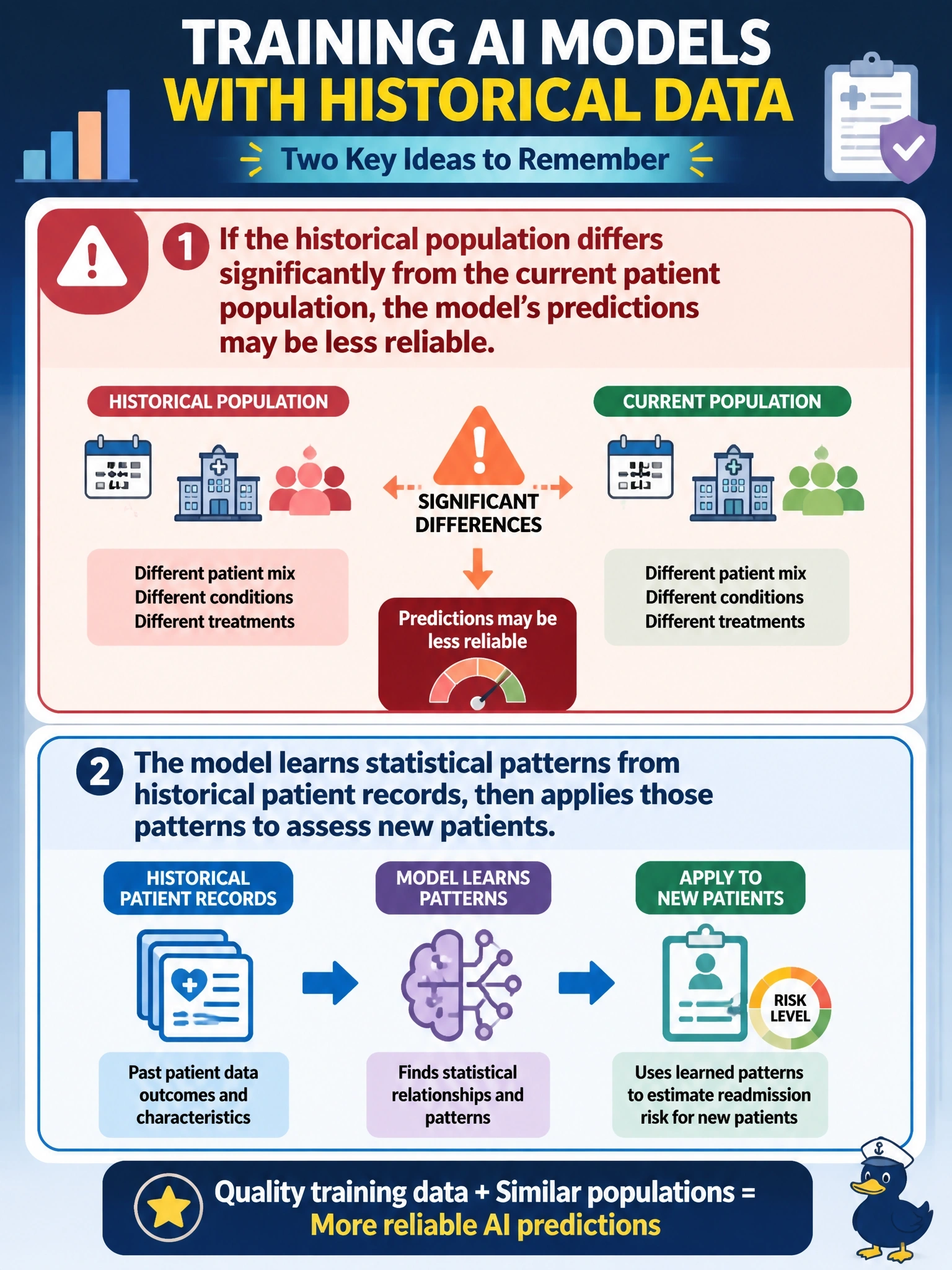
Your model only knows what its training data showed it, so when today's patients look different from the historical group it learned from, its predictions get shakier. Underneath that, it's simply applying statistical patterns pulled from past records to new cases — nothing more, and never a guarantee.
Full Explanation
Training uses historical patient records so the model can learn statistical patterns and apply them to new patients, and because those learned patterns reflect the historical population specifically, a significant mismatch between that population and the current one can reduce prediction reliability. The claim that historical training data guarantees a model will never make an incorrect prediction is a false guarantee — no model trained on historical data, however extensive, can be assured to never err, since predictions remain probabilistic estimates rather than certainties. The idea that a trained model requires no further evaluation against real-world outcomes understates the need for ongoing monitoring; tracking a model's real-world performance after deployment is an important safeguard, not an optional step that training eliminates. The suggestion that training on historical data means the model copies individual patient identities into its outputs confuses pattern learning with data copying — a properly functioning model learns general statistical relationships rather than reproducing specific patients' identities. Together, the two correct statements highlight both how training works and why population representativeness is a key factor in a model's ongoing reliability, which is exactly what a clinical operations committee should be checking.