
A telecom marketing lead is briefing the executive team on AI terminology ahead of a vendor RFP. Select TWO statements that are accurate. (Select TWO.)
Select all correct answers, then click Submit.
Short Explanation
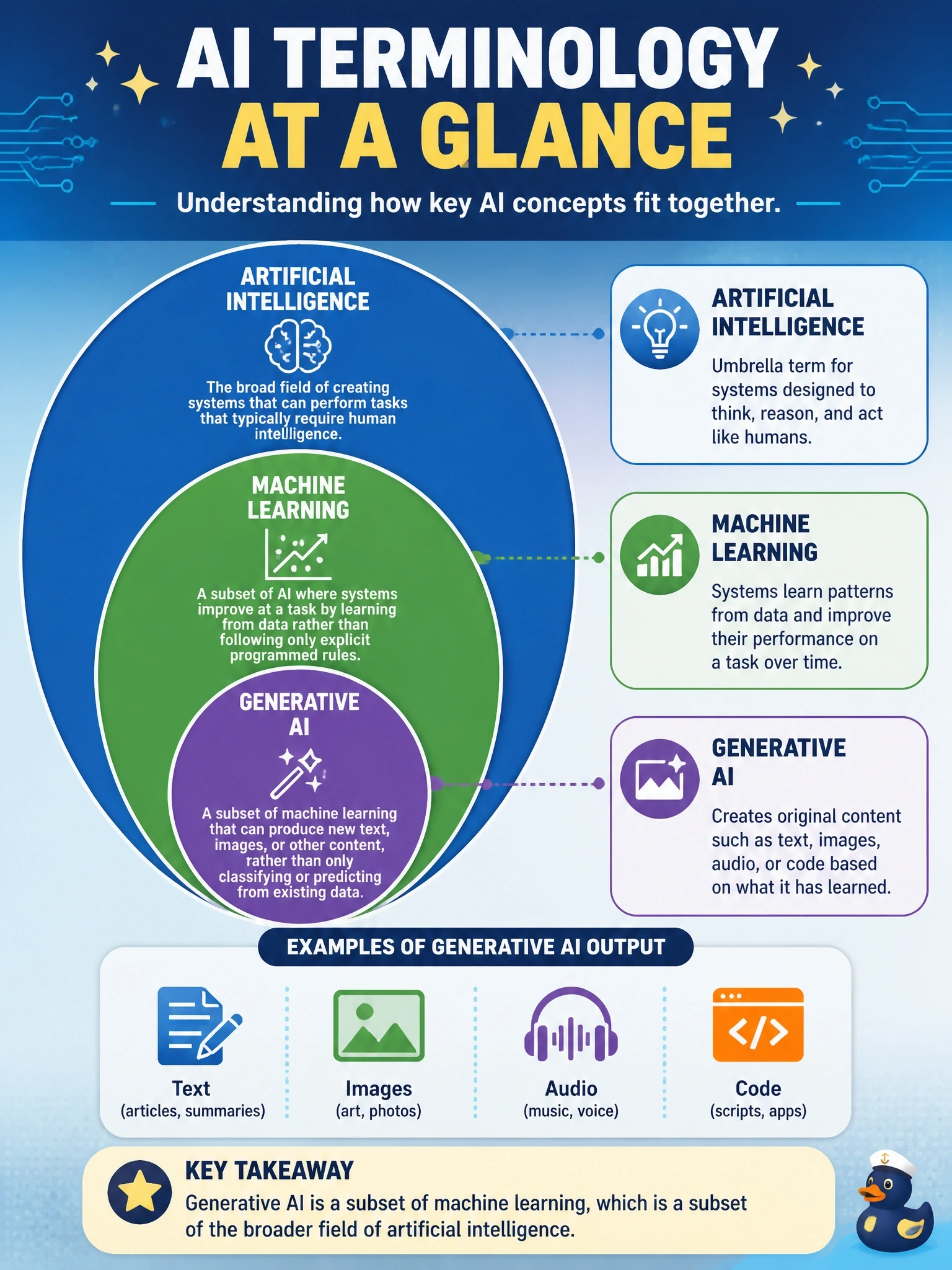
When you're sorting these terms out for the board, keep the nesting straight: machine learning earns its place by learning from data instead of just following hard-coded rules, and generative AI sits inside that circle because it actually creates new text or images rather than only predicting from what's already there. Get that nesting right and you won't mislabel a vendor's product anywhere in the RFP.
Full Explanation
Machine learning fits within AI as the data-driven learning approach — systems that improve by learning from data rather than by following only explicit programmed rules — and generative AI sits within machine learning as the specialization focused on producing new content rather than only classifying or predicting from existing data. This nested relationship is the core distinction leadership needs before reading vendor proposals. The claim that all AI systems used in telecom today are generative AI overstates GenAI's reach: many telecom AI systems, such as network-anomaly detectors, are predictive ML tools with no content-generation function, so "all" is inaccurate. The claim that machine learning and generative AI are unrelated fields is also wrong, since GenAI is built using machine learning techniques and depends on them rather than developing in isolation. A system that only looks up answers from a fixed database, without ever learning from data or generating anything new, doesn't qualify as generative AI at all — that behavior describes fixed retrieval, not the pattern-learning and content-creation that defines the category. Getting these relationships straight helps the marketing lead avoid mislabeling vendor products in board materials or RFP language, which can lead to mismatched budget expectations later.