
A telecom customer-support director tells leadership that the company's new AI-driven call-routing tool relies on "an algorithm" and "a trained model." Select TWO statements that correctly distinguish these terms. (Select TWO.)
Select all correct answers, then click Submit.
Short Explanation
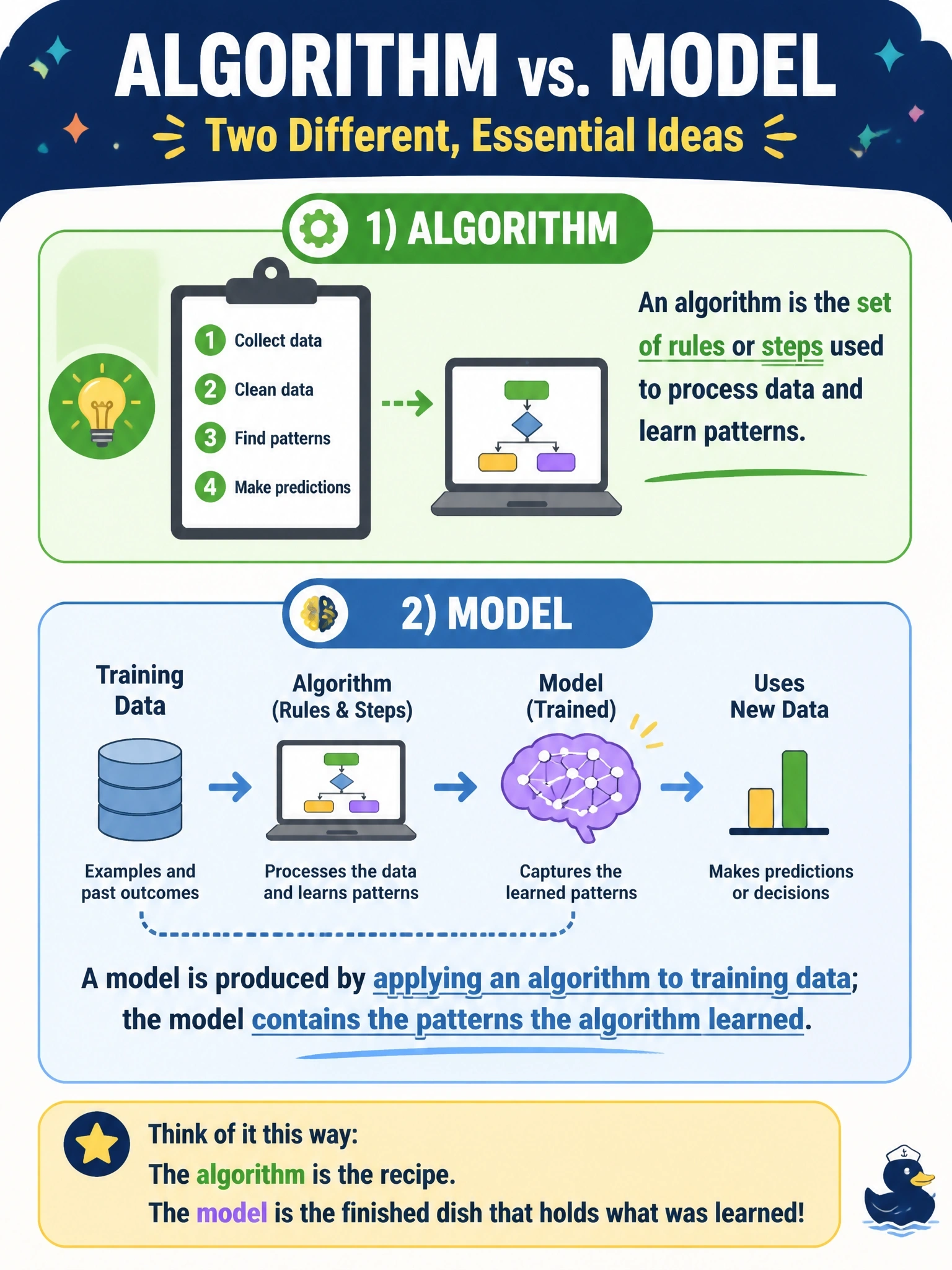
Think of it like a recipe and the meal it produces: the algorithm is the recipe — the steps you follow — and the model is the meal that comes out once you've actually cooked with real ingredients, your training data. Swap in different ingredients and you get a different meal, even if you're following the exact same recipe. That's why an algorithm and a model are never interchangeable, before or after training.
Full Explanation
An algorithm is the procedure used to learn from data, and a model is the resulting artifact that holds the learned patterns — you apply the algorithm to training data to produce the model, and the two remain distinct concepts even after training finishes. The claim that identical algorithms always yield identical models is false: because a model's patterns come from the data it's trained on, the same algorithm run on different training data typically produces different models. The idea that the algorithm becomes the model once training wraps up is also wrong; the algorithm is reusable and can train many separate models over time, so treating the terms as interchangeable erases a distinction that matters in practice. Similarly, the claim that an algorithm only matters during inference gets things backwards — the algorithm does its real work during training, learning patterns from data, while inference instead applies the already-trained model without running the algorithm again. Keeping the algorithm/model split clear matters operationally: when a director hears a vendor say "our algorithm learns customer intent," the real question to ask is what training data shaped the resulting model, since that data, not the algorithm alone, determines the quality of what the tool actually does.