
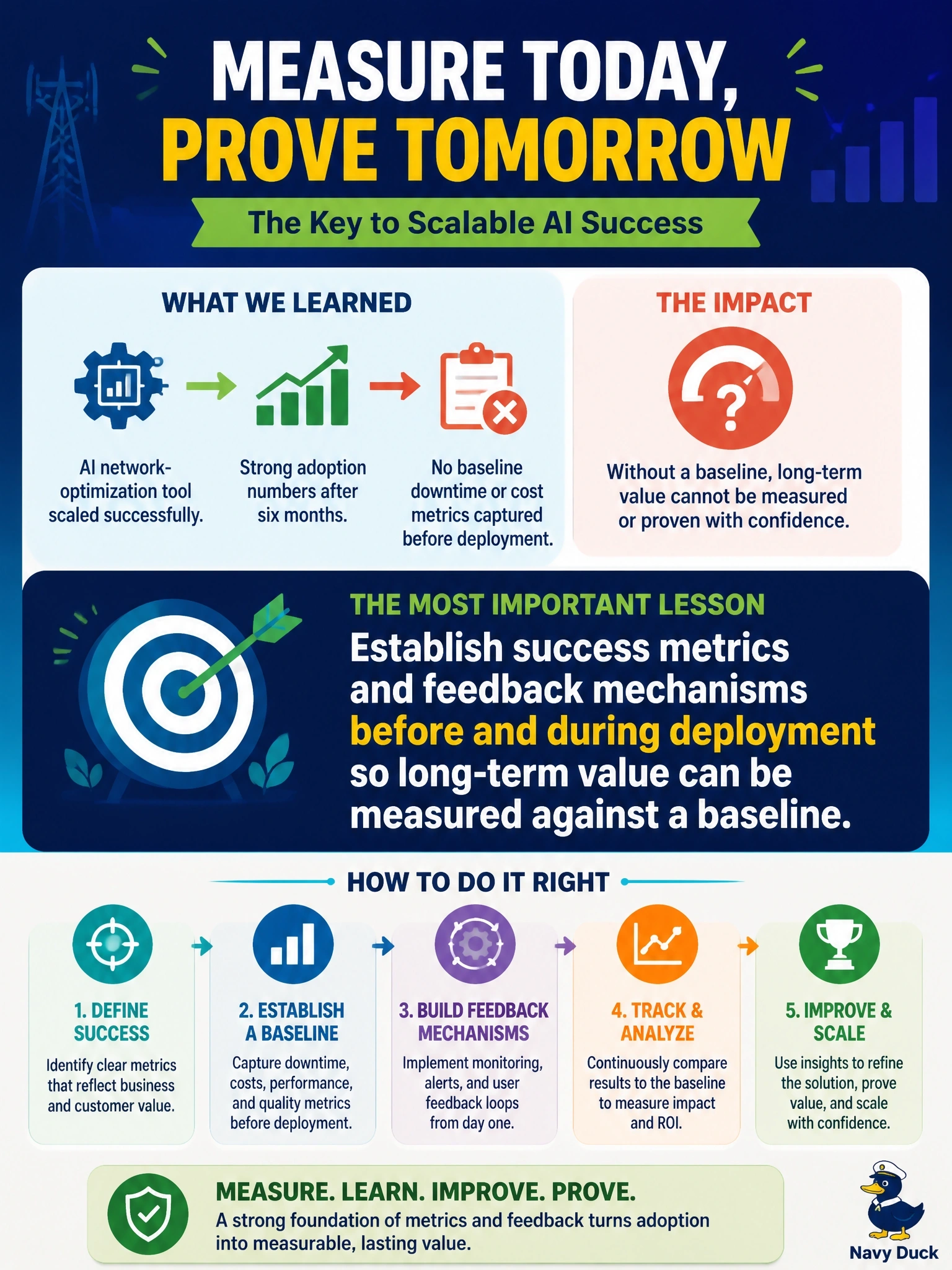
A telecom scaled an AI network-optimization tool and reported strong adoption numbers after six months. Leadership later discovers no baseline downtime or cost metrics were captured before deployment. What is the most important lesson for future scaling efforts?
Select an answer to reveal the explanation.
Short Explanation
Think about trying to prove you lost weight without ever stepping on a scale beforehand — that's the spot this telecom is in. Without a baseline captured before rollout, there's no way to know if the tool actually improved downtime or cost. Adoption tells you people used it, not whether it worked.
Full Explanation
Without a baseline captured before deployment, there's no way to attribute later results to the AI tool itself, which is exactly why establishing success metrics and feedback mechanisms before and during rollout is the essential lesson from this scenario. Treating adoption numbers alone as sufficient evidence of long-term business value repeats the telecom's own mistake: adoption reflects usage, not outcomes, and strong adoption can coexist with downtime and cost figures that stayed flat or worsened while no one was tracking them. Deferring metric collection until an initiative has fully scaled compounds the same error by pushing measurement even further out, forfeiting the baseline comparison entirely since pre-deployment conditions can't be captured retroactively once the rollout is already complete. Claiming feedback mechanisms become unnecessary once a tool proves technically reliable confuses reliability with value; a tool can run reliably and still fail to reduce downtime or cost, and feedback mechanisms are exactly what would reveal that gap. The operating principle: tracking long-term value requires a baseline and ongoing feedback established from the start, not metrics added after the fact or judged solely on adoption. Operational check: before any deployment, has a pre-launch baseline actually been captured for the outcome the initiative is meant to improve?