
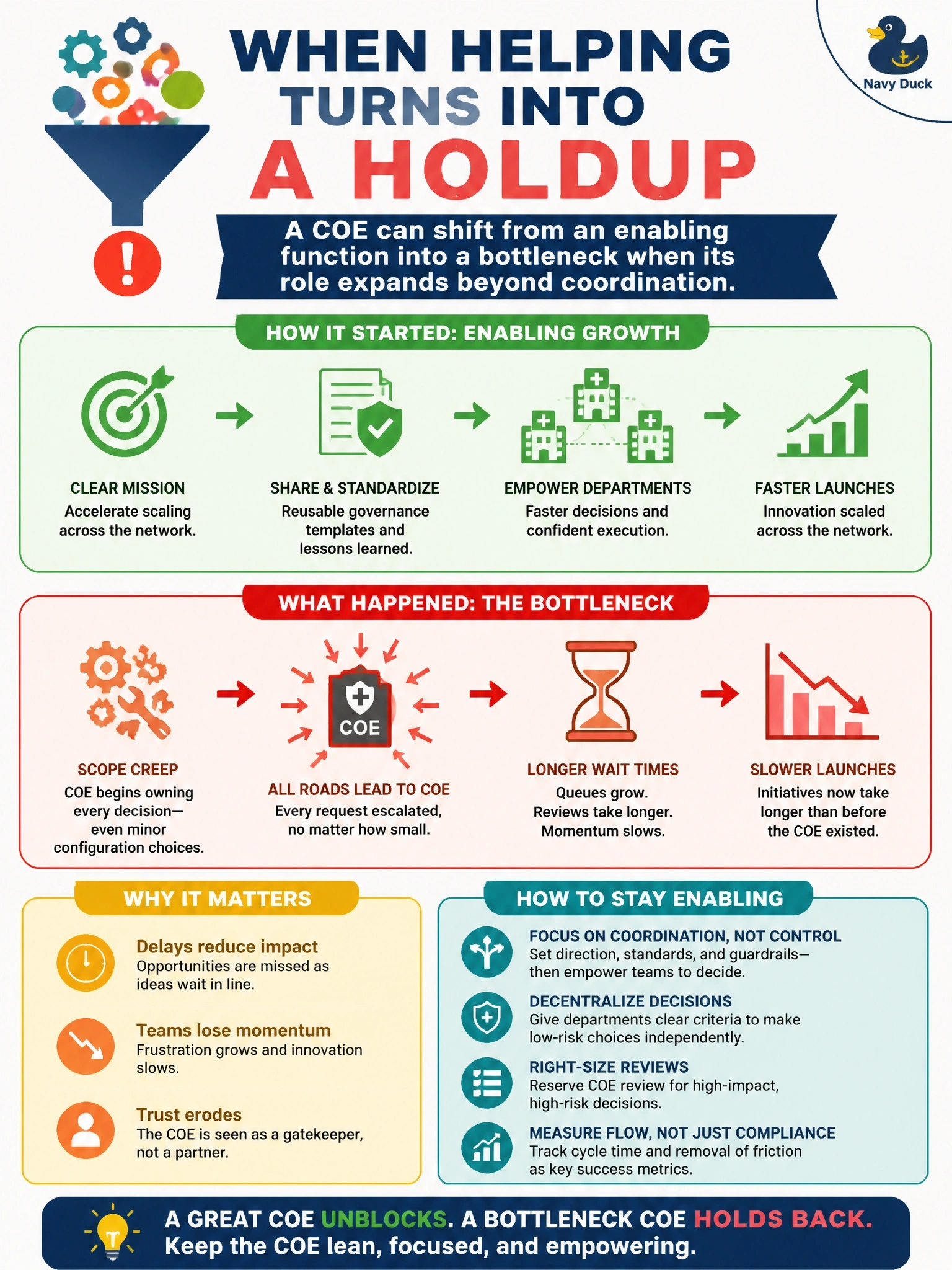
A hospital network's AI COE was originally formed to accelerate scaling by sharing reusable governance templates and lessons learned across departments. Eighteen months later, department leaders report that nearly every AI decision, including minor tool configuration choices, must be escalated to the COE, and initiatives now take longer to launch than before the COE existed. What does this scenario best illustrate?
Select an answer to reveal the explanation.
Short Explanation
A coordinator who starts out just sharing best practices can slowly drift into signing off on every little decision, and that's scope creep turning a helpful function into a drag. Your COE didn't fail because coordination doesn't work; it failed because its role expanded past coordination into decisions that used to belong to the teams themselves.
Full Explanation
The scenario traces a specific mechanism: a COE that started by sharing reusable governance templates and lessons learned expanded its scope to cover minor operational decisions, and initiatives slowed down as a direct result — that's a textbook illustration of a COE's value depending on staying focused on coordination rather than absorbing decisions that belong closer to the actual work. Claiming COEs are inherently unsuitable for healthcare because of regulatory complexity overgeneralizes one organization's experience into an industry-wide claim the scenario doesn't support; nothing described here is specific to healthcare regulation, it's about scope creep in the COE's mandate. Concluding the COE should be disbanded entirely because centralized coordination never improves outcomes is too absolute — the same COE demonstrably helped in its original, narrower role of sharing templates and lessons learned, so the evidence points to a scope problem, not a case against coordination itself. Blaming department leaders for escalating unnecessarily and suggesting they be retrained misplaces the cause; they're following an escalation requirement the COE itself created by expanding its authority, not misunderstanding the COE's purpose. The operating principle: a COE helps through coordination and shared assets, and becomes a bottleneck exactly when it starts making operational calls that used to belong to the teams doing the work. Operational check: is the COE still limited to standards and coordination, or has its scope quietly expanded into approving routine decisions?