
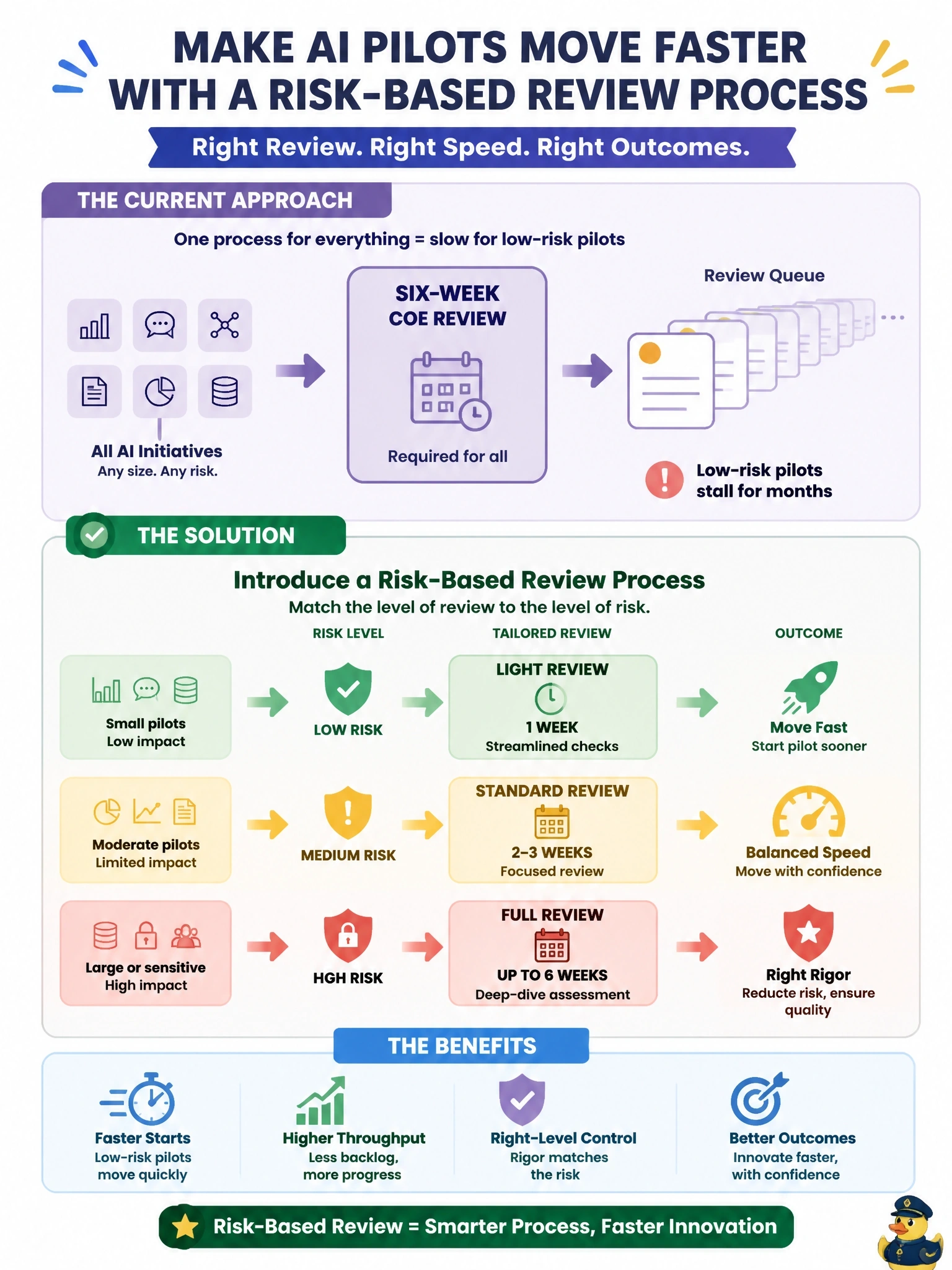
A telecom's AI COE requires every business unit's AI initiative, regardless of size or risk, to complete a six-week COE review before any pilot can begin. Several low-risk, small-scale pilots have stalled in the review queue for months. What should the COE change?
Select an answer to reveal the explanation.
Short Explanation
Running every purchase, from a box of pens to a new building, through the same six-week approval process is exactly what's happening here. A risk-based review lets small, low-stakes pilots move fast while bigger, riskier initiatives still get the full look — the fix isn't scrapping review, it's scaling it to match what's actually at stake for your pilots.
Full Explanation
The problem described is a uniform six-week review applied regardless of risk, which turns the COE into a bottleneck for pilots that don't need that level of scrutiny — the fix is matching review depth to actual risk rather than removing review altogether. Eliminating the COE entirely and letting each business unit self-govern throws away the genuine coordination and standardization benefit it provides for larger or riskier initiatives, overcorrecting for a process design flaw rather than fixing it. Requiring pilots to wait even longer so the COE can batch a larger backlog makes the bottleneck worse, not better, since it stacks more initiatives behind the same slow, uniform gate. Moving the review responsibility to the compliance department without changing the underlying process just relocates the identical one-size-fits-all requirement to a different team; the review still applies uniformly to every initiative regardless of risk, so low-risk pilots keep stalling under a new name. The operating principle: a COE helps when its process scales with risk, and becomes a bottleneck when it treats every initiative, regardless of stakes, the same way. Operational check: does the review process differentiate at all between a small internal pilot and a customer-facing, high-stakes deployment?