
An insurance company piloted an AI claims-triage tool in its auto-claims unit and reduced processing time by 20%. Leadership wants to scale the tool to other claims lines, including property, life, and health. What is the best next step?
Select an answer to reveal the explanation.
Short Explanation
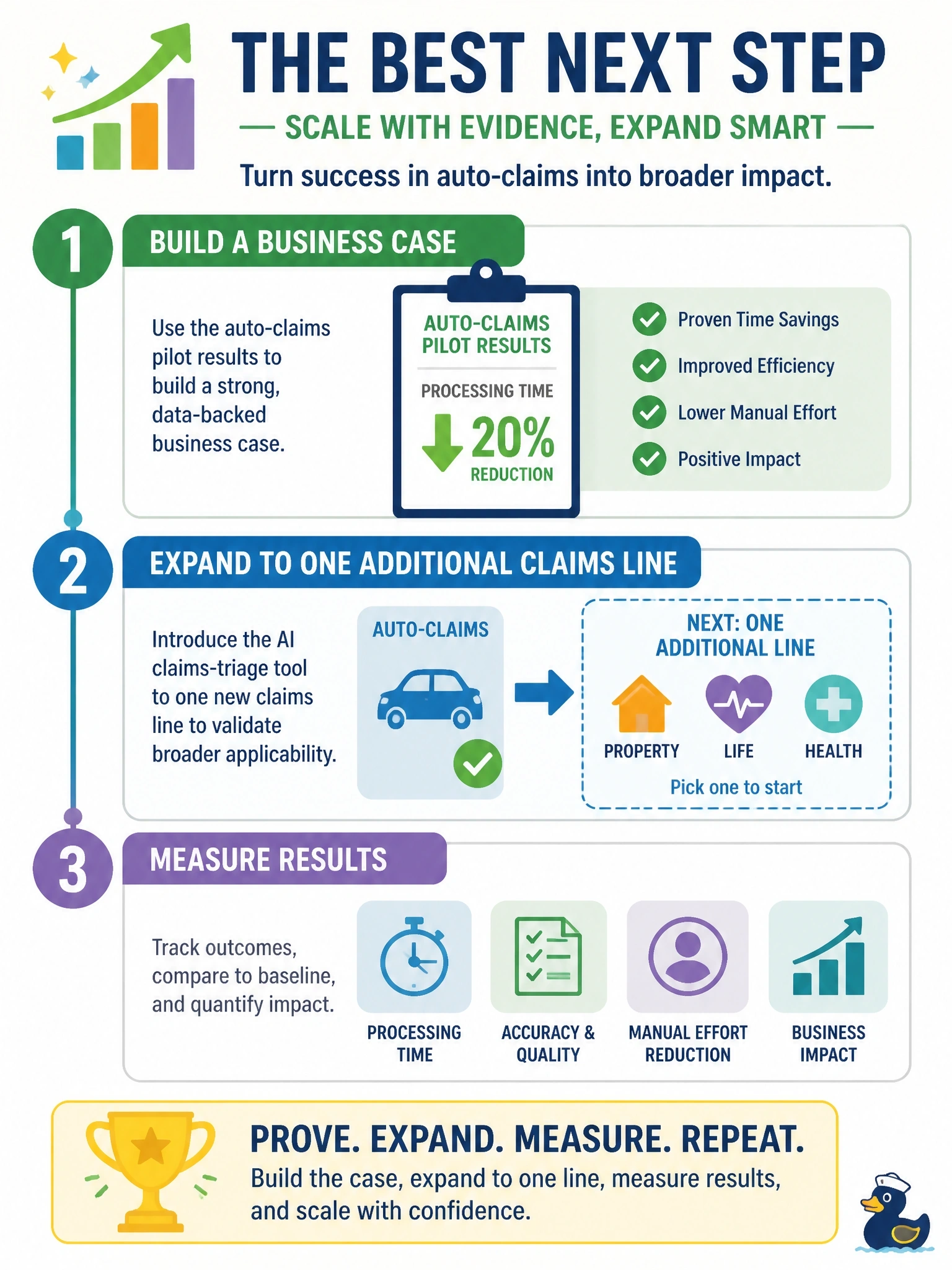
Treat that 20% win in auto-claims as proof of concept, not proof it'll work identically everywhere else you roll it out. The smart next move for you is expanding to one more claims line and measuring it, not leaping to every line at once and not re-running the whole pilot from scratch.
Full Explanation
Building toward enterprise-wide deployment from a proven short-term win means expanding one meaningful increment at a time and using each result to inform the next step, which is what using the auto-claims results to build a case, expand to a single additional line, and measure outcomes accomplishes. Rolling the tool out to every remaining claims line immediately with the same auto-claims configuration ignores real differences between lines — property, life, and health claims involve different documentation and risk factors — so copying one line's setup everywhere at once is a much larger leap than the proven win actually justifies. Shelving the tool because claims-triage needs differ across lines is overly pessimistic; those differences are a reason to expand carefully and incrementally, not a reason to abandon a tool that already delivered a real 20% improvement. Requiring every claims line to independently repeat the full pilot before any scaling decision is duplicative — it re-validates a concept that's already proven and would slow down the exact momentum a short-term win is meant to build. The operating principle: leverage an early win into a sequence of incremental, measured expansions rather than either a single leap or an unnecessary reset. Operational check: has the next expansion step been sized to what the evidence so far actually supports?